
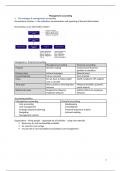
Management accounting
1. The manager & management accounting
Accountancy involves => the collection, summarization and reporting of financial information
Accountancy as an information system
Managerial vs. financial accounting
Managerial accounting Financial accounting
Purpose Decision making Communicate financial
position to outsiders
Primary users Internal managers External users
Focus/Emphasis Future-oriented Past-oriented
Rules Do not have to follow GAAP; GAAP compliant; CPT audited
cost vs. benefit
Time span Ultra current to very long time Historical monthly, quarterly,
horizons yearly reports
Behavioral issues Designed to influence Indirect effects on employee
employee behavoir behavior
Accounting activties
Management accounting Financial accounting
- Cost accounting - Bookkeeping
- Cost management - Consolidation
- Strategic long-term planning - Financial statement analysis
- Budgeting - External auditing
- Management control
Organization – hiring people – organized set of activities – using raw materials
Resources are not inexhaustibly available
So: need for cost savings
Crucial role of cost calculation/accounting & cost management
1
,Management accounting includes Value Chain Analysis
Management accounting contributes to planning and control
- Organizations need useful planning and control systems to develop and implement their strategy
Role of management accountants
- Problem solving/ decision making
Planning: most important tool = budget
- Scorekeeping
Performance measurement
- Attention directing
Control: taking actions that implement planning decisions, deciding how to evaluate
performance, providing feedback to help future decision making
Management accounting guidelines
- Cost-benefit approach is commonly used: benefits generally must exceed costs as a basic
decision rule
- Behavioral and technical considerations : people are involved in decisions, not just euros/dollars
and cents
- Different costs for different purposes
Position of management accountants within organization structure
- Line management (production, marketing, distribution management)
Directly responsible for attaining organizational goals
- Staff management (finance and accounting, IT, HRM)
Provide advice and assistance to line management
- Today: teams, line versus staff is less clear-cut
Professional ethics
- Competence - Integrity
2
, - Confidentiality - Objectivity
2. Cost terms & purpose
2.1 General cost terms
- A cost = the measure of resources given up to achieve a particular purpose
Is made to benefit of a product, service, process, machine, departement, BU
‘Cost object’ = anything for which a measurement of costs is desired
- Cost ≠ cash outflow
- Different costing approaches
Actual cost = cost incurred (historical, past cost)
Budgeted cost = predicted or forecasted cost (future cost) => type = standard costs
Difference between actual and budgeted costs = variances
2.2 Direct- Indirect (assignment)
- About cost assignment to the cost object
- Direct costs = related to the particular cost object and can be traced to it in an easy and
convenient way
- Indirect costs = overheid = related to the particular cost object but cannot be traced to it in an
economically feasible way
Need to be allocated to the cost object
Direct costs Indirect costs = overheids
- Direct material: raw material consumed in - Indirect material : costs of material
manufacturing process, physical part of required for manufacturing process but
finished product does not become integral part of finished
- Direct labor : costs of salaries, wages, fringe products
benefits for personnel who work directly on - Indirect labor : costs of personnel not
manufacturing process working directly on product
- Other manufacturing costs : depreciation
of plant and equipment, property tax,
insurance, utilities, operating costs,
overtime premiums, …
Cost tracing cost allocation
Cost object
2.3 Fixed- Variable
- About cost behavior in relationship to the cost driver: the way a cost changes in relation to
changes in the activity of the organization
- Cost driver = activities that cause costs to be incurred, characteristics of an activity that causes
costs to be incurred by that activity
- After identifying costs and cost driversn we can examine the relationship of various costs to the
activities perfomerd = cost behavior
- Variable costs : changes in total in direct proportion to a change in the level of activity/cost
driver
Variable cost per unit is constant
- Fixed costs : remains unchanged in total as the level of
activity/cost driver changes
Fixed cost per unit changes as activity changes
3
, Relevant range = bandwidth of normal activity level in which there is a specific relationship between
the level of activity and a given cost
VB. BMW X5
Direct cost Indirect cost
Variable cost Cost of tires in assembly of automobile Power costs at plant
Fixed cost Salary of supervisor on BMW X5 assembly Annual lease costs at plant
line (plant = productie locatie)
2.4 Product/inventoriable- period costs (time expenses)
- About timing of expenses / accounting classification
- Product costs = are assigned to goods that were either purchased or manufactured for resale =
inventoriable costs
direct material, direct labor, manufacturing overhead (=indirect, allocated)
- Period costs = all other costs, associated with the period in which they are incurred
R&D costs, selling costs, administrative costs
Product costs can differ depending on use
- Product costs for determining sales price
- Product costs for inventory valuation and income statement
- Product cost for internal reporting
Period costs
- Period costs are all costs in the income statement other than cost of goods sold.
- Period costs are recorded as expenses of the accounting period in which they are incurred.
- For manufacturing-sector companies, period costs include all non-manufacturing costs (research
and development, distribution, etc.).
- For merchandising-sector companies, period costs include all costs not related to the cost of
goods purchased for resale.
- For service-sector companies, all of their costs are period costs.
Cost flows visualized
4
1. The manager & management accounting
Accountancy involves => the collection, summarization and reporting of financial information
Accountancy as an information system
Managerial vs. financial accounting
Managerial accounting Financial accounting
Purpose Decision making Communicate financial
position to outsiders
Primary users Internal managers External users
Focus/Emphasis Future-oriented Past-oriented
Rules Do not have to follow GAAP; GAAP compliant; CPT audited
cost vs. benefit
Time span Ultra current to very long time Historical monthly, quarterly,
horizons yearly reports
Behavioral issues Designed to influence Indirect effects on employee
employee behavoir behavior
Accounting activties
Management accounting Financial accounting
- Cost accounting - Bookkeeping
- Cost management - Consolidation
- Strategic long-term planning - Financial statement analysis
- Budgeting - External auditing
- Management control
Organization – hiring people – organized set of activities – using raw materials
Resources are not inexhaustibly available
So: need for cost savings
Crucial role of cost calculation/accounting & cost management
1
,Management accounting includes Value Chain Analysis
Management accounting contributes to planning and control
- Organizations need useful planning and control systems to develop and implement their strategy
Role of management accountants
- Problem solving/ decision making
Planning: most important tool = budget
- Scorekeeping
Performance measurement
- Attention directing
Control: taking actions that implement planning decisions, deciding how to evaluate
performance, providing feedback to help future decision making
Management accounting guidelines
- Cost-benefit approach is commonly used: benefits generally must exceed costs as a basic
decision rule
- Behavioral and technical considerations : people are involved in decisions, not just euros/dollars
and cents
- Different costs for different purposes
Position of management accountants within organization structure
- Line management (production, marketing, distribution management)
Directly responsible for attaining organizational goals
- Staff management (finance and accounting, IT, HRM)
Provide advice and assistance to line management
- Today: teams, line versus staff is less clear-cut
Professional ethics
- Competence - Integrity
2
, - Confidentiality - Objectivity
2. Cost terms & purpose
2.1 General cost terms
- A cost = the measure of resources given up to achieve a particular purpose
Is made to benefit of a product, service, process, machine, departement, BU
‘Cost object’ = anything for which a measurement of costs is desired
- Cost ≠ cash outflow
- Different costing approaches
Actual cost = cost incurred (historical, past cost)
Budgeted cost = predicted or forecasted cost (future cost) => type = standard costs
Difference between actual and budgeted costs = variances
2.2 Direct- Indirect (assignment)
- About cost assignment to the cost object
- Direct costs = related to the particular cost object and can be traced to it in an easy and
convenient way
- Indirect costs = overheid = related to the particular cost object but cannot be traced to it in an
economically feasible way
Need to be allocated to the cost object
Direct costs Indirect costs = overheids
- Direct material: raw material consumed in - Indirect material : costs of material
manufacturing process, physical part of required for manufacturing process but
finished product does not become integral part of finished
- Direct labor : costs of salaries, wages, fringe products
benefits for personnel who work directly on - Indirect labor : costs of personnel not
manufacturing process working directly on product
- Other manufacturing costs : depreciation
of plant and equipment, property tax,
insurance, utilities, operating costs,
overtime premiums, …
Cost tracing cost allocation
Cost object
2.3 Fixed- Variable
- About cost behavior in relationship to the cost driver: the way a cost changes in relation to
changes in the activity of the organization
- Cost driver = activities that cause costs to be incurred, characteristics of an activity that causes
costs to be incurred by that activity
- After identifying costs and cost driversn we can examine the relationship of various costs to the
activities perfomerd = cost behavior
- Variable costs : changes in total in direct proportion to a change in the level of activity/cost
driver
Variable cost per unit is constant
- Fixed costs : remains unchanged in total as the level of
activity/cost driver changes
Fixed cost per unit changes as activity changes
3
, Relevant range = bandwidth of normal activity level in which there is a specific relationship between
the level of activity and a given cost
VB. BMW X5
Direct cost Indirect cost
Variable cost Cost of tires in assembly of automobile Power costs at plant
Fixed cost Salary of supervisor on BMW X5 assembly Annual lease costs at plant
line (plant = productie locatie)
2.4 Product/inventoriable- period costs (time expenses)
- About timing of expenses / accounting classification
- Product costs = are assigned to goods that were either purchased or manufactured for resale =
inventoriable costs
direct material, direct labor, manufacturing overhead (=indirect, allocated)
- Period costs = all other costs, associated with the period in which they are incurred
R&D costs, selling costs, administrative costs
Product costs can differ depending on use
- Product costs for determining sales price
- Product costs for inventory valuation and income statement
- Product cost for internal reporting
Period costs
- Period costs are all costs in the income statement other than cost of goods sold.
- Period costs are recorded as expenses of the accounting period in which they are incurred.
- For manufacturing-sector companies, period costs include all non-manufacturing costs (research
and development, distribution, etc.).
- For merchandising-sector companies, period costs include all costs not related to the cost of
goods purchased for resale.
- For service-sector companies, all of their costs are period costs.
Cost flows visualized
4


