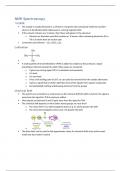
NMR Spectroscopy
1
H NMR
The sample is usually dissolved in a solvent in a long thin tube and placed inside the machine
where it is bombarded with radiowaves in a strong magnetic field
If the solvent contains any 1H atoms, then these will appear in the spectrum
o Solvents are therefore used that contain no 1H atoms, often containing deuterium (D or
2
H) as D atoms have no nuclear spin
Commonly used solvents – CCl4, CDCl3, C6D6
Calibration
A small quantity of tetramethylsilane (TMS) is added to samples as this produces a signal
providing an internal standard to which other peaks are compared
o It gives one strong signal (12 H’s in identical environments)
o It is inert
o It is non-toxic
o It has a low boiling point of 26oC so can easily be removed from the sample afterwards
o It gives a signal that is further right than most of the signals from organic compounds
o Not deshielded (nothing withdrawing electrons from the group)
Chemical Shift
The spectra are recorded on a scale known as the chemical shift (δ) which is how far the signal is
away from the signal for TMS in parts per million
Most signals are between 0 and 10 ppm away from the signal for TMS
The chemical shift depends on what other atoms/groups are near the H
o The closer the H is to electronegative atoms (e.g. Cl, O) the greater the shift
o The more electronegative atoms near, the greater the shift
o
The data sheet can be used to find approximate values for chemical shifts (may not be exact
match but best match is taken)
1
H NMR
The sample is usually dissolved in a solvent in a long thin tube and placed inside the machine
where it is bombarded with radiowaves in a strong magnetic field
If the solvent contains any 1H atoms, then these will appear in the spectrum
o Solvents are therefore used that contain no 1H atoms, often containing deuterium (D or
2
H) as D atoms have no nuclear spin
Commonly used solvents – CCl4, CDCl3, C6D6
Calibration
A small quantity of tetramethylsilane (TMS) is added to samples as this produces a signal
providing an internal standard to which other peaks are compared
o It gives one strong signal (12 H’s in identical environments)
o It is inert
o It is non-toxic
o It has a low boiling point of 26oC so can easily be removed from the sample afterwards
o It gives a signal that is further right than most of the signals from organic compounds
o Not deshielded (nothing withdrawing electrons from the group)
Chemical Shift
The spectra are recorded on a scale known as the chemical shift (δ) which is how far the signal is
away from the signal for TMS in parts per million
Most signals are between 0 and 10 ppm away from the signal for TMS
The chemical shift depends on what other atoms/groups are near the H
o The closer the H is to electronegative atoms (e.g. Cl, O) the greater the shift
o The more electronegative atoms near, the greater the shift
o
The data sheet can be used to find approximate values for chemical shifts (may not be exact
match but best match is taken)