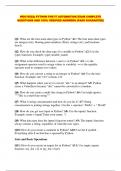
WGU D522; PYTHON FOR IT AUTOMATION EXAM COMPLETE
QUESTIONS AND 100% VERIFIED ANSWERS (PASS GUARANTEE)
Q1: What are the four main data types in Python? A1: The four main data types
are integers (int), floating-point numbers (float), strings (str), and booleans
(bool).
Q2: How do you check the data type of a variable in Python? A2: Use the
type() function. Example: type(variable_name)
Q3: What is the difference between = and == in Python? A3: = is the
assignment operator used to assign values to variables. == is the equality
operator used to compare two values.
Q4: How do you convert a string to an integer in Python? A4: Use the int()
function. Example: int("123") returns 123.
Q5: What happens when you try to convert "abc" to an integer? A5: Python
raises a ValueError because "abc" cannot be converted to a number.
Q6: How do you create a multi-line string in Python? A6: Use triple quotes:
"""This is a multi-line string"""
Q7: What is string concatenation and how do you do it? A7: String
concatenation is joining strings together. Use the + operator: "Hello" + " World"
Q8: How do you get user input in Python? A8: Use the input() function.
Example: name = input("Enter your name: ")
Q9: What data type does the input() function return? A9: The input() function
always returns a string, regardless of what the user types.
Q10: How do you create a comment in Python? A10: Use the # symbol.
Everything after # on that line is ignored by Python.
Lists and Basic Operations
Q11: How do you create an empty list in Python? A11: Use empty square
brackets: my_list = [] or my_list = list()
,Q12: How do you add an item to the end of a list? A12: Use the append()
method. Example: my_list.append("item")
Q13: How do you access the first element of a list? A13: Use index 0:
my_list[0]
Q14: How do you access the last element of a list? A14: Use index -1: my_list[-
1]
Q15: How do you get the length of a list? A15: Use the len() function.
Example: len(my_list)
Q16: How do you remove an item from a list by value? A16: Use the remove()
method. Example: my_list.remove("item")
Q17: What's the difference between append() and extend()? A17: append() adds
a single element to the list. extend() adds all elements from an iterable to the
list.
Q18: How do you create a list of numbers from 1 to 10? A18: Use list(range(1,
11)) or [1, 2, 3, 4, 5, 6, 7, 8, 9, 10]
Q19: How do you check if an item exists in a list? A19: Use the in operator.
Example: if "item" in my_list:
Q20: How do you sort a list in ascending order? A20: Use the sort() method:
my_list.sort() or create a new sorted list with sorted(my_list)
Control Structures
Q21: What is the syntax for an if statement in Python? A21:
if condition:
# code block
Q22: How do you write an if-elif-else statement? A22:
if condition1:
# code
elif condition2:
# code
else:
# code
Q23: What is the syntax for a for loop in Python? A23:
,for item in iterable:
# code block
Q24: How do you create a for loop that runs 5 times? A24: for i in range(5):
Q25: What is the syntax for a while loop? A25:
while condition:
# code block
Q26: How do you exit a loop prematurely? A26: Use the break statement.
Q27: How do you skip to the next iteration of a loop? A27: Use the continue
statement.
Q28: What are comparison operators in Python? A28: == (equal), != (not
equal), < (less than), > (greater than), <= (less than or equal), >= (greater than or
equal)
Q29: What are logical operators in Python? A29: and, or, and not
Q30: How do you check if a number is even? A30: Use the modulo operator: if
number % 2 == 0:
Functions
Q31: How do you define a function in Python? A31:
def function_name(parameters):
# function body
return value
Q32: How do you call a function? A32: Use the function name followed by
parentheses: function_name(arguments)
Q33: What is the difference between parameters and arguments? A33:
Parameters are variables in the function definition. Arguments are the actual
values passed to the function when called.
Q34: How do you return a value from a function? A34: Use the return
statement: return value
Q35: What happens if a function doesn't have a return statement? A35: The
function returns None by default.
, Q36: How do you define a function with default parameters? A36:
def function_name(param1, param2="default_value"):
# function body
Q37: What is variable scope in Python? A37: Variable scope determines where
variables can be accessed. Local variables are only accessible within the
function they're defined in.
Q38: How do you access a global variable inside a function? A38: Use the
global keyword: global variable_name
Q39: What is a lambda function? A39: A lambda function is a small
anonymous function defined with the lambda keyword: lambda x: x * 2
Q40: How do you document a function? A40: Use docstrings with triple quotes:
def function_name():
"""This is a docstring describing the function."""
pass
Error Handling
Q41: How do you handle exceptions in Python? A41: Use try-except blocks:
try:
# risky code
except ExceptionType:
# handle exception
Q42: What is the difference between syntax errors and runtime errors? A42:
Syntax errors occur when code doesn't follow Python syntax rules. Runtime
errors occur during program execution.
Q43: How do you catch multiple exception types? A43:
try:
# code
except (ValueError, TypeError):
# handle both exceptions
Q44: What is the purpose of the finally block? A44: The finally block executes
regardless of whether an exception occurs, typically used for cleanup.
QUESTIONS AND 100% VERIFIED ANSWERS (PASS GUARANTEE)
Q1: What are the four main data types in Python? A1: The four main data types
are integers (int), floating-point numbers (float), strings (str), and booleans
(bool).
Q2: How do you check the data type of a variable in Python? A2: Use the
type() function. Example: type(variable_name)
Q3: What is the difference between = and == in Python? A3: = is the
assignment operator used to assign values to variables. == is the equality
operator used to compare two values.
Q4: How do you convert a string to an integer in Python? A4: Use the int()
function. Example: int("123") returns 123.
Q5: What happens when you try to convert "abc" to an integer? A5: Python
raises a ValueError because "abc" cannot be converted to a number.
Q6: How do you create a multi-line string in Python? A6: Use triple quotes:
"""This is a multi-line string"""
Q7: What is string concatenation and how do you do it? A7: String
concatenation is joining strings together. Use the + operator: "Hello" + " World"
Q8: How do you get user input in Python? A8: Use the input() function.
Example: name = input("Enter your name: ")
Q9: What data type does the input() function return? A9: The input() function
always returns a string, regardless of what the user types.
Q10: How do you create a comment in Python? A10: Use the # symbol.
Everything after # on that line is ignored by Python.
Lists and Basic Operations
Q11: How do you create an empty list in Python? A11: Use empty square
brackets: my_list = [] or my_list = list()
,Q12: How do you add an item to the end of a list? A12: Use the append()
method. Example: my_list.append("item")
Q13: How do you access the first element of a list? A13: Use index 0:
my_list[0]
Q14: How do you access the last element of a list? A14: Use index -1: my_list[-
1]
Q15: How do you get the length of a list? A15: Use the len() function.
Example: len(my_list)
Q16: How do you remove an item from a list by value? A16: Use the remove()
method. Example: my_list.remove("item")
Q17: What's the difference between append() and extend()? A17: append() adds
a single element to the list. extend() adds all elements from an iterable to the
list.
Q18: How do you create a list of numbers from 1 to 10? A18: Use list(range(1,
11)) or [1, 2, 3, 4, 5, 6, 7, 8, 9, 10]
Q19: How do you check if an item exists in a list? A19: Use the in operator.
Example: if "item" in my_list:
Q20: How do you sort a list in ascending order? A20: Use the sort() method:
my_list.sort() or create a new sorted list with sorted(my_list)
Control Structures
Q21: What is the syntax for an if statement in Python? A21:
if condition:
# code block
Q22: How do you write an if-elif-else statement? A22:
if condition1:
# code
elif condition2:
# code
else:
# code
Q23: What is the syntax for a for loop in Python? A23:
,for item in iterable:
# code block
Q24: How do you create a for loop that runs 5 times? A24: for i in range(5):
Q25: What is the syntax for a while loop? A25:
while condition:
# code block
Q26: How do you exit a loop prematurely? A26: Use the break statement.
Q27: How do you skip to the next iteration of a loop? A27: Use the continue
statement.
Q28: What are comparison operators in Python? A28: == (equal), != (not
equal), < (less than), > (greater than), <= (less than or equal), >= (greater than or
equal)
Q29: What are logical operators in Python? A29: and, or, and not
Q30: How do you check if a number is even? A30: Use the modulo operator: if
number % 2 == 0:
Functions
Q31: How do you define a function in Python? A31:
def function_name(parameters):
# function body
return value
Q32: How do you call a function? A32: Use the function name followed by
parentheses: function_name(arguments)
Q33: What is the difference between parameters and arguments? A33:
Parameters are variables in the function definition. Arguments are the actual
values passed to the function when called.
Q34: How do you return a value from a function? A34: Use the return
statement: return value
Q35: What happens if a function doesn't have a return statement? A35: The
function returns None by default.
, Q36: How do you define a function with default parameters? A36:
def function_name(param1, param2="default_value"):
# function body
Q37: What is variable scope in Python? A37: Variable scope determines where
variables can be accessed. Local variables are only accessible within the
function they're defined in.
Q38: How do you access a global variable inside a function? A38: Use the
global keyword: global variable_name
Q39: What is a lambda function? A39: A lambda function is a small
anonymous function defined with the lambda keyword: lambda x: x * 2
Q40: How do you document a function? A40: Use docstrings with triple quotes:
def function_name():
"""This is a docstring describing the function."""
pass
Error Handling
Q41: How do you handle exceptions in Python? A41: Use try-except blocks:
try:
# risky code
except ExceptionType:
# handle exception
Q42: What is the difference between syntax errors and runtime errors? A42:
Syntax errors occur when code doesn't follow Python syntax rules. Runtime
errors occur during program execution.
Q43: How do you catch multiple exception types? A43:
try:
# code
except (ValueError, TypeError):
# handle both exceptions
Q44: What is the purpose of the finally block? A44: The finally block executes
regardless of whether an exception occurs, typically used for cleanup.