QUIZ
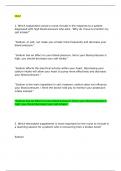
1. Which explanation would a nurse include in the response to a patient
diagnosed with high blood pressure who asks, “Why do I have to monitor my
salt intake?”
“Sodium, or salt, can make you urinate more frequently and decrease your
blood pressure.”
“Sodium has an effect on your blood pressure. Since your blood pressure is
high, you should decrease your salt intake.”
“Sodium affects the electrical activity within your heart. Decreasing your
sodium intake will allow your heart to pump more effectively and decrease
your blood pressure.”
“Sodium is the main ingredient in salt; however, sodium does not influence
your blood pressure. I think the doctor told you to monitor your potassium
intake instead.”
“Sodium has an effect on your blood pressure. Since your blood pressure is
high, you should decrease your salt intake.”
2. Which electrolyte supplement is most important for the nurse to include in
a teaching session for a patient who is recovering from a broken bone?
Sodium
,Potassium
Calcium
Magnesium
Calcium
3. Which supplements would a nurse include when asked by patient with
osteoporosis, “Is there anything I can take over-the-counter to manage my
condition?”
Select all that apply.
Potassium
Calcium
Magnesium
Glucose
Sodium
Calcium
, Magnesium
“‘“!
4. Which primary functions would the nurse include when teaching the
patient about electrolytes within the body?
Select all that apply.
Transmitting nerve impulses
Regulating acid-base balance
Altering the action potential of nerve fibers
Maintaining fluid osmolality
Secreting insulin and epinephrine
Transmitting nerve impulses
Regulating acid-base balance
Altering the action potential of nerve fibers
Maintaining fluid osmolality
5. A patient has developed a clot in a coronary artery, and the heart muscle
cells did not make enough adenosine triphosphate (ATP). Which explanation
1. Which explanation would a nurse include in the response to a patient
diagnosed with high blood pressure who asks, “Why do I have to monitor my
salt intake?”
“Sodium, or salt, can make you urinate more frequently and decrease your
blood pressure.”
“Sodium has an effect on your blood pressure. Since your blood pressure is
high, you should decrease your salt intake.”
“Sodium affects the electrical activity within your heart. Decreasing your
sodium intake will allow your heart to pump more effectively and decrease
your blood pressure.”
“Sodium is the main ingredient in salt; however, sodium does not influence
your blood pressure. I think the doctor told you to monitor your potassium
intake instead.”
“Sodium has an effect on your blood pressure. Since your blood pressure is
high, you should decrease your salt intake.”
2. Which electrolyte supplement is most important for the nurse to include in
a teaching session for a patient who is recovering from a broken bone?
Sodium
,Potassium
Calcium
Magnesium
Calcium
3. Which supplements would a nurse include when asked by patient with
osteoporosis, “Is there anything I can take over-the-counter to manage my
condition?”
Select all that apply.
Potassium
Calcium
Magnesium
Glucose
Sodium
Calcium
, Magnesium
“‘“!
4. Which primary functions would the nurse include when teaching the
patient about electrolytes within the body?
Select all that apply.
Transmitting nerve impulses
Regulating acid-base balance
Altering the action potential of nerve fibers
Maintaining fluid osmolality
Secreting insulin and epinephrine
Transmitting nerve impulses
Regulating acid-base balance
Altering the action potential of nerve fibers
Maintaining fluid osmolality
5. A patient has developed a clot in a coronary artery, and the heart muscle
cells did not make enough adenosine triphosphate (ATP). Which explanation