RCE2601
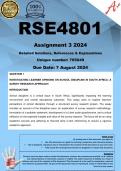
Assignment 4 2025
Unique Number:
Due Date: 4 September 2025
INTRODUCTION
This assignment explores the process of designing and implementing a research study to
investigate the impact of technology-enhanced teaching on learner engagement in South
African secondary schools. The aim is to provide the Department of Basic Education with
evidence-based recommendations for improving teaching practices through the integration
of digital tools. The work will address key components of research design, including
developing an appropriate literature review framework, selecting suitable research
paradigms, and choosing the most effective research approach. It will also consider the
application of action research to address challenges during the study, ensuring that findings
are responsive to real-world classroom contexts. Furthermore, the assignment will highlight
the importance of ethical considerations and ensuring trustworthiness in qualitative research.
By systematically engaging with each question, this study will not only deepen
understanding of educational research methods but also contribute practical insights into
advancing digital integration in South African schools.
Terms of use
By making use of this document you agree to:
Use this document as a guide for learning, comparison and reference purpose,
Terms of use
Not to duplicate, reproduce and/or misrepresent the contents of this document as your own work,
By making use of this document you agree to:
Use this document
Fully accept the consequences
solely as a guide forshould you plagiarise
learning, reference,or and
misuse this document.
comparison purposes,
Ensure originality of your own work, and fully accept the consequences should you plagiarise or misuse this document.
Comply with all relevant standards, guidelines, regulations, and legislation governing academic and written work.
Disclaimer
Great care has been taken in the preparation of this document; however, the contents are provided "as is" without any express or
implied representations or warranties. The author accepts no responsibility or liability for any actions taken based on the
information contained within this document. This document is intended solely for comparison, research, and reference purposes.
Reproduction, resale, or transmission of any part of this document, in any form or by any means, is strictly prohibited.
, +27 67 171 1739
INTRODUCTION
This assignment explores the process of designing and implementing a research
study to investigate the impact of technology-enhanced teaching on learner
engagement in South African secondary schools. The aim is to provide the
Department of Basic Education with evidence-based recommendations for improving
teaching practices through the integration of digital tools. The work will address key
components of research design, including developing an appropriate literature
review framework, selecting suitable research paradigms, and choosing the most
effective research approach. It will also consider the application of action research to
address challenges during the study, ensuring that findings are responsive to real-
world classroom contexts. Furthermore, the assignment will highlight the importance
of ethical considerations and ensuring trustworthiness in qualitative research. By
systematically engaging with each question, this study will not only deepen
understanding of educational research methods but also contribute practical insights
into advancing digital integration in South African schools.
QUESTION 1 – LITERATURE REVIEW DESIGN
a) Conceptual Framework vs Theoretical Framework and the Most Appropriate
for this Study
A conceptual framework is a research tool that outlines the key concepts,
variables, and relationships relevant to a study. It serves as a map for the research
by clarifying how the researcher understands the topic and intends to investigate it.
The conceptual framework is developed from existing literature and reflects the
specific focus of the study, often incorporating practical aspects and the researcher’s
interpretation of how variables interact.
A theoretical framework, in contrast, is derived from established theories that
explain phenomena related to the research question. It provides a lens through
which the researcher interprets findings, offering an existing theoretical base to guide
data collection, analysis, and interpretation. While a conceptual framework is tailored
to the particular study and often combines different concepts, a theoretical
framework strictly follows the principles of the selected theory or theories.
Disclaimer
Great care has been taken in the preparation of this document; however, the contents are provided "as is"
without any express or implied representations or warranties. The author accepts no responsibility or
liability for any actions taken based on the information contained within this document. This document is
intended solely for comparison, research, and reference purposes. Reproduction, resale, or transmission
of any part of this document, in any form or by any means, is strictly prohibited.
Assignment 4 2025
Unique Number:
Due Date: 4 September 2025
INTRODUCTION
This assignment explores the process of designing and implementing a research study to
investigate the impact of technology-enhanced teaching on learner engagement in South
African secondary schools. The aim is to provide the Department of Basic Education with
evidence-based recommendations for improving teaching practices through the integration
of digital tools. The work will address key components of research design, including
developing an appropriate literature review framework, selecting suitable research
paradigms, and choosing the most effective research approach. It will also consider the
application of action research to address challenges during the study, ensuring that findings
are responsive to real-world classroom contexts. Furthermore, the assignment will highlight
the importance of ethical considerations and ensuring trustworthiness in qualitative research.
By systematically engaging with each question, this study will not only deepen
understanding of educational research methods but also contribute practical insights into
advancing digital integration in South African schools.
Terms of use
By making use of this document you agree to:
Use this document as a guide for learning, comparison and reference purpose,
Terms of use
Not to duplicate, reproduce and/or misrepresent the contents of this document as your own work,
By making use of this document you agree to:
Use this document
Fully accept the consequences
solely as a guide forshould you plagiarise
learning, reference,or and
misuse this document.
comparison purposes,
Ensure originality of your own work, and fully accept the consequences should you plagiarise or misuse this document.
Comply with all relevant standards, guidelines, regulations, and legislation governing academic and written work.
Disclaimer
Great care has been taken in the preparation of this document; however, the contents are provided "as is" without any express or
implied representations or warranties. The author accepts no responsibility or liability for any actions taken based on the
information contained within this document. This document is intended solely for comparison, research, and reference purposes.
Reproduction, resale, or transmission of any part of this document, in any form or by any means, is strictly prohibited.
, +27 67 171 1739
INTRODUCTION
This assignment explores the process of designing and implementing a research
study to investigate the impact of technology-enhanced teaching on learner
engagement in South African secondary schools. The aim is to provide the
Department of Basic Education with evidence-based recommendations for improving
teaching practices through the integration of digital tools. The work will address key
components of research design, including developing an appropriate literature
review framework, selecting suitable research paradigms, and choosing the most
effective research approach. It will also consider the application of action research to
address challenges during the study, ensuring that findings are responsive to real-
world classroom contexts. Furthermore, the assignment will highlight the importance
of ethical considerations and ensuring trustworthiness in qualitative research. By
systematically engaging with each question, this study will not only deepen
understanding of educational research methods but also contribute practical insights
into advancing digital integration in South African schools.
QUESTION 1 – LITERATURE REVIEW DESIGN
a) Conceptual Framework vs Theoretical Framework and the Most Appropriate
for this Study
A conceptual framework is a research tool that outlines the key concepts,
variables, and relationships relevant to a study. It serves as a map for the research
by clarifying how the researcher understands the topic and intends to investigate it.
The conceptual framework is developed from existing literature and reflects the
specific focus of the study, often incorporating practical aspects and the researcher’s
interpretation of how variables interact.
A theoretical framework, in contrast, is derived from established theories that
explain phenomena related to the research question. It provides a lens through
which the researcher interprets findings, offering an existing theoretical base to guide
data collection, analysis, and interpretation. While a conceptual framework is tailored
to the particular study and often combines different concepts, a theoretical
framework strictly follows the principles of the selected theory or theories.
Disclaimer
Great care has been taken in the preparation of this document; however, the contents are provided "as is"
without any express or implied representations or warranties. The author accepts no responsibility or
liability for any actions taken based on the information contained within this document. This document is
intended solely for comparison, research, and reference purposes. Reproduction, resale, or transmission
of any part of this document, in any form or by any means, is strictly prohibited.