100% satisfaction guarantee Immediately available after payment Both online and in PDF No strings attached 4.6 TrustPilot
logo-home
Exam (elaborations)

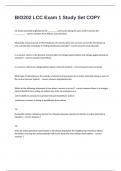
BIO202 LCC Exam 1 Study Set COPY Verified Practice Questions And 100% Correct Answers.

Rating
-
Sold
-
Pages
2
Grade
A+
Uploaded on
13-08-2025
Written in
2025/2026

An action potential originated at the ________ and travels along the axon until it reaches the _________. - correct answers Axon hillock: axon terminal What type of ion channels in the membrane of neurons allow ions to move across the membrane at rest, and thereby contribute to resting membrane potential? - correct answers Leak channels In a neuron, where is the greatest concentration of voltage-gated sodium and voltage-gaged potassium channels? - correct answers Axon hillock In a neuron, where are voltage-gated calcium channels located? - correct answers Axon terminal What type of cell enhances the velocity of electrical transmission of an action potential along an axon in the central nervous system? - correct answers oligodendrocyte Which of the following statement is true when a neuron is at rest? - correct answers-there is a stronger electrochemical force acting on sodium ions than on potassium ions -permeability to potassium is greater than permeability to sodium -potassium is nearer to being at equilibrium than sodium T/F During the relative refractory period, the stimulus intensity required to initiate an action potential is elevated. - correct answers T T/F Once an action potential is generated, it will always depolarize the neighboring membrane above threshold, ensuring the action potential will travel along the axon without interruption. - correct answers T T/F The NA+/K+ pump is electrogenic. - correct answersT Which of the following is NOT one of the major cell types found in the human body? a. Endocrine cells b. Muscle cells c. Epithelial cells d. Nervous cells e. Connective tissue cells - correct answers A- endocrine cells The process of maintaining the internal environment in a state compatible for life is called ___________, and it occurs primarily through __________. - correct answers Homeostasis, negative feedback Which of the following is NOT a part of the internal environment? - correct answers Airway to lungs Exercise provides a substantial stressor to many systems of the body, including the cardiovascular system, forcing the body to_______________. - correct answers Prioritize resource allocation What type of gland secretes products into ducts leading to the external environment? - correct answers Exocrine glands What is the primary mechanism for maintaining homeostasis? - correct answers negative feedback Which transport processes can be saturated, that is, can reach a transport maximum? - correct answers-Secondary active transport -Primary active transport -Facilitated diffusion The concentration of an anion inside a cell is 0.3%. The concentration of this anion outside the cell is 0.1%. How could the cell obtain more of this ion inside the cell? - correct answers a

Show more Read less
Institution
Course


Whoops! We can’t load your doc right now. Try again or contact support.

Written for

Course

Document information

Uploaded on
August 13, 2025
Number of pages
2
Written in
2025/2026
Type
Exam (elaborations)
Contains
Questions & answers

Subjects

Content preview

BIO202 LCC Exam 1 Study Set COPY

An action potential originated at the ________ and travels along the axon until it reaches the
_________. - correct answers Axon hillock: axon terminal


What type of ion channels in the membrane of neurons allow ions to move across the membrane at
rest, and thereby contribute to resting membrane potential? - correct answers Leak channels


In a neuron, where is the greatest concentration of voltage-gated sodium and voltage-gaged potassium
channels? - correct answers Axon hillock


In a neuron, where are voltage-gated calcium channels located? - correct answers Axon terminal


What type of cell enhances the velocity of electrical transmission of an action potential along an axon in
the central nervous system? - correct answers oligodendrocyte


Which of the following statement is true when a neuron is at rest? - correct answers-there is a stronger
electrochemical force acting on sodium ions than on potassium ions

-permeability to potassium is greater than permeability to sodium

-potassium is nearer to being at equilibrium than sodium


T/F

During the relative refractory period, the stimulus intensity required to initiate an action potential is
elevated. - correct answers T


T/F

Once an action potential is generated, it will always depolarize the neighboring membrane above
threshold, ensuring the action potential will travel along the axon without interruption. - correct
answers T

$14.99
Get access to the full document:

100% satisfaction guarantee
Immediately available after payment
Both online and in PDF
No strings attached


Also available in package deal

Get to know the seller

Seller avatar
Reputation scores are based on the amount of documents a seller has sold for a fee and the reviews they have received for those documents. There are three levels: Bronze, Silver and Gold. The better the reputation, the more your can rely on the quality of the sellers work.
RealGrades Nursing
Follow You need to be logged in order to follow users or courses
Sold
170
Member since
2 year
Number of followers
52
Documents
11665
Last sold
3 weeks ago

4.0

26 reviews

5
12
4
5
3
7
2
1
1
1

Why students choose Stuvia

Created by fellow students, verified by reviews

Quality you can trust: written by students who passed their tests and reviewed by others who've used these notes.

Didn't get what you expected? Choose another document

No worries! You can instantly pick a different document that better fits what you're looking for.

Pay as you like, start learning right away

No subscription, no commitments. Pay the way you're used to via credit card and download your PDF document instantly.

Student with book image

“Bought, downloaded, and aced it. It really can be that simple.”

Alisha Student

Frequently asked questions