

lOMoARcPSD|26582732
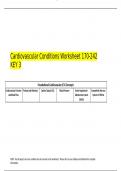
Cardiovascular Conditions Worksheet 170-242
KEY 3
Foundational Cardiovascular (CV) Concepts
Cardiovascular Function Preload and Afterload Cardiac Output (CO) Blood Pressure Renin-Angiotensin- Sympathetic Nervous
and Blood Flow Aldosterone System System CV Effects
(RAAS)
NOTE: Not all aspects of every condition may be covered on the worksheet. Please refer to your syllabus and textbook for complete
information.
, lOMoARcPSD|26582732
Cardiovascular Conditions Worksheet Key – M. Campagna MSN-Ed, BSN, RN, Content Enrichment Specialist
Blood Flow: Preload Cardiac output is the Blood pressure is the The RAAS is one of the “fight or flight”
Veins flow into the vena The amount of stretch of amount of blood amount of pressure body’s natural ways to
cava which empties into the heart muscle as it pumped out of the exerted on the walls of increase blood pressure Activated in times of
the right side of the Fills up prior to heart every minute. the arteries. when needed to stess. Its goal is to
heart. This side then contraction. maintain homeostasis. maintain survival of the
pumps into the lungs. Formula: Maintaining adequate body’s main vital
From here, it travels to Mainly affected by blood CO = HR (heart rate) x BP is necessary for When blood pressure, organs: the heart, brain,
the left side of the heart. volume and venous SV (stroke volume) tissues to be perfused volume, or salt levels and lungs.
This side then pumps return. Formula Explanation: with oxygen. decrease in the blood,
into the arterial system Cardiac output is the system is activated. CV Effects of activation:
and out to the body and Afterload The amount of determined by the Formula: HR: ↑
the organs. resistance the heart has about of blood pumped BP= CO (cardiac output) The result of the system BP: ↑ because of
to pump against to get out with every squeeze x SVR (systemic vascular is: peripheral vessel
Heart’s Job: the blood out. X the number of resistance) Vasoconstriction. constriction.
The heart is a pump. Its squeezes per minute. Formula Explanation: BP Excretion of potassium
job is to propel the blood Mainly affected by the is determined by the Retention of salt &
forward and keep it constriction and/or The symptoms of amount of blood water.
circulating. decreased cardiac
patency of blood vessels pumped out of the heart
output are like those of
and heart valves. every minute X the
Arteries vs. Veins decreased perfusion.
constriction or dilation
Arteries take
Urine output: ↓ of the blood vessels.
oxygenated blood to the
tissues. Veins take Blood pressure: ↓
deoxygenated blood to Breathing: ↑RR, SOB
the heart. LOC: confusion,
lethargy, restlessness
Pain: chest pain
Skin: pale, cool, clammy
Pulse quality: weak
Dizziness, fatigue
Main Cardiac Drug Classes
NOTE: Not all aspects of every condition may be covered on the worksheet. Please refer to your syllabus and textbook for complete
information.
Cardiovascular Conditions Worksheet 170-242
KEY 3
Foundational Cardiovascular (CV) Concepts
Cardiovascular Function Preload and Afterload Cardiac Output (CO) Blood Pressure Renin-Angiotensin- Sympathetic Nervous
and Blood Flow Aldosterone System System CV Effects
(RAAS)
NOTE: Not all aspects of every condition may be covered on the worksheet. Please refer to your syllabus and textbook for complete
information.
, lOMoARcPSD|26582732
Cardiovascular Conditions Worksheet Key – M. Campagna MSN-Ed, BSN, RN, Content Enrichment Specialist
Blood Flow: Preload Cardiac output is the Blood pressure is the The RAAS is one of the “fight or flight”
Veins flow into the vena The amount of stretch of amount of blood amount of pressure body’s natural ways to
cava which empties into the heart muscle as it pumped out of the exerted on the walls of increase blood pressure Activated in times of
the right side of the Fills up prior to heart every minute. the arteries. when needed to stess. Its goal is to
heart. This side then contraction. maintain homeostasis. maintain survival of the
pumps into the lungs. Formula: Maintaining adequate body’s main vital
From here, it travels to Mainly affected by blood CO = HR (heart rate) x BP is necessary for When blood pressure, organs: the heart, brain,
the left side of the heart. volume and venous SV (stroke volume) tissues to be perfused volume, or salt levels and lungs.
This side then pumps return. Formula Explanation: with oxygen. decrease in the blood,
into the arterial system Cardiac output is the system is activated. CV Effects of activation:
and out to the body and Afterload The amount of determined by the Formula: HR: ↑
the organs. resistance the heart has about of blood pumped BP= CO (cardiac output) The result of the system BP: ↑ because of
to pump against to get out with every squeeze x SVR (systemic vascular is: peripheral vessel
Heart’s Job: the blood out. X the number of resistance) Vasoconstriction. constriction.
The heart is a pump. Its squeezes per minute. Formula Explanation: BP Excretion of potassium
job is to propel the blood Mainly affected by the is determined by the Retention of salt &
forward and keep it constriction and/or The symptoms of amount of blood water.
circulating. decreased cardiac
patency of blood vessels pumped out of the heart
output are like those of
and heart valves. every minute X the
Arteries vs. Veins decreased perfusion.
constriction or dilation
Arteries take
Urine output: ↓ of the blood vessels.
oxygenated blood to the
tissues. Veins take Blood pressure: ↓
deoxygenated blood to Breathing: ↑RR, SOB
the heart. LOC: confusion,
lethargy, restlessness
Pain: chest pain
Skin: pale, cool, clammy
Pulse quality: weak
Dizziness, fatigue
Main Cardiac Drug Classes
NOTE: Not all aspects of every condition may be covered on the worksheet. Please refer to your syllabus and textbook for complete
information.


