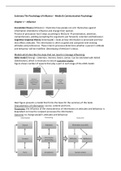
UCF COM 1000 final Young
Human Communication - correct answer The process of managing messages for the purpose of creating
shared meaning
Transaction - correct answer Between at least two people
Simultaneously sending and receiving messages to and from one another
Messages - correct answer Verbal or nonverbal
Intentional or Unintentional
Channels - correct answer The medium through which a message is sent how we interact
Interference (noise) - correct answer Prevents messages from being received, or prevents intended
meaning from being understood
Other Factors - correct answer Feedback- What response to a message
Time- Can change feedback to a message
Intrapersonal Communication - correct answer Communication within a person
Perception may change from person to person
Interpersonal Communication - correct answer Communication with another person
Interviewing - correct answer Question and answer format between people
Usually a formal setting
,small group communication - correct answer3or more, ideally 5-7
work together
behavior influenced by others
Public Communication - correct answer Engaging multiple people
Lectures, stand up comedy, speeches
Organizational Communication - correct answer Designed to factor in the roles of large amounts of
people
Health Communication - correct answerStructuring communication so interaction between doctors and
patients are more appropriate
Mass/Media Communication - correct answerTV, Movies, Radio
Elements of Effective Communication - correct answerUnderstanding
Pleasure
Attitude Influence
Improved Relationships
Action
Humanistic Approaches - correct answerRhetoric
Interpretivists- Looks at specific events through different viewpoints
Critical Scholars- Look at critical issues
Qualitative - correct answerRigorous observation rules
Work "in the field"
Collect detailed and descriptive data
,Interviews, ethnography, participant data
Quantitative - correct answerUncover patterns in communications via numbers
Advanced statistical and rigid testing to support/reject hypothesis
Can work "in the field" or in lab
The Scientific Method - correct answerAsk a question or state a problem
Formulate hypothesis or research question
Design and conduct observation, measurement, or experiment
Analyze and interpret data
Empirical - correct answerData based on observation or experience
Objective - correct answerMinimized personal bias
Logical - correct answerRational, consistent, sensible judgement on data
Public - correct answerResults are publicized
Content Analysis - correct answerSystematic analysis of messages
Purposes of Content Analysis - correct answerDescribes frequency of behavior
Compares behavior types/rates across different contexts
Content Analysis Issues - correct answerRequires a representative sample
Needs clear, specific definitions of behaviors
Limited to studying what is already occurring
Survey Research - correct answerExamines what people do
, Relies on self reports
Examines relationships between variables
ex. Relationship questionnaires, Attitude surveys, media habits research
Survey Research Issues - correct answerNeed representative sample
Questions must be high quality
No control over variables
Cannot make casual conclusions
Self reports
Experimental Research - correct answerManipulation of variables
Control of other variables/settings
Measures effect/outcome of manipulation
Experiment Issues - correct answerGoal: Drawing casual conclusions
Requires random assignment to conditions
Hard to generate results
Artificial setting
Limited subject population
Reliability - correct answerConsistency of measurement results
Validity - correct answerAccuracy of results
Perception - correct answerInterpreting the sensory experience of the world
Selective Attention - correct answerThe ability to process certain stimuli while filtering others
Perceptual Filters - correct answerPhysical/Psychological Limits
Human Communication - correct answer The process of managing messages for the purpose of creating
shared meaning
Transaction - correct answer Between at least two people
Simultaneously sending and receiving messages to and from one another
Messages - correct answer Verbal or nonverbal
Intentional or Unintentional
Channels - correct answer The medium through which a message is sent how we interact
Interference (noise) - correct answer Prevents messages from being received, or prevents intended
meaning from being understood
Other Factors - correct answer Feedback- What response to a message
Time- Can change feedback to a message
Intrapersonal Communication - correct answer Communication within a person
Perception may change from person to person
Interpersonal Communication - correct answer Communication with another person
Interviewing - correct answer Question and answer format between people
Usually a formal setting
,small group communication - correct answer3or more, ideally 5-7
work together
behavior influenced by others
Public Communication - correct answer Engaging multiple people
Lectures, stand up comedy, speeches
Organizational Communication - correct answer Designed to factor in the roles of large amounts of
people
Health Communication - correct answerStructuring communication so interaction between doctors and
patients are more appropriate
Mass/Media Communication - correct answerTV, Movies, Radio
Elements of Effective Communication - correct answerUnderstanding
Pleasure
Attitude Influence
Improved Relationships
Action
Humanistic Approaches - correct answerRhetoric
Interpretivists- Looks at specific events through different viewpoints
Critical Scholars- Look at critical issues
Qualitative - correct answerRigorous observation rules
Work "in the field"
Collect detailed and descriptive data
,Interviews, ethnography, participant data
Quantitative - correct answerUncover patterns in communications via numbers
Advanced statistical and rigid testing to support/reject hypothesis
Can work "in the field" or in lab
The Scientific Method - correct answerAsk a question or state a problem
Formulate hypothesis or research question
Design and conduct observation, measurement, or experiment
Analyze and interpret data
Empirical - correct answerData based on observation or experience
Objective - correct answerMinimized personal bias
Logical - correct answerRational, consistent, sensible judgement on data
Public - correct answerResults are publicized
Content Analysis - correct answerSystematic analysis of messages
Purposes of Content Analysis - correct answerDescribes frequency of behavior
Compares behavior types/rates across different contexts
Content Analysis Issues - correct answerRequires a representative sample
Needs clear, specific definitions of behaviors
Limited to studying what is already occurring
Survey Research - correct answerExamines what people do
, Relies on self reports
Examines relationships between variables
ex. Relationship questionnaires, Attitude surveys, media habits research
Survey Research Issues - correct answerNeed representative sample
Questions must be high quality
No control over variables
Cannot make casual conclusions
Self reports
Experimental Research - correct answerManipulation of variables
Control of other variables/settings
Measures effect/outcome of manipulation
Experiment Issues - correct answerGoal: Drawing casual conclusions
Requires random assignment to conditions
Hard to generate results
Artificial setting
Limited subject population
Reliability - correct answerConsistency of measurement results
Validity - correct answerAccuracy of results
Perception - correct answerInterpreting the sensory experience of the world
Selective Attention - correct answerThe ability to process certain stimuli while filtering others
Perceptual Filters - correct answerPhysical/Psychological Limits