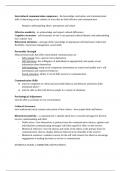
Intercultural communication competence - the knowledge, motivation, and communication
skill of interacting across cultures in ways that are both effective and communicative
- Requires understanding others’ perceptions and values
Affective sensitivity - to acknowledge and respect cultural differences
Cognitive awareness - self-awareness of one’s own personal cultural identity and understanding
how cultures vary
Behavioral adroitness - message skills, knowledge of appropriate self-disclosure, behavioral
flexibility, interaction management, social skills
Personality Strength
Main personal traits that affect intercultural communication are
- Self-concept: how a person views themselves
- Self-disclosure: the willingness of individuals to appropriately and openly reveal
information about themselves
- Self-monitoring: using social comparison information to control and modify one’s self
presentation and expressive behavior
- Social-relaxation: ability to reveal little anxiety in communication
Communication Skills
● must be competent in verbal and nonverbal behavior and behavior adroitness skills
mentioned above ^
● must be able to deal with diverse people in a variety of situations
Psychological Adjustment
must be able to acclimate to new environments
Cultural Awareness
must understand social customs and system of host culture - how people think and behave
Rhetorical sensitivity - a communicator’s attitude about how to encode messages for the best
receiver understanding and effect
- Noble selves: view themselves as primary basis for communication choices; egotism and
individualism communicating messages with little regard for effect on the receiver
- Rhetorical reflectors: view the desires and needs of the others as the primary basis for
communication choices; display behavior believed to be desirable to the receiver
- Rhetorical sensitives: combine concern for the self with concern for others to encourage
engagement in making decisions as to how to communicate
INTERCULTURAL COMMUNICATION ETHICS
skill of interacting across cultures in ways that are both effective and communicative
- Requires understanding others’ perceptions and values
Affective sensitivity - to acknowledge and respect cultural differences
Cognitive awareness - self-awareness of one’s own personal cultural identity and understanding
how cultures vary
Behavioral adroitness - message skills, knowledge of appropriate self-disclosure, behavioral
flexibility, interaction management, social skills
Personality Strength
Main personal traits that affect intercultural communication are
- Self-concept: how a person views themselves
- Self-disclosure: the willingness of individuals to appropriately and openly reveal
information about themselves
- Self-monitoring: using social comparison information to control and modify one’s self
presentation and expressive behavior
- Social-relaxation: ability to reveal little anxiety in communication
Communication Skills
● must be competent in verbal and nonverbal behavior and behavior adroitness skills
mentioned above ^
● must be able to deal with diverse people in a variety of situations
Psychological Adjustment
must be able to acclimate to new environments
Cultural Awareness
must understand social customs and system of host culture - how people think and behave
Rhetorical sensitivity - a communicator’s attitude about how to encode messages for the best
receiver understanding and effect
- Noble selves: view themselves as primary basis for communication choices; egotism and
individualism communicating messages with little regard for effect on the receiver
- Rhetorical reflectors: view the desires and needs of the others as the primary basis for
communication choices; display behavior believed to be desirable to the receiver
- Rhetorical sensitives: combine concern for the self with concern for others to encourage
engagement in making decisions as to how to communicate
INTERCULTURAL COMMUNICATION ETHICS