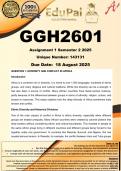
,GGH2601 Assignment 1 (COMPLETE ANSWERS)
Semester 2 2025 (143131) - DUE 18 August 2025;
100% TRUSTED Complete, trusted solutions and
explanations.
Question 1: How diversity on the African continent can fuel
conflict (20 marks)
Africa’s diversity—ethnic, cultural, linguistic, and religious—
can create identity-based divisions. When political power,
resources, or economic opportunities are perceived to favour
certain groups, tensions arise. Ethnic nationalism, historical
grievances from colonial borders, and competition over land
and jobs often escalate into violence. Weak governance,
corruption, and external interference can exploit these
divisions, turning diversity into a source of rivalry rather than
unity.
Question 2: Using SDG 11 and 17 to address resource
challenges from population growth
Rapid population growth strains housing, infrastructure,
water, and energy. SDG 11 (Sustainable Cities and
Communities) promotes inclusive urban planning, affordable
housing, efficient transport, and resilient infrastructure to
manage urbanisation sustainably. SDG 17 (Partnerships for the
Goals) fosters collaboration between governments, private
sector, civil society, and international bodies to share
technology, funding, and expertise. Together, they support
, resource-efficient development, reduce inequality, and build
capacity to handle population pressures.
Question 1
Discuss how diversity on the African continent can be viewed
as fueling conflict. (20 Marks)
Diversity in Africa refers to the wide variety of ethnic groups,
languages, cultures, religions, and socio-political systems found
across the continent. While diversity can be a source of cultural
richness and innovation, it has also historically been linked to
conflict under certain political, economic, and social conditions.
1. Ethnic and tribal divisions
Semester 2 2025 (143131) - DUE 18 August 2025;
100% TRUSTED Complete, trusted solutions and
explanations.
Question 1: How diversity on the African continent can fuel
conflict (20 marks)
Africa’s diversity—ethnic, cultural, linguistic, and religious—
can create identity-based divisions. When political power,
resources, or economic opportunities are perceived to favour
certain groups, tensions arise. Ethnic nationalism, historical
grievances from colonial borders, and competition over land
and jobs often escalate into violence. Weak governance,
corruption, and external interference can exploit these
divisions, turning diversity into a source of rivalry rather than
unity.
Question 2: Using SDG 11 and 17 to address resource
challenges from population growth
Rapid population growth strains housing, infrastructure,
water, and energy. SDG 11 (Sustainable Cities and
Communities) promotes inclusive urban planning, affordable
housing, efficient transport, and resilient infrastructure to
manage urbanisation sustainably. SDG 17 (Partnerships for the
Goals) fosters collaboration between governments, private
sector, civil society, and international bodies to share
technology, funding, and expertise. Together, they support
, resource-efficient development, reduce inequality, and build
capacity to handle population pressures.
Question 1
Discuss how diversity on the African continent can be viewed
as fueling conflict. (20 Marks)
Diversity in Africa refers to the wide variety of ethnic groups,
languages, cultures, religions, and socio-political systems found
across the continent. While diversity can be a source of cultural
richness and innovation, it has also historically been linked to
conflict under certain political, economic, and social conditions.
1. Ethnic and tribal divisions