

MATH225
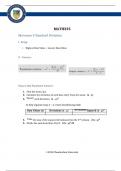
Skewness S Standard Deviation
I. Range
• Highest Data Value – Lowest Data Value
II. Variance
Steps to find Population Variance:
1. Find the mean. (μ)
2. Calculate the deviation of each data entry from the mean. (x - μ)
3. Square each deviation. (x - μ)2
To help organize steps 2 – 3, create the following table:
Data Values (x) Deviations (x - μ) Deviations Squared (x - μ)2
4. Take the sum of the squared deviations from the 3rd column. Z(x - μ)2
5. Divide the sum from Step 4 by N. Z(x - μ)2/N
©2024 Chamberlain University
, III. Standard Deviation
To find Population Standard Deviation:
1 – 5. Same as steps above
6. Take the square root of answer from Step 5.
Example: Find the range, mean, variance, and standard deviation of the
population data set.
22, 10, 6, 9, 8
Range = 16 Mean
(m) = 11
(x - μ) (x - μ)2
22 11 121
10 -1 1
6 -5 25
9 -2 4
8 -3 9
Z(x - μ)2 = 160
Z(x - μ)2/N = 160/5 = 32
Population standard deviation = 5.66 Sample
variance = 160/4 = 40
Sample standard deviation = 6.32
Example: The lengths of the first 10 words of two books are listed below. Find
the range, variance, and standard deviation for each of the two samples,
then compare the two sets of results. Does there appear to be a difference
in variation?
Book 1: 4, 3, 3, 3, 3, 4, 4, 5, 4, 6 > SD = 0.994
Book 2: 11, 10, 12, 3, 9, 7, 4, 9, 3, 6 > SD = 3.307
©2024 Chamberlain University
Skewness S Standard Deviation
I. Range
• Highest Data Value – Lowest Data Value
II. Variance
Steps to find Population Variance:
1. Find the mean. (μ)
2. Calculate the deviation of each data entry from the mean. (x - μ)
3. Square each deviation. (x - μ)2
To help organize steps 2 – 3, create the following table:
Data Values (x) Deviations (x - μ) Deviations Squared (x - μ)2
4. Take the sum of the squared deviations from the 3rd column. Z(x - μ)2
5. Divide the sum from Step 4 by N. Z(x - μ)2/N
©2024 Chamberlain University
, III. Standard Deviation
To find Population Standard Deviation:
1 – 5. Same as steps above
6. Take the square root of answer from Step 5.
Example: Find the range, mean, variance, and standard deviation of the
population data set.
22, 10, 6, 9, 8
Range = 16 Mean
(m) = 11
(x - μ) (x - μ)2
22 11 121
10 -1 1
6 -5 25
9 -2 4
8 -3 9
Z(x - μ)2 = 160
Z(x - μ)2/N = 160/5 = 32
Population standard deviation = 5.66 Sample
variance = 160/4 = 40
Sample standard deviation = 6.32
Example: The lengths of the first 10 words of two books are listed below. Find
the range, variance, and standard deviation for each of the two samples,
then compare the two sets of results. Does there appear to be a difference
in variation?
Book 1: 4, 3, 3, 3, 3, 4, 4, 5, 4, 6 > SD = 0.994
Book 2: 11, 10, 12, 3, 9, 7, 4, 9, 3, 6 > SD = 3.307
©2024 Chamberlain University


