Tactical Applications and Settlement
Tactical applications
Summary Judgment
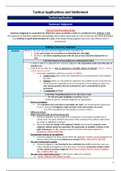
Part 24 Civil Procedure Rules
Summary judgment is a procedure by which the court can decide a claim or a particular issue without a trial.
The existence of Summary Judgment acknowledges that certain cases need not run to trial; the aim of the procedure
is to facilitate a quick determination of a case, avoid long-running litigation and save costs where a trial is
unnecessary.
Making a Summary Judgment
Grounds CPR 24.2 - The court may give summary judgment if the respondent has:
(a) No real prospect of succeeding on or defending the claim AND
(b) There is no other compelling reason why the case or issue should be disposed of at a
trial.
1: No Real Prospect of Succeeding on or Defending the Claim
In order to defeat an application for summary judgment, the respondent needs more than just an
arguable case.
It has to be one that has a "real, as opposed to a fanciful, chance of winning" (Swain v Hillman
[1999] EWCA Civ 3053).
Commonly, applications will focus on (para 1.3, PD24):
o A point of law which means the respondent has no real prospects of succeeding in
his claim.
o Evidence which can reasonably be expected to be available at trial, or the lack of it,
which means the respondent has no real prospects of succeeding e.g. where it is
clear beyond question that the statement of case is contradicted by all the
documents.
o A combination of these.
2: No Other Compelling Reason to Try the Case or Issue
The following may constitute compelling reasons:
(if they are proven, summary judgment not appropriate)
Need to investigate:
The respondent may need time to investigate the claim, not having had the opportunity
to do so, and such investigation might provide it with real prospects of success.
o E.g. if the respondent has been unable to contact a witness.
Difference in facts
Where one party holds all of the factual cards
Summary Judgment can be sought prior to disclosure. It is therefore possible that, in
certain cases, one party will be in possession of the majority of the evidence before they
are under an obligation to disclose.
Where the facts are wholly in the applicant's hands and it would be unjust to enter
judgment without giving the respondent the opportunity to establish a defence in the
light of disclosure, or after serving a request for further information (Harrison v
Bottenheim (1878) 26 WR 362).
Questionable conduct by the applicant:
Summary judgment has been refused where the applicant's conduct can be questioned, for
instance where they are being dishonest or devious (Miles v Bull [1969] 1 QB 258).
The case is particularly complex:
Summary judgment is not intended to be a substitute for a trial in which the court can
make a detailed investigation of all of the issues. Therefore, particularly complex claims
are less suited to Summary Judgment (Three Rivers District Council v Bank of England
(No. 3) [2001] UKHL 16).
The case is on a novel point of law for which there is little prior authority.
Swain v Hillman [1999] EWCA Civ 3053
1
Tactical applications
Summary Judgment
Part 24 Civil Procedure Rules
Summary judgment is a procedure by which the court can decide a claim or a particular issue without a trial.
The existence of Summary Judgment acknowledges that certain cases need not run to trial; the aim of the procedure
is to facilitate a quick determination of a case, avoid long-running litigation and save costs where a trial is
unnecessary.
Making a Summary Judgment
Grounds CPR 24.2 - The court may give summary judgment if the respondent has:
(a) No real prospect of succeeding on or defending the claim AND
(b) There is no other compelling reason why the case or issue should be disposed of at a
trial.
1: No Real Prospect of Succeeding on or Defending the Claim
In order to defeat an application for summary judgment, the respondent needs more than just an
arguable case.
It has to be one that has a "real, as opposed to a fanciful, chance of winning" (Swain v Hillman
[1999] EWCA Civ 3053).
Commonly, applications will focus on (para 1.3, PD24):
o A point of law which means the respondent has no real prospects of succeeding in
his claim.
o Evidence which can reasonably be expected to be available at trial, or the lack of it,
which means the respondent has no real prospects of succeeding e.g. where it is
clear beyond question that the statement of case is contradicted by all the
documents.
o A combination of these.
2: No Other Compelling Reason to Try the Case or Issue
The following may constitute compelling reasons:
(if they are proven, summary judgment not appropriate)
Need to investigate:
The respondent may need time to investigate the claim, not having had the opportunity
to do so, and such investigation might provide it with real prospects of success.
o E.g. if the respondent has been unable to contact a witness.
Difference in facts
Where one party holds all of the factual cards
Summary Judgment can be sought prior to disclosure. It is therefore possible that, in
certain cases, one party will be in possession of the majority of the evidence before they
are under an obligation to disclose.
Where the facts are wholly in the applicant's hands and it would be unjust to enter
judgment without giving the respondent the opportunity to establish a defence in the
light of disclosure, or after serving a request for further information (Harrison v
Bottenheim (1878) 26 WR 362).
Questionable conduct by the applicant:
Summary judgment has been refused where the applicant's conduct can be questioned, for
instance where they are being dishonest or devious (Miles v Bull [1969] 1 QB 258).
The case is particularly complex:
Summary judgment is not intended to be a substitute for a trial in which the court can
make a detailed investigation of all of the issues. Therefore, particularly complex claims
are less suited to Summary Judgment (Three Rivers District Council v Bank of England
(No. 3) [2001] UKHL 16).
The case is on a novel point of law for which there is little prior authority.
Swain v Hillman [1999] EWCA Civ 3053
1