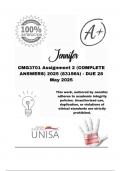
, PVL3704 ASSIGNMENT 1 (COMPLETE ANSWERS) Semester 2
2025 – DUE 21 August 2025 ;100% trusted ,comprehensive and
complete reliable solution with clear explanation
QUESTION 1 Discuss in general (without reference to a specific
enrichment action) how the extent of enrichment liability (or the
quantum of the enrichment claim) will be calculated. (15)
The Quantum of an Enrichment Claim
In South African private law, the extent of enrichment liability, also
known as the quantum of the enrichment claim, refers to the measure
of compensation that the enriched party may be required to pay to the
impoverished party. This calculation is a central feature of claims based
on unjustified enrichment, which are founded on the legal maxim
"nemo debet locupletari aliena iactura" — no one should be enriched
at the expense of another without a legal cause.
The law of unjustified enrichment seeks to correct imbalances in
circumstances where one party has been impoverished by conferring a
benefit upon another without a valid legal justification. However, the
obligation to restore this imbalance is not absolute. The enriched party is
only liable to the extent that they are still enriched, and the
impoverished party is only entitled to recover what was lost, not to
profit from the situation.
This principle ensures that the law maintains a restitutionary
character, focusing on the restoration of unjustified benefits rather than
2025 – DUE 21 August 2025 ;100% trusted ,comprehensive and
complete reliable solution with clear explanation
QUESTION 1 Discuss in general (without reference to a specific
enrichment action) how the extent of enrichment liability (or the
quantum of the enrichment claim) will be calculated. (15)
The Quantum of an Enrichment Claim
In South African private law, the extent of enrichment liability, also
known as the quantum of the enrichment claim, refers to the measure
of compensation that the enriched party may be required to pay to the
impoverished party. This calculation is a central feature of claims based
on unjustified enrichment, which are founded on the legal maxim
"nemo debet locupletari aliena iactura" — no one should be enriched
at the expense of another without a legal cause.
The law of unjustified enrichment seeks to correct imbalances in
circumstances where one party has been impoverished by conferring a
benefit upon another without a valid legal justification. However, the
obligation to restore this imbalance is not absolute. The enriched party is
only liable to the extent that they are still enriched, and the
impoverished party is only entitled to recover what was lost, not to
profit from the situation.
This principle ensures that the law maintains a restitutionary
character, focusing on the restoration of unjustified benefits rather than