Statistics
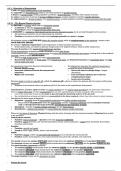
QRMC |Lecture 1 (chapter 6)
Cases and variables
Cases are the things we want to study, in SPSS each case has a separate row (persons)
Variable is an entity that can take on a variety of different values. In SPSS, each variable has a
separate column.
- Concrete variable: stable or consistent (biological sex)
- Abstract variable: change of differ over time or across situations (satisfaction)
Aspects of variables
- Difference in kind: occur when two or more groups do different things associated with their
groups (football and cheerleaders).
- Difference in degree: occur when two groups have differing degree of a variable that they
both display (degree of verbal aggression).
Relationship as research concept refers to the correspondence or connection between two
variables. Relationships between variables fall into one of the three categories:
I. Positive relationship
Exist when an increase in one variable produces an increase in the other variable, or when a
decrease in a variable corresponds with a decrease in the other variable.
II. Negative relationship
Exist when a decrease in one variable produces an increase in the other variable, or when an
increase in a variable corresponds with a decrease in the other variable.
III. Neutral relationship
Variables are not related, when the change of one variable does not correspond with a
change in another variable.
Types of variables
- Independent variable: part of the research environment that are manipulated or changed.
This variable is what we are studying with respect to how it impacts a dependent variable
(predicts the dependent value).
- Dependent variable: recorded or measured, but they are not exposed to any type of
alteration (dependent on independent variable).
- Intervening variable: to determine if the effects of a change in the independent variable in
turn cause a change in the dependent variable.
Levels of variables
I. Nominal
Variable which has no meaningful numerical value, possible values for a nominal variable are
labels or categories. The variable cannot be ordered, only categorized.
Gender (1= male, 2= female)
Genres (1= drama, 2= comedy, 3= horror)
Colors (1= blue, 2= red, 3= green)
, II. Ordinal
Numerical values that can be ordered from low to high, but the distances between the
values are not fixed and we cannot indicate how much higher a variable is.
Order of arrival (1= first, 2= second, 3= third)
Educational level (1= bachelor, 2= master, 3= doctoral degree)
Socioeconomic status (1= lower class, 2= middle class, 3= upper class)
III. Interval
Values can be ordered from low to high, and the distances between the values are fixed and
meaningful. Interval variable has no natural zero starting point.
Celsius temperature
IQ intelligence scale
Likert scale
IV. Ratio
Values can be ordered, distances are meaningful and there is a natural zero starting point.
Income in euro
Number of e-mails received in a week
Number of students in a class
To increase the reliability of variables, some items are formulated positively, while others are
formulated negatively. In order to create a scaling instrument, it is necessary to recode some items.
Types of interval scales
- Likert scale: respond on statements based on a preexisting scale. System is ranging from
1 (strongly disagree) to 5 (strongly agree).
- Semantic differential scale: scale consisting of a series of adjectives that are oppositely
worded, system is ranging from 1 (unmotivated) to 7 (motivated).
- Scalogram scale: to ascertain an individual’s belief about a given topic, ranging from
statements with the options YES (agree) or NO (disagree).
SPSS
Recoding variables
Transform > Recode into different variable
- Select Old and New values to commute values
Total score of variable
Transform > Compute
Grouping data
Transform > Recode into different variable
- Select Old and New values > Range to enter classes (group 1: below 154 cm)
QRMC |Lecture 1 (chapter 6)
Cases and variables
Cases are the things we want to study, in SPSS each case has a separate row (persons)
Variable is an entity that can take on a variety of different values. In SPSS, each variable has a
separate column.
- Concrete variable: stable or consistent (biological sex)
- Abstract variable: change of differ over time or across situations (satisfaction)
Aspects of variables
- Difference in kind: occur when two or more groups do different things associated with their
groups (football and cheerleaders).
- Difference in degree: occur when two groups have differing degree of a variable that they
both display (degree of verbal aggression).
Relationship as research concept refers to the correspondence or connection between two
variables. Relationships between variables fall into one of the three categories:
I. Positive relationship
Exist when an increase in one variable produces an increase in the other variable, or when a
decrease in a variable corresponds with a decrease in the other variable.
II. Negative relationship
Exist when a decrease in one variable produces an increase in the other variable, or when an
increase in a variable corresponds with a decrease in the other variable.
III. Neutral relationship
Variables are not related, when the change of one variable does not correspond with a
change in another variable.
Types of variables
- Independent variable: part of the research environment that are manipulated or changed.
This variable is what we are studying with respect to how it impacts a dependent variable
(predicts the dependent value).
- Dependent variable: recorded or measured, but they are not exposed to any type of
alteration (dependent on independent variable).
- Intervening variable: to determine if the effects of a change in the independent variable in
turn cause a change in the dependent variable.
Levels of variables
I. Nominal
Variable which has no meaningful numerical value, possible values for a nominal variable are
labels or categories. The variable cannot be ordered, only categorized.
Gender (1= male, 2= female)
Genres (1= drama, 2= comedy, 3= horror)
Colors (1= blue, 2= red, 3= green)
, II. Ordinal
Numerical values that can be ordered from low to high, but the distances between the
values are not fixed and we cannot indicate how much higher a variable is.
Order of arrival (1= first, 2= second, 3= third)
Educational level (1= bachelor, 2= master, 3= doctoral degree)
Socioeconomic status (1= lower class, 2= middle class, 3= upper class)
III. Interval
Values can be ordered from low to high, and the distances between the values are fixed and
meaningful. Interval variable has no natural zero starting point.
Celsius temperature
IQ intelligence scale
Likert scale
IV. Ratio
Values can be ordered, distances are meaningful and there is a natural zero starting point.
Income in euro
Number of e-mails received in a week
Number of students in a class
To increase the reliability of variables, some items are formulated positively, while others are
formulated negatively. In order to create a scaling instrument, it is necessary to recode some items.
Types of interval scales
- Likert scale: respond on statements based on a preexisting scale. System is ranging from
1 (strongly disagree) to 5 (strongly agree).
- Semantic differential scale: scale consisting of a series of adjectives that are oppositely
worded, system is ranging from 1 (unmotivated) to 7 (motivated).
- Scalogram scale: to ascertain an individual’s belief about a given topic, ranging from
statements with the options YES (agree) or NO (disagree).
SPSS
Recoding variables
Transform > Recode into different variable
- Select Old and New values to commute values
Total score of variable
Transform > Compute
Grouping data
Transform > Recode into different variable
- Select Old and New values > Range to enter classes (group 1: below 154 cm)