

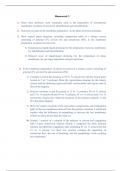
Homework 3
1. Name three polymers most commonly used in the preparation of microporous
membranes via phase inversion for ultrafiltration and microfiltration.
2. Name the six steps in the membrane preparation via the phase inversion technique.
3. Show typical phase diagrams, including composition paths in a ternary system
consisting of polymer (P), solvent (S) and nonsolvent (NS), in the membrane
preparation via phase inversion for:
1) Instantaneous liquid-liquid demixing for the preparation of porous membranes
for ultrafiltration and microfiltration
2) Delayed onset of liquid-liquid demixing for the preparation of dense
membranes for gas/vapor separations and pervaporation.
4. In the membrane preparation via phase inversion for a ternary system consisting of
polymer (P), solvent (S), and nonsolvent (NS):
1) Consider a system that demixes at 30 wt. % nonsolvent with the critical point
located at 5 wt. % polymer. Draw the typical phase diagram for the ternary
system with the demixing region and label various points and regions and tie
line on the diagram.
2) Polymer solutions A and B consists of 15 wt. % polymer, 80 wt. % solvent
and 5 wt. % nonsolvent and 30 wt. % polymer, 65 wt. % solvent and 5 wt. %
nonsolvent, respectively. Mark the locations of the polymer solutions A and
B in the phase diagram.
3) Show the relative locations of the top-surface compositions and composition
paths of the two membranes derived from the polymer solutions A and B and
explain what the difference in morphology is between the two membranes
(which are more porous than the other is).
4) System 1 consists of a solution of the polymer in solvent and coagulation
bath of pure nonsolvent whereas System 2 comprises the same polymer
solution and different coagulation bath containing 85 wt. % nonsolvent and
15 wt. % solvent. For these two systems, compare the magnitude of
nonsolvent flow, the rate of demixing, and the morphology of the resulting
two membranes.
1. Name three polymers most commonly used in the preparation of microporous
membranes via phase inversion for ultrafiltration and microfiltration.
2. Name the six steps in the membrane preparation via the phase inversion technique.
3. Show typical phase diagrams, including composition paths in a ternary system
consisting of polymer (P), solvent (S) and nonsolvent (NS), in the membrane
preparation via phase inversion for:
1) Instantaneous liquid-liquid demixing for the preparation of porous membranes
for ultrafiltration and microfiltration
2) Delayed onset of liquid-liquid demixing for the preparation of dense
membranes for gas/vapor separations and pervaporation.
4. In the membrane preparation via phase inversion for a ternary system consisting of
polymer (P), solvent (S), and nonsolvent (NS):
1) Consider a system that demixes at 30 wt. % nonsolvent with the critical point
located at 5 wt. % polymer. Draw the typical phase diagram for the ternary
system with the demixing region and label various points and regions and tie
line on the diagram.
2) Polymer solutions A and B consists of 15 wt. % polymer, 80 wt. % solvent
and 5 wt. % nonsolvent and 30 wt. % polymer, 65 wt. % solvent and 5 wt. %
nonsolvent, respectively. Mark the locations of the polymer solutions A and
B in the phase diagram.
3) Show the relative locations of the top-surface compositions and composition
paths of the two membranes derived from the polymer solutions A and B and
explain what the difference in morphology is between the two membranes
(which are more porous than the other is).
4) System 1 consists of a solution of the polymer in solvent and coagulation
bath of pure nonsolvent whereas System 2 comprises the same polymer
solution and different coagulation bath containing 85 wt. % nonsolvent and
15 wt. % solvent. For these two systems, compare the magnitude of
nonsolvent flow, the rate of demixing, and the morphology of the resulting
two membranes.


