Memory revision
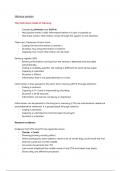
The multi store model of memory:
- Created by Aktinson and Shiffrin
- Has passive stores, holds information before it is lost or passed on
- Has linear stores, information moves through the system in one direction
There are 3 features of each store
- Coding: format information is stored in
- Duration: how long information is held for
- Capacity: how much information can be held
Sensory register (SR)
- Sensory information coming from the senses is detected and recorded
automatically
- Coding is modality specific, the coding is different for each sense organ
- Capacity is unlimited
- Duration is 250ms
- Information that is not paid attention to is lost
Information is then passed to the short term memory (STM) through attention
- Coding is autousic
- Capacity is 7+-2 and is improved by chunking
- Duration is 18-30 seconds
- Information can be lost via decay or displaced
Information can be passed to the long term memory (LTM) via maintenance rehearsal
and elaborative rehearsal. It is passed back through retrieval
- Coding is semantic
- Capacity is unlimited (no limit has been found yet)
- Duration is unlimited
Research evidence:
Evidence that STM and LTM are separate stores
- Clanzer + Cunitz
- Showing primary recency effect
- When participants were asked to recall a list of words they could recall the first
and last words but not the middle
- 1st words moved into the LTM
- Last words displaced the middle words in the STM and takes their place
- Shows they are different processes
, Evidence for the capacity of SR
- Sterling
- Flashed a grid of letters and used different sounds for each row
- Got participants to immediately recall and recall after 20 minutes
- Recall for a row was over 75%
- Shows capacity of SR is large as all the rows was contained within the capacity
of the ionic store
Evidence for coding in LTM and STM
- Baddelly
- Gave 10 word lists of either semantically similar, acoustically similar,
semantically similar, acoustically dissimilar
- Got them to recall immediately to test SR and 20 minutes after to test LTM
- Acoustically similar words was worst for immediately, shows STM is coded
acoustically as the similarity caused confusion
- Semantically similar words was worst for 20 minutes after, shows LTM is coded
semantically as the similarity caused confusion
Evidence for capacity of STM
- Jacobs
- When participants were asked to recall a list of numbers on average they could
recall 9
- Shows capacity is 7+-2
- Miller suggests that this can be improved by chunking as it reduces the number
of words overall
Evidence for duration of STM
- Peterson and peterson
- Asked participants to recall trigams and used interference tasks to stop
maintenance rehearsal
- Found that recall after 18-30 seconds was less than 10%
- Suggests that duration of STM is 18-30 seconds
Evidence for capacity of LTM
- Wagenaar
- Had a diary for a course of 6 years with over 2,400 entries
- When tested on events after a year there was 75% recall
- After 5 years it was 45%
- Shows capacity is large
Evidence for duration of LTM
- Showed photos of old school friends to participants between 18-74
- 90% recall after 15 years
- 80% recall for names after 48 years
The multi store model of memory:
- Created by Aktinson and Shiffrin
- Has passive stores, holds information before it is lost or passed on
- Has linear stores, information moves through the system in one direction
There are 3 features of each store
- Coding: format information is stored in
- Duration: how long information is held for
- Capacity: how much information can be held
Sensory register (SR)
- Sensory information coming from the senses is detected and recorded
automatically
- Coding is modality specific, the coding is different for each sense organ
- Capacity is unlimited
- Duration is 250ms
- Information that is not paid attention to is lost
Information is then passed to the short term memory (STM) through attention
- Coding is autousic
- Capacity is 7+-2 and is improved by chunking
- Duration is 18-30 seconds
- Information can be lost via decay or displaced
Information can be passed to the long term memory (LTM) via maintenance rehearsal
and elaborative rehearsal. It is passed back through retrieval
- Coding is semantic
- Capacity is unlimited (no limit has been found yet)
- Duration is unlimited
Research evidence:
Evidence that STM and LTM are separate stores
- Clanzer + Cunitz
- Showing primary recency effect
- When participants were asked to recall a list of words they could recall the first
and last words but not the middle
- 1st words moved into the LTM
- Last words displaced the middle words in the STM and takes their place
- Shows they are different processes
, Evidence for the capacity of SR
- Sterling
- Flashed a grid of letters and used different sounds for each row
- Got participants to immediately recall and recall after 20 minutes
- Recall for a row was over 75%
- Shows capacity of SR is large as all the rows was contained within the capacity
of the ionic store
Evidence for coding in LTM and STM
- Baddelly
- Gave 10 word lists of either semantically similar, acoustically similar,
semantically similar, acoustically dissimilar
- Got them to recall immediately to test SR and 20 minutes after to test LTM
- Acoustically similar words was worst for immediately, shows STM is coded
acoustically as the similarity caused confusion
- Semantically similar words was worst for 20 minutes after, shows LTM is coded
semantically as the similarity caused confusion
Evidence for capacity of STM
- Jacobs
- When participants were asked to recall a list of numbers on average they could
recall 9
- Shows capacity is 7+-2
- Miller suggests that this can be improved by chunking as it reduces the number
of words overall
Evidence for duration of STM
- Peterson and peterson
- Asked participants to recall trigams and used interference tasks to stop
maintenance rehearsal
- Found that recall after 18-30 seconds was less than 10%
- Suggests that duration of STM is 18-30 seconds
Evidence for capacity of LTM
- Wagenaar
- Had a diary for a course of 6 years with over 2,400 entries
- When tested on events after a year there was 75% recall
- After 5 years it was 45%
- Shows capacity is large
Evidence for duration of LTM
- Showed photos of old school friends to participants between 18-74
- 90% recall after 15 years
- 80% recall for names after 48 years