
Q- Explain what Is Pareto Efficiency?
An economy is said to be in a Pareto optimum state when no economic changes can make one
individual better off without making at least one other individual worse off.
Pareto efficiency, or Pareto optimality, is an economic state where resources cannot be
reallocated to make one individual better off without making at least one individual worse off.
Pareto efficiency implies that resources are allocated in the most economically
efficient manner, but does not imply equality or fairness.
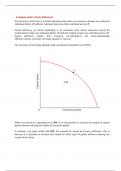
The concept can be simply applied using a production possibility curve (PPC).
When an economy is operating on its PPC, it is not possible to increase the output of capital
goods without reducing the output of consumer goods.
In contrast, any point within the PPC, for example X, would be Pareto inefficient. This is
because it is possible to increase the output of either type of goods without reducing the
output of the other.
An economy is said to be in a Pareto optimum state when no economic changes can make one
individual better off without making at least one other individual worse off.
Pareto efficiency, or Pareto optimality, is an economic state where resources cannot be
reallocated to make one individual better off without making at least one individual worse off.
Pareto efficiency implies that resources are allocated in the most economically
efficient manner, but does not imply equality or fairness.
The concept can be simply applied using a production possibility curve (PPC).
When an economy is operating on its PPC, it is not possible to increase the output of capital
goods without reducing the output of consumer goods.
In contrast, any point within the PPC, for example X, would be Pareto inefficient. This is
because it is possible to increase the output of either type of goods without reducing the
output of the other.


