Remedies for misrepresentation
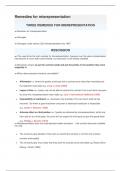
THREE REMEDIES FOR MISREPRESENTATION
⇒ Rescision for misrepresentation
⇒ Damages
⇒ Damages under section 2(2) Misrepresentation Act 1967
RESCISSION
⇒ This used to be the main remedy for misrepresentation, however over the years compensation
has become a much wider used remedy, but rescission is still widely available
⇒ Rescission means to put the contract aside and put the parties in the position they were
originally in
⇒ When does rescission become unavailable?
• Affirmation i.e. where the parties continues with a contract even after they know/discover
the statement was false e.g. Long v Lloyd [1958]
• Lapse of time i.e. a party may not be able to rescind the contract if too much time has gone
by since the misrepresentation was made e.g. Leaf v International Galleries [1950]
• Impossibility of restitution i.e. rescission only possible if ‘he can return what he has
received’. So where a good had been consumer or destroyed restitution is impossible
e.g. Clarke v Dickson (1858)
• Adverse effect on third parties i.e. if goods are obtained by misrepresentation, which are
then sold on to a third party, the court will not expect the third party to give the goods back
e.g. Phillips v Brooks [1919]
⇒ Misrepresentation does not automatically enable rescission → the contract becomes voidable
not void
• The innocent party decides if they wish to rescind the contract, if not then the contract
remains enforceable
• The innocent party must notify that they wish the contract to be rescinded e.g. Reese Silver
Mining v Smith (1869)
THREE REMEDIES FOR MISREPRESENTATION
⇒ Rescision for misrepresentation
⇒ Damages
⇒ Damages under section 2(2) Misrepresentation Act 1967
RESCISSION
⇒ This used to be the main remedy for misrepresentation, however over the years compensation
has become a much wider used remedy, but rescission is still widely available
⇒ Rescission means to put the contract aside and put the parties in the position they were
originally in
⇒ When does rescission become unavailable?
• Affirmation i.e. where the parties continues with a contract even after they know/discover
the statement was false e.g. Long v Lloyd [1958]
• Lapse of time i.e. a party may not be able to rescind the contract if too much time has gone
by since the misrepresentation was made e.g. Leaf v International Galleries [1950]
• Impossibility of restitution i.e. rescission only possible if ‘he can return what he has
received’. So where a good had been consumer or destroyed restitution is impossible
e.g. Clarke v Dickson (1858)
• Adverse effect on third parties i.e. if goods are obtained by misrepresentation, which are
then sold on to a third party, the court will not expect the third party to give the goods back
e.g. Phillips v Brooks [1919]
⇒ Misrepresentation does not automatically enable rescission → the contract becomes voidable
not void
• The innocent party decides if they wish to rescind the contract, if not then the contract
remains enforceable
• The innocent party must notify that they wish the contract to be rescinded e.g. Reese Silver
Mining v Smith (1869)