

100% satisfaction guarantee Immediately available after payment Both online and in PDF No strings attached 4.6 TrustPilot
logo-home
Exam (elaborations)

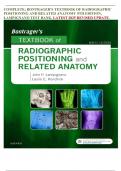
COMPLETE; BONTRAGER'S TEXTBOOK OF RADIOGRAPHIC POSITIONING AND RELATED ANATOMY 9TH EDITION, LAMPIGNANO TEST BANK. LATEST 2025 REVISED UPDATE.

Rating
-
Sold
-
Pages
442
Grade
A+
Uploaded on
01-08-2025
Written in
2025/2026

COMPLETE; BONTRAGER'S TEXTBOOK OF RADIOGRAPHIC POSITIONING AND RELATED ANATOMY 9TH EDITION, LAMPIGNANO TEST BANK. LATEST 2025 REVISED UPDATE. Table of Contents: Chapter 1. Terminology, Imaging and Positioning Principles Chapter 2. Chest Chapter 3. Abdomen Chapter 4. Upper Limb Chapter 5. Humerus and Shoulder Girdle Chapter 6. Lower Limb Chapter 7. Femur and Pelvic Girdle Chapter 8. Cervical and Thoracic Spine Chapter 9. Lumbar Spine, Sacrum, and Coccyx Chapter 10. Bony Thorax — Sternum and Ribs Chapter 11. Cranium, Facial Bones, and Paranasal Sinuses Chapter 12. Biliary Tract and Upper Gastrointestinal System Chapter 13. Lower Gastrointestinal System Chapter 14. Urinary System and Venipuncture Chapter 15. Trauma, Mobile, and Surgical Radiography Chapter 16. Pediatric Radiography Chapter 17. Angiography and Interventional Procedures Chapter 18. Computed Tomography Chapter 19. Special Radiographic Procedures Chapter 20. Diagnostic and Therapeutic Modalities Chapter 01: Terminology, Positioning, and Imaging Principles Lampignano: Bontrager’s Textbook of Radiographic Positioning and Related Anatomy, 9th Edition MULTIPLE CHOICE 1. What type of tissue binds together and supports the various structures of the body? a. Epithelial b. Connective c. Muscular d. Nervous CORRECT: B REF: 3 2. The lowest level of structural organization in the human body is the level. a. molecular b. cellular c. chemical d. atomic ANS: D REF: 4 3. What type of tissue covers internal and external surfaces of the body? a. Muscular b. Connective c. Nervous d. Epithelial CORRECT: D REF: 3 4. How many individual body systems comprise the human body? a. 22 b. 13 c. 10 d. 8 CORRECT: C REF: 3 5. How many separate bones are found in the adult human body? a. 181 b. 215 c. 206 d. 236 CORRECT: C REF: 4 6. Which system of the human body is responsible for the elimination of solid waste? a. Circulatory b. Respiratory c. Urinary d. Digest ANS: C REF: 3 7. Which of the following systems of the human body includes all ductless glands of the body? a. Endocrine b. Integumentary c. Muscular d. Glandular CORRECT: A REF: 6 8. Which of the following body systems helps to regulate body temperature? a. Circulatory b. Urinary c. Endocrine d. Nervous CORRECT: A REF: 7 9. Which of the following bones is part of the axial skeleton? a. Radius b. Hip bone c. Clavicle d. Sternum CORRECT: D REF: 7 10. How many bones are there in the adult axial skeleton? a. 206 b. 80 c. 54 d. 126 CORRECT: B REF: 7 11. What is the name of the small oval-shaped bone found in tendons? a. Wormian b. Tendinous c. Irregular d. Sesamoid CORRECT: D REF: 8 12. Which of the following bones is classified as a long bone? a. Carpal bone b. Scapula c. Cranium d. Humerus CORRECT: D REF: 8 13. What is the name of the dense fibrous membrane that covers bone? a. Cancellous portion b. Periosteum c. Diploë d. Medullary portion B REF: 9 14. Which of the following bones is classified as a short bone? a. Vertebrae b. Phalanges (toes) c. Scapulae d. Carpal (wrist bones) CORRECT: D REF: 9 15. Which of the following is a secondary growth center for endochondral ossification? a. Diaphysis b. Epiphyses c. Metaphysis d. Articular cartilage CORRECT: B REF: 10 16. Which aspect of the long bones is responsible for the production of red blood cells? a. Compact bone b. Periosteum c. Medullary cavity d. Spongy or cancellous bone CORRECT: D REF: 10 17. Examples of “flat” bones are the: a. calvaria, ribs, scapulae, and sternum. b. ribs, sternum, patella, and ilia of pelvis. c. sternum, scapulae, ilia of pelvis, and base of cranium. d. sternum and ilia of pelvis only. CORRECT: A REF: 9 18. What is the primary center for bone growth termed? a. Epiphyses b. Diaphysis c. Metaphysis d. Epiphyseal plate CORRECT: B REF: 10 19. Which of the following is NOT a functional classification of joints? a. Synarthrosis b. Amphiarthrosis c. Cartilaginous d. Diarthrosis CORRECT: C REF: 11 20. The structural term for a freely movable joint is: a. fibrous. b. cartilaginous. c. synovial. d. gomphosis. CORRECT: C REF: 11 21. Which of the following joints displays flexion and extension type of movement primarily? a. Pivot b. Ellipsoidal c. Saddle d. Ginglymus CORRECT: D REF: 13 22. Which of the following joints is NOT a synovial joint? a. Skull suture b. Elbow joint c. Hip joint d. Proximal radioulnar joint CORRECT: A REF: 12 |14 23. Which of the following is classified as a saddle (sellar) joint? a. Ankle joint b. Temporomandibular joint c. Knee joint d. Intercarpal joint CORRECT: A REF: 13 24. Which of the following is classified as a bicondylar joint? a. Shoulder joint b. Temporomandibular joint c. First and second cervical vertebra joint d. Distal radioulnar joint CORRECT: B REF: 14 25. An upright position with the arms abducted, palms forward, and head forward describes the position. a. anteroposterior (AP) b. decubitus c. anatomic d. oblique CORRECT: C REF: 10 26. A representation of the patient’s anatomic structures that can be obtained, viewed, manipulated, and stored digitally is the definition for: a. radiography. radiographic image. radiographic examination. C REF: 16 radiographic film. 27. The vertical plane that divides the body into equal right and left halves describes the plane. a. coronal b. median or midsagittal c. longitudinal d. horizontal CORRECT: B REF: 17 28. A longitudinal plane that divides the body into equal anterior and posterior parts is the plane. a. midcoronal b. midsagittal c. horizontal d. oblique CORRECT: A REF: 17 29. Which of the following terms describes the sole of the foot? a. Palmar b. Dorsum c. Volar d. Plantar CORRECT: D REF: 18 30. Which term describes the back or posterior aspect of the hand? a. Dorsum pedis b. Dorsum manus c. Palmar d. Volar CORRECT: B REF: 18 31. A position in which the head is lower than the feet is: a. Trendelenburg. b. lithotomy. c. Fowler. d. recumbent. CORRECT: A REF: 20 32. Which term describes lying down in any position? a. Horizontal b. Fowler c. Recumbent d. Anatomic CORRECT: C REF: 20 33. A recumbent oblique position in which the patient is lying on the left anterior surface with it rotated toward the image receptor is termed: a. right posterior oblique. b. left posterior oblique. c. Sims’ position. d. Fowler position. CORRECT: C REF: 21 34. A patient is lying on her back facing the x-ray tube. The right side of her body is turned 20° toward the image receptor. What is this radiographic position? a. LPO (left posterior oblique) b. RPO (right posterior oblique) c. RAO (right anterior oblique) d. LAO (left anterior oblique) CORRECT: B REF: 21 35. A patient is erect with the left side directly against the image receptor. The central ray (CR) enters the right side of the body. What is this radiographic position? a. Right lateral b. Left lateral decubitus c. Left lateral d. Dorsal decubitus CORRECT: C REF: 21 36. A patient is lying on her back. The x-ray tube is horizontally directed with the CR entering the right side of the body. The image receptor is adjacent to the left side of the body. What is the radiographic position? a. Left lateral decubitus b. Left lateral c. Right lateral decubitus d. Dorsal decubitus CORRECT: D REF: 22 37. A patient is erect facing the image receptor. The left side of the body is turned 45° toward the image receptor. The CR enters the posterior aspect of the body and exits the anterior. What is this radiographic position? a. LAO b. LPO c. Left lateral d. Posteroanterior (PA) CORRECT: A REF: 21

Show more Read less
Institution
BONTRAGER\\\'S TEXTBOOK OF RADIOGRAPHIC POSITIONING
Course
BONTRAGER\\\'S TEXTBOOK OF RADIOGRAPHIC POSITIONING

Content preview

COMPLETE; BONTRAGER'S TEXTBOOK OF RADIOGRAPHIC
POSITIONING AND RELATED ANATOMY 9TH EDITION,
LAMPIGNANO TEST BANK. LATEST 2025 REVISED UPDATE.

,Table of Contents:
Chapter 1. Terminology, Imaging and Positioning Principles
Chapter 2. Chest
Chapter 3. Abdomen
Chapter 4. Upper Limb
Chapter 5. Humerus and Shoulder Girdle
Chapter 6. Lower Limb
Chapter 7. Femur and Pelvic Girdle
Chapter 8. Cervical and Thoracic Spine
Chapter 9. Lumbar Spine, Sacrum, and Coccyx
Chapter 10. Bony Thorax — Sternum and Ribs
Chapter 11. Cranium, Facial Bones, and Paranasal Sinuses
Chapter 12. Biliary Tract and Upper Gastrointestinal System
Chapter 13. Lower Gastrointestinal System
Chapter 14. Urinary System and Venipuncture
Chapter 15. Trauma, Mobile, and Surgical Radiography
Chapter 16. Pediatric Radiography
Chapter 17. Angiography and Interventional Procedures
Chapter 18. Computed Tomography
Chapter 19. Special Radiographic Procedures
Chapter 20. Diagnostic and Therapeutic Modalities

,Chapter 01: Terminology, Positioning, and Imaging
Principles Lampignano: Bontrager’s Textbook of
Radiographic Positioning and Related Anatomy, 9th Edition

MULTIPLE CHOICE

1. What type of tissue binds together and supports the various structures of the body?
a. Epithelial
b. Connective
c. Muscular
d. Nervous

CORRECT: B REF: 3

2. The lowest level of structural organization in the human body is the level.
a. molecular
b. cellular
c. chemical
d. atomic

, ANS: D REF: 4

3. What type of tissue covers internal and external surfaces of the body?
a. Muscular
b. Connective
c. Nervous
d. Epithelial

CORRECT: D REF: 3


4. How many individual body systems comprise the human body?
a. 22
b. 13
c. 10
d. 8


CORRECT: C REF: 3


5. How many separate bones are found in the adult human body?
a. 181
b. 215
c. 206
d. 236


CORRECT: C REF: 4


6. Which system of the human body is responsible for the elimination of solid
waste? a. Circulatory
b. Respiratory
c. Urinary
d. Digest


Written for

Institution
BONTRAGER\\\'S TEXTBOOK OF RADIOGRAPHIC POSITIONING
Course
BONTRAGER\\\'S TEXTBOOK OF RADIOGRAPHIC POSITIONING

Document information

Uploaded on
August 1, 2025
Number of pages
442
Written in
2025/2026
Type
Exam (elaborations)
Contains
Questions & answers

Subjects

Get to know the seller

Seller avatar
Reputation scores are based on the amount of documents a seller has sold for a fee and the reviews they have received for those documents. There are three levels: Bronze, Silver and Gold. The better the reputation, the more your can rely on the quality of the sellers work.
Studycart Chamberlain College Of Nursing
View profile
Follow You need to be logged in order to follow users or courses
Sold
22
Member since
2 year
Number of followers
7
Documents
164
Last sold
2 days ago
Edustation

Offering a wide range of educational resources, including testbanks, answered exams, studyguides, summary notes, casestudies and other digital materials. Our study materials are a curated selection of essential and comprehensive study materials. We aim to provide clients with convenient access to academic materials to support their learning journey. Browse purchase and download resources seamlessly to enhance your educational experience . Kindly rate our documents and give remarks to help other clients benefit from the documents. Success in your educational journey.

Read more Read less
3.3

3 reviews

5
1
4
1
3
0
2
0
1
1

Recently viewed by you

Why students choose Stuvia

Created by fellow students, verified by reviews

Quality you can trust: written by students who passed their tests and reviewed by others who've used these notes.

Didn't get what you expected? Choose another document

No worries! You can instantly pick a different document that better fits what you're looking for.

Pay as you like, start learning right away

No subscription, no commitments. Pay the way you're used to via credit card and download your PDF document instantly.

Student with book image

“Bought, downloaded, and aced it. It really can be that simple.”

Alisha Student

Frequently asked questions
