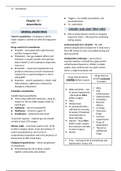
15 – Anaesthesia
Triggers = by volatile anaesthetics and
Chapter 15 – suxamethonium.
Anaesthesia Tx = dantrolene
SURGERY AND LONG-TERM MEDS
GENERAL ANAESTHESIA
Risk of losing disease control on stopping
Total IV anaesthesia = technique in which long-term meds > risk posed by continuing
major surgery is carried out with all drugs given during surgery
via IV.
Corticosteroids (incl. inhaled) – Pts with
Drugs used for IV anaesthesia adrenal atrophy due to long-term Tx may have a
Propofol – associated with rapid recovery fall in BP unless CS cover is provided during and
and less hangover effect post-op period.
Thiopental – has no analgesic effects and
induction is usually smooth and rapid but Antiplatelets/anticoags – assess risk to
dose-related CV and respiratory depression consider whether it should be replaced with
may occur unfractionated heparin or LMWH. In stable
Etomidate – causes less hypotension but angina, only continue peri-op aspirin where
produces extraneous muscle movements there’s a high thrombotic risk
(reduced by an opioid analgesic or short-
Drugs that are
acting BZP) Drugs that should be
usually continued
Ketamine – used in paediatrics. Linked with STOPPED before surgery
in surgery
hallucinations, nightmares (reduced by
diazepam, midazolam)
AEDs
ARBs and ACEIs – risk
Inhalation anaesthetics: Anti-
of severe hypotension
parkinsonians
Volatile liquid anaesthetics - discontinue 24hrs
Antipsychotics
Given using calibrated vaporisers, using air, before surgery
Anxiolytics
oxygen or nitrous oxide-oxygen masks as COCs
Broncho-
carried gas Herbal meds
dilators
K+ sparing diuretics –
Isoflurane – risk of increased HR CV drugs
withhold on morning
Desflurane – irritant to upper RT Glaucoma
of surgery if impaired
Sevoflurane – potent but slow onset drugs
renal perfusion or
Immuno-
To prevent hypoxia – inspired gas mix should tissue damage
suppressants
contain at least 25% oxygen Lithium – stop 24hrs
Drugs of
before major surgery
Nitrous oxide – commonly used in conc. of 50 dependence
but continue normally
Thyroid or
to 66% in oxygen. Alone, it has low potency. If in minor surgery
antithyroid
used in pneumothorax, due to risk of MAOIs
drugs
compromised respiration and in the presence of
intracranial air after head injury
TCAs – increased risk of arrhythmias and
Malignant hyperthermia – lethal complication hypotension. Assess risk.
of anaesthesia
Characterised by rise in temp, muscle
rigidity, tachycardia and acidosis.
Triggers = by volatile anaesthetics and
Chapter 15 – suxamethonium.
Anaesthesia Tx = dantrolene
SURGERY AND LONG-TERM MEDS
GENERAL ANAESTHESIA
Risk of losing disease control on stopping
Total IV anaesthesia = technique in which long-term meds > risk posed by continuing
major surgery is carried out with all drugs given during surgery
via IV.
Corticosteroids (incl. inhaled) – Pts with
Drugs used for IV anaesthesia adrenal atrophy due to long-term Tx may have a
Propofol – associated with rapid recovery fall in BP unless CS cover is provided during and
and less hangover effect post-op period.
Thiopental – has no analgesic effects and
induction is usually smooth and rapid but Antiplatelets/anticoags – assess risk to
dose-related CV and respiratory depression consider whether it should be replaced with
may occur unfractionated heparin or LMWH. In stable
Etomidate – causes less hypotension but angina, only continue peri-op aspirin where
produces extraneous muscle movements there’s a high thrombotic risk
(reduced by an opioid analgesic or short-
Drugs that are
acting BZP) Drugs that should be
usually continued
Ketamine – used in paediatrics. Linked with STOPPED before surgery
in surgery
hallucinations, nightmares (reduced by
diazepam, midazolam)
AEDs
ARBs and ACEIs – risk
Inhalation anaesthetics: Anti-
of severe hypotension
parkinsonians
Volatile liquid anaesthetics - discontinue 24hrs
Antipsychotics
Given using calibrated vaporisers, using air, before surgery
Anxiolytics
oxygen or nitrous oxide-oxygen masks as COCs
Broncho-
carried gas Herbal meds
dilators
K+ sparing diuretics –
Isoflurane – risk of increased HR CV drugs
withhold on morning
Desflurane – irritant to upper RT Glaucoma
of surgery if impaired
Sevoflurane – potent but slow onset drugs
renal perfusion or
Immuno-
To prevent hypoxia – inspired gas mix should tissue damage
suppressants
contain at least 25% oxygen Lithium – stop 24hrs
Drugs of
before major surgery
Nitrous oxide – commonly used in conc. of 50 dependence
but continue normally
Thyroid or
to 66% in oxygen. Alone, it has low potency. If in minor surgery
antithyroid
used in pneumothorax, due to risk of MAOIs
drugs
compromised respiration and in the presence of
intracranial air after head injury
TCAs – increased risk of arrhythmias and
Malignant hyperthermia – lethal complication hypotension. Assess risk.
of anaesthesia
Characterised by rise in temp, muscle
rigidity, tachycardia and acidosis.