NCTRC Exam #2 Questions & Answers.
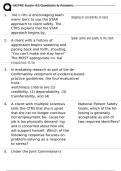
1. The CTRS is encouraging team
Stopping to concentrate on tacks
mem- bers to use the STAR
approach to client safety. The
CTRS explains that the STAR
approach begins by,
Speak calmly and quietly to the client
2. A client with a history of
aggression begins swearing and
pacing back and forth, shouting,
"You can't make me stay here!"
The MOST appropriate ini- tial
response is to
3. In evaluating research as part of the de-
Confirmability velopment of evidence-based
practice guidelines, the four evaluative/
trust-
worthiness criteria are (1)
credibility, (2) dependability, (3)
transferability, and (4)
4. A client with multiple sclerosis National Patient Safety
tells the CTRS that she is upset Goals, which of the fol-
that she can no longer continue lowing is generally
her employment be- cause her acceptable as one of
job is too physically demand- ing two required identifiers?
and is concerned about how she
will support herself. Which of the
following response focuses on
problem-solving as a response
to stress?
5. Under the Joint Commission's
1/
43
, NCTRC Exam #2 Questions & Answers.
"What plans do you have for finding a new job?"
Date of Birth
6. Dancing or skating
2/
43
, NCTRC Exam #2 Questions & Answers.
When advising parents about age- ap- first step to reading
propriate exercise for a 4-year-old crucially should be to
child about the be discharged
from the hospital after treatment 12. The three primary
for diabetes, which of the elements of motiva-
following activities is MOST tional interviewing are
appropriate?
7. Using the average cost of a
problem and the cost of
intervention to demon- strate is
an
8. What are the 5 Stages of
Substance Abuse
9. Which of the following
characteristics indicate that a
dog is likely well suited to be a
therapy dog?
10. If, when utilizing the Plan Do Study
Act (PDSA) method of
continuous quality improvement,
study of the outcomes of a trial
indicates that the solution that
was instituted was not effective,
the next step is to
11. When reviewing a number of
articles as part of the
development of evi- dence-
based practice guidelines, the
3/
43
, NCTRC Exam #2 Questions & Answers.
st-Benefit Analysis
perimentation, Regular Use, Problem Use, De- pendence,
Addiction
mains confident in ditterent environments
turn to the Plan Step
onsider the source
llaboration, Evocation, and Autonomy
4/
43
1. The CTRS is encouraging team
Stopping to concentrate on tacks
mem- bers to use the STAR
approach to client safety. The
CTRS explains that the STAR
approach begins by,
Speak calmly and quietly to the client
2. A client with a history of
aggression begins swearing and
pacing back and forth, shouting,
"You can't make me stay here!"
The MOST appropriate ini- tial
response is to
3. In evaluating research as part of the de-
Confirmability velopment of evidence-based
practice guidelines, the four evaluative/
trust-
worthiness criteria are (1)
credibility, (2) dependability, (3)
transferability, and (4)
4. A client with multiple sclerosis National Patient Safety
tells the CTRS that she is upset Goals, which of the fol-
that she can no longer continue lowing is generally
her employment be- cause her acceptable as one of
job is too physically demand- ing two required identifiers?
and is concerned about how she
will support herself. Which of the
following response focuses on
problem-solving as a response
to stress?
5. Under the Joint Commission's
1/
43
, NCTRC Exam #2 Questions & Answers.
"What plans do you have for finding a new job?"
Date of Birth
6. Dancing or skating
2/
43
, NCTRC Exam #2 Questions & Answers.
When advising parents about age- ap- first step to reading
propriate exercise for a 4-year-old crucially should be to
child about the be discharged
from the hospital after treatment 12. The three primary
for diabetes, which of the elements of motiva-
following activities is MOST tional interviewing are
appropriate?
7. Using the average cost of a
problem and the cost of
intervention to demon- strate is
an
8. What are the 5 Stages of
Substance Abuse
9. Which of the following
characteristics indicate that a
dog is likely well suited to be a
therapy dog?
10. If, when utilizing the Plan Do Study
Act (PDSA) method of
continuous quality improvement,
study of the outcomes of a trial
indicates that the solution that
was instituted was not effective,
the next step is to
11. When reviewing a number of
articles as part of the
development of evi- dence-
based practice guidelines, the
3/
43
, NCTRC Exam #2 Questions & Answers.
st-Benefit Analysis
perimentation, Regular Use, Problem Use, De- pendence,
Addiction
mains confident in ditterent environments
turn to the Plan Step
onsider the source
llaboration, Evocation, and Autonomy
4/
43