EAPS 105 Homework & Quiz 4 , 5, and 6 (exam
2) well answered already passed
b. 0 K
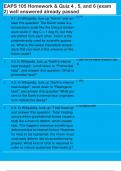
1. 4.1. In Wikipedia, look up "Kelvin" and an-
swer this question: The Kelvin scale is a
temperature scale like the Celsius temper-
ature scale (1 deg C = 1 deg K), but they
are shifted from each other. Kelvin is the
predominantly used for scientific purpos-
es. What is the lowest theoretical temper-
ature that can exist in the universe on the
Kelvin scale?
a. Heat from the original formation of plan-
2. 4.2. In Wikipedia, look up "Earth's internal
et.
heat budget", scroll down to "Primordial
heat", and answer this question: What is
primordial heat?
c. 50%
3. 4.3. In Wikipedia, look up "Earth's internal
heat budget", scroll down to "Radiogenic
heat", and answer this question: What per-
cent of the Earth's internal heat originates
from radioactive decay?
b. An elliptical orbit
4. 4.4. In Wikipedia, look up "Tidal heating"
and answer this question: Tidal heating
occurs when gravitational forces cause a
body like a moon to deform, which creates
heat. This happens whenever something is
deformed due to internal friction. However,
for heat to be sustained, the moon must
continually deform, like an accordion being
played. What kind of orbit is required in
order to induce sustained tidal heating?
,EAPS 105 Homework & Quiz 4 , 5, and 6 (exam
2) well answered already passed
5. 4.5. In Wikipedia, look up "Earth's internal c. Volcanism
heat budget", scroll down to "Heat flow and
tectonic plates", and answer this question:
What is the primary means with which bod-
ies with high internal heat, such as Io, get
rid of their internal heat?
6. 4.6. In Wikipedia, look up "Thermal conduc- c. By microscopic collisions of particles
tion" and answer this question: How is heat within the body.
transferred though conduction?
7. 4.7. In Wikipedia, look up "Convection (heat b. By movement of fluids
transfer)" and answer this question: How is
heat transferred through convection?
8. 4.8. In Wikipedia, look up "Mantle (geolo- a. A layer inside a planetary body bounded
gy)" and answer this question: What is a below by a core and above by a crust.
mantle?
9. 4.9. In Wikipedia, look up "Lithosphere" b. The rigid, outermost shell of a terrestri-
and answer this question: What is lithos- al-type planet or natural satellite
phere?
10. 4.10. In Wikipedia, look up "Asthenos- c. The viscous, mechanically weak, and
phere" and answer this question: What is ductile region of the upper mantle.
asthenosphere?
11. 4.11. In Wikipedia, look up "Mantle convec- b. The very slow creeping motion of man-
tion" and answer this question: What is a tle caused by convection currents carrying
mantle convection? heat from the interior to the planet's sur-
face.
,EAPS 105 Homework & Quiz 4 , 5, and 6 (exam
2) well answered already passed
12. a. Plate tectonics
, EAPS 105 Homework & Quiz 4 , 5, and 6 (exam
2) well answered already passed
4.12. In Wikipedia, look up "Earth's internal
heat budget", scroll down to "Heat flow and
tectonic plates", and answer this question:
What is the primary means with which bod-
ies with intermediate internal heat, such
as the Earth, get rid of their internal heat
(don't concern yourself with a very young
Earth)?
13. 4.13. In Wikipedia, look up "Mid-ocean a. It is where seafloor spreading takes
ridge" and answer this question: What is a place along a divergent plate boundary.
mid-ocean ridge?
14. 4.14. In Wikipedia, look up "Subduction" c. It is where oceanic lithosphere is recy-
and answer this question: What is a sub- cled into the Earth's mantle at convergent
duction? boundaries.
15. 4.15. In Wikipedia, look up "Earth's internal b. Conduction through a single lithospher-
heat budget", scroll down to "Heat flow and ic plate
tectonic plates", and answer this question:
What is the primary means with which bod-
ies with lower internal heat, such as the
Moon and Mars, get rid of their internal
heat?
16. 4.16. In Wikipedia, look up "Dynamo the- d. The process through which a rotating,
ory" and answer this question: What is a convecting, and electrically conducting flu-
dynamo? id can maintain a magnetic field over as-
tronomical time scales.
17. 4.17. In Wikipedia, look up "Earth's mag- c. The liquid outer core
netic field" and answer this question: In
2) well answered already passed
b. 0 K
1. 4.1. In Wikipedia, look up "Kelvin" and an-
swer this question: The Kelvin scale is a
temperature scale like the Celsius temper-
ature scale (1 deg C = 1 deg K), but they
are shifted from each other. Kelvin is the
predominantly used for scientific purpos-
es. What is the lowest theoretical temper-
ature that can exist in the universe on the
Kelvin scale?
a. Heat from the original formation of plan-
2. 4.2. In Wikipedia, look up "Earth's internal
et.
heat budget", scroll down to "Primordial
heat", and answer this question: What is
primordial heat?
c. 50%
3. 4.3. In Wikipedia, look up "Earth's internal
heat budget", scroll down to "Radiogenic
heat", and answer this question: What per-
cent of the Earth's internal heat originates
from radioactive decay?
b. An elliptical orbit
4. 4.4. In Wikipedia, look up "Tidal heating"
and answer this question: Tidal heating
occurs when gravitational forces cause a
body like a moon to deform, which creates
heat. This happens whenever something is
deformed due to internal friction. However,
for heat to be sustained, the moon must
continually deform, like an accordion being
played. What kind of orbit is required in
order to induce sustained tidal heating?
,EAPS 105 Homework & Quiz 4 , 5, and 6 (exam
2) well answered already passed
5. 4.5. In Wikipedia, look up "Earth's internal c. Volcanism
heat budget", scroll down to "Heat flow and
tectonic plates", and answer this question:
What is the primary means with which bod-
ies with high internal heat, such as Io, get
rid of their internal heat?
6. 4.6. In Wikipedia, look up "Thermal conduc- c. By microscopic collisions of particles
tion" and answer this question: How is heat within the body.
transferred though conduction?
7. 4.7. In Wikipedia, look up "Convection (heat b. By movement of fluids
transfer)" and answer this question: How is
heat transferred through convection?
8. 4.8. In Wikipedia, look up "Mantle (geolo- a. A layer inside a planetary body bounded
gy)" and answer this question: What is a below by a core and above by a crust.
mantle?
9. 4.9. In Wikipedia, look up "Lithosphere" b. The rigid, outermost shell of a terrestri-
and answer this question: What is lithos- al-type planet or natural satellite
phere?
10. 4.10. In Wikipedia, look up "Asthenos- c. The viscous, mechanically weak, and
phere" and answer this question: What is ductile region of the upper mantle.
asthenosphere?
11. 4.11. In Wikipedia, look up "Mantle convec- b. The very slow creeping motion of man-
tion" and answer this question: What is a tle caused by convection currents carrying
mantle convection? heat from the interior to the planet's sur-
face.
,EAPS 105 Homework & Quiz 4 , 5, and 6 (exam
2) well answered already passed
12. a. Plate tectonics
, EAPS 105 Homework & Quiz 4 , 5, and 6 (exam
2) well answered already passed
4.12. In Wikipedia, look up "Earth's internal
heat budget", scroll down to "Heat flow and
tectonic plates", and answer this question:
What is the primary means with which bod-
ies with intermediate internal heat, such
as the Earth, get rid of their internal heat
(don't concern yourself with a very young
Earth)?
13. 4.13. In Wikipedia, look up "Mid-ocean a. It is where seafloor spreading takes
ridge" and answer this question: What is a place along a divergent plate boundary.
mid-ocean ridge?
14. 4.14. In Wikipedia, look up "Subduction" c. It is where oceanic lithosphere is recy-
and answer this question: What is a sub- cled into the Earth's mantle at convergent
duction? boundaries.
15. 4.15. In Wikipedia, look up "Earth's internal b. Conduction through a single lithospher-
heat budget", scroll down to "Heat flow and ic plate
tectonic plates", and answer this question:
What is the primary means with which bod-
ies with lower internal heat, such as the
Moon and Mars, get rid of their internal
heat?
16. 4.16. In Wikipedia, look up "Dynamo the- d. The process through which a rotating,
ory" and answer this question: What is a convecting, and electrically conducting flu-
dynamo? id can maintain a magnetic field over as-
tronomical time scales.
17. 4.17. In Wikipedia, look up "Earth's mag- c. The liquid outer core
netic field" and answer this question: In