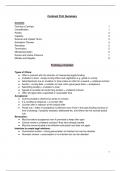
Contract FLK Summary
Contents
Forming a Contract 1
Consideration 1
Parties 2
Capacity 2
Express and Implied Terms 3
Exemption Clauses 4
Remedies 5
Termination 5
Misrepresentation 6
Duress and Undue Influence 7
Mistake and Illegality 8
Forming a Contract
Types of Offers:
● Offer to contract with the intention of it becoming legally binding
● Invitation to treat - simply inviting offers and negotiation e.g. goods in a shop
● Advertisements are an invitation to treat unless an offer for a reward = unilateral contract
● Auction - inviting bids = invitation to treat, when gavel goes down = acceptance
● Submitting tenders = invitation to treat
● Agreed to consider all conforming tenders = unilateral contract
● Offer will lapse after a specified or reasonable time
Acceptance:
● Communicated to offerree by words or conduct
● If a conditional response = a counter offer
● Counter offer is rejection of the original offer
● Postal rule = letter of acceptance is effective even if lost in the post (binding contract at
time of posting), if properly stamped, addressed etc. and offeror did not exclude postal
rule
Revocation:
● Must be before acceptance even if promised to keep offer open
● Cannot revoke a unilateral contract if they have already started
● Must be communicated to be effective and postal rule does not apply
Intention to create legal relations:
● Commercial context = strong presumption of intention but can be rebutted
● Domestic context = presumption of no intention but can be rebutted
1
, Consideration
Types of consideration:
● Give something in return for a promise
● Value of consideration is irrelevant and does not need to be equivalent
● Refraining from doing something is not consideration
● If someone does something and is offered payment after = not sufficient consideration
unless:
○ Act done at promisors request
○ Mutual understanding they would be compensated
○ If made in advance, would have been legally enforceable
Varying a contract:
● Need agreement, consideration and intention to create legal relations
● Performing an existing contractual duty is not adequate consideration in exchange for
more money unless they exceeded their contractual duty or the promisee conferred a
practical benefit
● If a creditor and debtor agree part payment = not binding unless confer practical benefit
Promissory estoppel:
● Can’t go back on promise as it would be unfair due to the circumstances - a promise not
to enforce legal rights
● When a promisor has made a promise to a promisee who then relies on that promise to
his subsequent detriment.
● Reliance was reasonable, and detrimentally relied on it
Parties
● Only parties to the contract are bound by it
● Third parties can have rights if:
○ Contract expressly provides they acquire a benefit
○ Term purports to confer a benefit to them
● Must be intended to be enforceable by a third party
● Must be expressly identified by name or as a member of a class
● Agent must have relevant authority to bind someone to a contract
● Apparent authority:
○ Principal represented by words or conduct that they had authority
○ Third party relies on that representation
○ Third party enters the contract as a result
Capacity
Minors:
● Minors not bound by contracts but the other party is bound
● Unless:
● A contract for necessaries (extends beyond essentials)
2
Contents
Forming a Contract 1
Consideration 1
Parties 2
Capacity 2
Express and Implied Terms 3
Exemption Clauses 4
Remedies 5
Termination 5
Misrepresentation 6
Duress and Undue Influence 7
Mistake and Illegality 8
Forming a Contract
Types of Offers:
● Offer to contract with the intention of it becoming legally binding
● Invitation to treat - simply inviting offers and negotiation e.g. goods in a shop
● Advertisements are an invitation to treat unless an offer for a reward = unilateral contract
● Auction - inviting bids = invitation to treat, when gavel goes down = acceptance
● Submitting tenders = invitation to treat
● Agreed to consider all conforming tenders = unilateral contract
● Offer will lapse after a specified or reasonable time
Acceptance:
● Communicated to offerree by words or conduct
● If a conditional response = a counter offer
● Counter offer is rejection of the original offer
● Postal rule = letter of acceptance is effective even if lost in the post (binding contract at
time of posting), if properly stamped, addressed etc. and offeror did not exclude postal
rule
Revocation:
● Must be before acceptance even if promised to keep offer open
● Cannot revoke a unilateral contract if they have already started
● Must be communicated to be effective and postal rule does not apply
Intention to create legal relations:
● Commercial context = strong presumption of intention but can be rebutted
● Domestic context = presumption of no intention but can be rebutted
1
, Consideration
Types of consideration:
● Give something in return for a promise
● Value of consideration is irrelevant and does not need to be equivalent
● Refraining from doing something is not consideration
● If someone does something and is offered payment after = not sufficient consideration
unless:
○ Act done at promisors request
○ Mutual understanding they would be compensated
○ If made in advance, would have been legally enforceable
Varying a contract:
● Need agreement, consideration and intention to create legal relations
● Performing an existing contractual duty is not adequate consideration in exchange for
more money unless they exceeded their contractual duty or the promisee conferred a
practical benefit
● If a creditor and debtor agree part payment = not binding unless confer practical benefit
Promissory estoppel:
● Can’t go back on promise as it would be unfair due to the circumstances - a promise not
to enforce legal rights
● When a promisor has made a promise to a promisee who then relies on that promise to
his subsequent detriment.
● Reliance was reasonable, and detrimentally relied on it
Parties
● Only parties to the contract are bound by it
● Third parties can have rights if:
○ Contract expressly provides they acquire a benefit
○ Term purports to confer a benefit to them
● Must be intended to be enforceable by a third party
● Must be expressly identified by name or as a member of a class
● Agent must have relevant authority to bind someone to a contract
● Apparent authority:
○ Principal represented by words or conduct that they had authority
○ Third party relies on that representation
○ Third party enters the contract as a result
Capacity
Minors:
● Minors not bound by contracts but the other party is bound
● Unless:
● A contract for necessaries (extends beyond essentials)
2