week 9 psych stata 2811 Question and answers verified to pass 2025
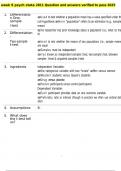
1. Differentiatio
n One- æU s e d to test whether a population mean has a value specified under th
sample null hypothesis æH e r e "population" refers to an estimator (e.g., sample
t-test mean)
æThe researcher has prior knowledge about a population (i.e., what its me
2. Differentiation is)
'
Two-sample æU s e d to test whether the means of two populations (i.e., sample means
t-test are equal
æSamples must be independent
æA l s o known as: independent samples t-test, two-sample t-test, between
samples t-test & unpaired samples t-test
3. Ingredients Independent Variable:
æOne categorical variable with two "levels" æMen versus women
æWestern students versus Queen's students
æDrug versus placebo
æPatient participants versus control participants
Dependent Variable:
æE a c h participant provides data on one outcome variable
æPreferably ratio or interval (though in practice we often use ordinal dat
also)
4. Assumptions 6.
5. What does
the t-test tell
us?
1/
8
, week 9 psych stata 2811 Question and answers verified to pass 2025
Did two samples come
from the same
population or ditterent
populations?
æRemember:
æResearcher has NO
prior knowledge about
the population(s)
æEstimates population
parameters from sample
data
Is the ditterence
between the sample
means indicative of
a real group
ditterence or is it
just sampling
error?
æRemember that
two independent
samples drawn
from the same
population are
unlikely to have
identical means.
æThe ditterence
between the means of
two samples drawn
from the same popula-
tion is "sampling
error"
2/
8
1. Differentiatio
n One- æU s e d to test whether a population mean has a value specified under th
sample null hypothesis æH e r e "population" refers to an estimator (e.g., sample
t-test mean)
æThe researcher has prior knowledge about a population (i.e., what its me
2. Differentiation is)
'
Two-sample æU s e d to test whether the means of two populations (i.e., sample means
t-test are equal
æSamples must be independent
æA l s o known as: independent samples t-test, two-sample t-test, between
samples t-test & unpaired samples t-test
3. Ingredients Independent Variable:
æOne categorical variable with two "levels" æMen versus women
æWestern students versus Queen's students
æDrug versus placebo
æPatient participants versus control participants
Dependent Variable:
æE a c h participant provides data on one outcome variable
æPreferably ratio or interval (though in practice we often use ordinal dat
also)
4. Assumptions 6.
5. What does
the t-test tell
us?
1/
8
, week 9 psych stata 2811 Question and answers verified to pass 2025
Did two samples come
from the same
population or ditterent
populations?
æRemember:
æResearcher has NO
prior knowledge about
the population(s)
æEstimates population
parameters from sample
data
Is the ditterence
between the sample
means indicative of
a real group
ditterence or is it
just sampling
error?
æRemember that
two independent
samples drawn
from the same
population are
unlikely to have
identical means.
æThe ditterence
between the means of
two samples drawn
from the same popula-
tion is "sampling
error"
2/
8