Interaction Design
Year 1 Semester A
Subject & Page
Introduction 2, 3
Persona’s 4
Cardsorting 5
Mockups 6
5 Whys 7
Interviews 8
Contextual Observation 9
10
Low Fidelity prototype
11
Empathic Modelling
12
Affinity Diagramming
13
Brainwriting 635 14
Storyboarding 15
Wireframing 15
Think-Aloud Protocol 16
Usability Testing 17
Difficult words - Highlighted
Page 1
, Introduction
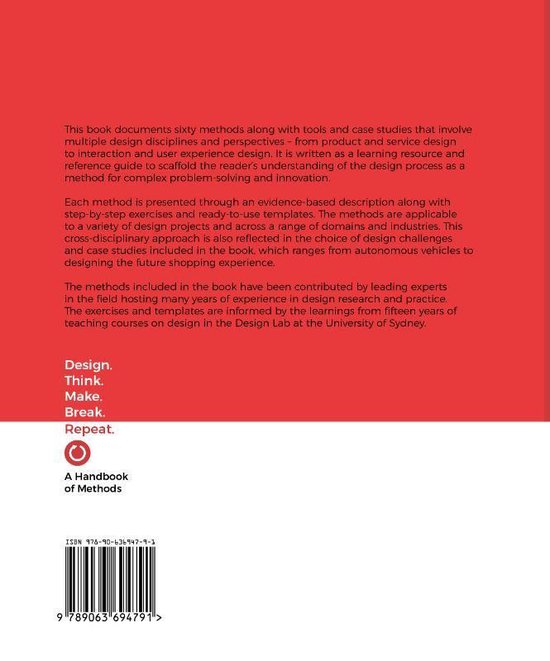
Design requires learning about the context (Think.).
Building prototypes as tangible representations (Make.) and testing the potential
solutions (Break.). By repeating this quicker we can focus on improving it (Repeat.).
Two popular design models that translate the way of “Design thinking” are the
Honeycomb (Stanford Uni)
and Double diamond (UK Design Council)
Page 2
, These models give a clear overview of the following 4 Levels
Level
Craftmanship 1 better construction
Detail Design 2 better appearance
better human factors
better performance
Concept Design 3 better ideas
better integration
better understanding
deeper penetration
broader consideration
better experience
social inclusion
Problem solving 4 intractable human concerns
wicked problems
complex systems
identifying the right problem
Based upon the original diagram by Owen (1990)
Data and ideas are being processed into concepts or prototypes. This becomes a
tangible representation of the solution. This often gets referred to a MVP (Minimal
Viable Product).
According to Eric von Hippel 70/80% of new product developments fail due to failure of
understanding the users’ needs. In order to break a design solution you have to
embrace failure. “kill your darlings” by taking a different perspective and exploring
many approaches rapidly can effectively solve the complex problem.
Next to keeping end consumers (which we refer to as User) in mind while designing,
we should also quite often keep the stakeholders in mind. Stakeholders are invested
or affected by the end product (for instance, making an app on which you can buy
products on which the company also has to deal with it. This makes the people that
have to work with it stakeholders.)
Page 3
, Personas
Personas are fictional characters (people) used to represent a typical user,
customers or other stakeholders. After gathering information of real people that
would or could potentially be these stakeholders, you can distil (filter) information from
all this raw user data that is most pertinent (relevant) to the designing issues.
However avoid idiosyncratic (uncommon and specifically personal) information, this is
misleading to get the a view of the average user. By finding patterns within the raw
user data you can create variables and articulate (express) them into one or more
visually engaging artefacts (such as a diagram).
By using storytelling you can thread together the user’s goals, motivation,
attitudes and behaviours into a unified (joined together) character. This personal
quality allows you to engage socially and emotionally with the needs of the user and to
include their opinion within all phases of the design process. It can also be valuable to
have a non-persona included (a representation of a user who would not engage with
the designed product or service). An important element to keep in mind that however
the personas may contain fictional information it should always represent the user’s
needs.
Persona’s are more tolerant with rough sketches and long design meetings. They
are used to communicate user needs within the design team, troubleshoot design
problems before reaching usability testing and guard against making decision based
upon own preferences and biases (prejudgement).
Page 4
, Cardsorting
Card sorting is a method that allows users and stakeholders to participate in the
design of an information architecture. As the name suggests they get to sort cards,
you can provoke a discussion through this method by giving them tangible cards with
keywords on them.
Through this method you can:
- Discover what information or tasks you should include or exclude
- Discover what terminology (terms) users know this by (what keywords they use)
- Design new ways for this grouping and structuring of information in a product or
service.
These structures are seen in everyday life differnating from a simple clock to your
smartphone. Designers often refer to structuring of content as ‘’Product’s information
architecture”.
Card sorting helps us with understanding our user’s mental model and build
information structures that speak to them. By putting information in certain places,
the user knows where to find it like a good map. As card sorting requires participants to
sort existing topics, it is a method best suited to refining a new concept or redesigning
an existing product.
Page 5
Year 1 Semester A
Subject & Page
Introduction 2, 3
Persona’s 4
Cardsorting 5
Mockups 6
5 Whys 7
Interviews 8
Contextual Observation 9
10
Low Fidelity prototype
11
Empathic Modelling
12
Affinity Diagramming
13
Brainwriting 635 14
Storyboarding 15
Wireframing 15
Think-Aloud Protocol 16
Usability Testing 17
Difficult words - Highlighted
Page 1
, Introduction
Design requires learning about the context (Think.).
Building prototypes as tangible representations (Make.) and testing the potential
solutions (Break.). By repeating this quicker we can focus on improving it (Repeat.).
Two popular design models that translate the way of “Design thinking” are the
Honeycomb (Stanford Uni)
and Double diamond (UK Design Council)
Page 2
, These models give a clear overview of the following 4 Levels
Level
Craftmanship 1 better construction
Detail Design 2 better appearance
better human factors
better performance
Concept Design 3 better ideas
better integration
better understanding
deeper penetration
broader consideration
better experience
social inclusion
Problem solving 4 intractable human concerns
wicked problems
complex systems
identifying the right problem
Based upon the original diagram by Owen (1990)
Data and ideas are being processed into concepts or prototypes. This becomes a
tangible representation of the solution. This often gets referred to a MVP (Minimal
Viable Product).
According to Eric von Hippel 70/80% of new product developments fail due to failure of
understanding the users’ needs. In order to break a design solution you have to
embrace failure. “kill your darlings” by taking a different perspective and exploring
many approaches rapidly can effectively solve the complex problem.
Next to keeping end consumers (which we refer to as User) in mind while designing,
we should also quite often keep the stakeholders in mind. Stakeholders are invested
or affected by the end product (for instance, making an app on which you can buy
products on which the company also has to deal with it. This makes the people that
have to work with it stakeholders.)
Page 3
, Personas
Personas are fictional characters (people) used to represent a typical user,
customers or other stakeholders. After gathering information of real people that
would or could potentially be these stakeholders, you can distil (filter) information from
all this raw user data that is most pertinent (relevant) to the designing issues.
However avoid idiosyncratic (uncommon and specifically personal) information, this is
misleading to get the a view of the average user. By finding patterns within the raw
user data you can create variables and articulate (express) them into one or more
visually engaging artefacts (such as a diagram).
By using storytelling you can thread together the user’s goals, motivation,
attitudes and behaviours into a unified (joined together) character. This personal
quality allows you to engage socially and emotionally with the needs of the user and to
include their opinion within all phases of the design process. It can also be valuable to
have a non-persona included (a representation of a user who would not engage with
the designed product or service). An important element to keep in mind that however
the personas may contain fictional information it should always represent the user’s
needs.
Persona’s are more tolerant with rough sketches and long design meetings. They
are used to communicate user needs within the design team, troubleshoot design
problems before reaching usability testing and guard against making decision based
upon own preferences and biases (prejudgement).
Page 4
, Cardsorting
Card sorting is a method that allows users and stakeholders to participate in the
design of an information architecture. As the name suggests they get to sort cards,
you can provoke a discussion through this method by giving them tangible cards with
keywords on them.
Through this method you can:
- Discover what information or tasks you should include or exclude
- Discover what terminology (terms) users know this by (what keywords they use)
- Design new ways for this grouping and structuring of information in a product or
service.
These structures are seen in everyday life differnating from a simple clock to your
smartphone. Designers often refer to structuring of content as ‘’Product’s information
architecture”.
Card sorting helps us with understanding our user’s mental model and build
information structures that speak to them. By putting information in certain places,
the user knows where to find it like a good map. As card sorting requires participants to
sort existing topics, it is a method best suited to refining a new concept or redesigning
an existing product.
Page 5