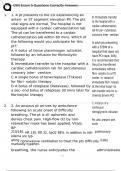
CEN Exam 5 Questions Correctly Answers.
1. 1. A pt presents to the ED experiencing an
B. Immediate transfer
anteri- or ST segment elevation MI. The pts
to the hospital with a
vital signs are normal. The hospital is not
cardiac catheterization
equipped with a cardaic catheterization lab.
lab for per- cutaneous
The pt can be transferred to a cardaic
coronary inter- vention
catheterization lab within 60 mins. Which of
the following would you anticipate for this In adult pts presenting
pt?: with a STEMI of a
A. A bolus of tissue plasminogen activator, hospital that does not
followed by an infusion for fibrinolytic have PCI capa- bility,
therapy it is recommended that
B. Immediate transfer to the hospital with a the pt be transferred
cardiac catheterization lab for percutaneous immediately without
coronary inter- vention fibri- nolytics to a PCI
C. A single bolus of tenecteplase (Tnkase) center, in- stead of
for fibri- nolytic therapy immediate fibri- nolysis
D. A bolus of reteplase (Retavase), followed by at the intial hospi- tal
a sec- ond bolus of reteplase 30 mins later for with transfer onlu for is-
fibrinolytic therapy chemia driven PCI
C. Initation of a
2. 2. An anxious pt arrives by ambulance
continuous
following an acute onset of difficulty nitroglycerin infusion
breathing. The pt is di- aphoretic and
denies chest pain. High-flow O2 by non- Pts who present with
rebreather mask has been applied. Vitals: acute
BP
210/140, HR 130, RR 32, SpO2 88%. In addition to initi- pulmonary
edema are typ-
ating noninvasive ventilation to treat the pts difficulty ically
markedly hyperten-
breathing, the nurse anticipates the administratio
, CEN Exam 5 Questions Correctly Answers.
n of which medication to further treat the sive and in acute
pts symp- toms?: respira- tory distress.
A. Morphine (Morphine sulfate) Rapid initia- tion of
B. Furosemide (Lasix) appropriate treat-
C. Initation of a continuous nitroglycerin ment is vital to
infusion reversing the
D. Acetylsalicylic acid (Aspirin) neurohormonal surge
and rescuing pts from
res- piratory and
complete car- diac
failure. Nitroglycerin
, CEN Exam 5 Questions Correctly Answers.
is the most important
first line medication in
treat- ment of acute
pulmonary edema and
respiratory dis- tress.
The initation of con-
tinuous NTG infusion at
low doses acts as a
vasodila- tor, leading
to decreased preload:
at higher doses
( >100mcg/min) acts as
a potent afterload
reducer
3. 3. An unrestrained driver is brought to the ED follow- B. Cardiac
marker evalua-
ing a motor vehicle collision. The pt reports hitting tion (CK or
Troponin)
their chest on the steering wheel and is complaining
of chest pain across the front of their chest. There are Not all
trauma pts with
no vital sign abnormalities and no other distributi
complaints of pain. The diagnosis of blunt ve
cardiac injury is con- sidered. The nurse shock?:
anticipates an order for which of the A. Neurogeni
following?: c
A. EKG B. Metabolic
B. Cardiac marker evaluation (CK or Troponin) C. Respirator
C. Cardiac monitoring y
D. Chest radiograph D. Obstructi
ve
4. 4. Which of the following is a form of
, CEN Exam 5 Questions Correctly Answers.
blunt cardiac injury will have acute alterations in cardiac markers, and
oth- er organ injury may cause release of creatinine kinase and confound
the diagno- sis of blunt cardiac injury
A. Neurogenic
1. 1. A pt presents to the ED experiencing an
B. Immediate transfer
anteri- or ST segment elevation MI. The pts
to the hospital with a
vital signs are normal. The hospital is not
cardiac catheterization
equipped with a cardaic catheterization lab.
lab for per- cutaneous
The pt can be transferred to a cardaic
coronary inter- vention
catheterization lab within 60 mins. Which of
the following would you anticipate for this In adult pts presenting
pt?: with a STEMI of a
A. A bolus of tissue plasminogen activator, hospital that does not
followed by an infusion for fibrinolytic have PCI capa- bility,
therapy it is recommended that
B. Immediate transfer to the hospital with a the pt be transferred
cardiac catheterization lab for percutaneous immediately without
coronary inter- vention fibri- nolytics to a PCI
C. A single bolus of tenecteplase (Tnkase) center, in- stead of
for fibri- nolytic therapy immediate fibri- nolysis
D. A bolus of reteplase (Retavase), followed by at the intial hospi- tal
a sec- ond bolus of reteplase 30 mins later for with transfer onlu for is-
fibrinolytic therapy chemia driven PCI
C. Initation of a
2. 2. An anxious pt arrives by ambulance
continuous
following an acute onset of difficulty nitroglycerin infusion
breathing. The pt is di- aphoretic and
denies chest pain. High-flow O2 by non- Pts who present with
rebreather mask has been applied. Vitals: acute
BP
210/140, HR 130, RR 32, SpO2 88%. In addition to initi- pulmonary
edema are typ-
ating noninvasive ventilation to treat the pts difficulty ically
markedly hyperten-
breathing, the nurse anticipates the administratio
, CEN Exam 5 Questions Correctly Answers.
n of which medication to further treat the sive and in acute
pts symp- toms?: respira- tory distress.
A. Morphine (Morphine sulfate) Rapid initia- tion of
B. Furosemide (Lasix) appropriate treat-
C. Initation of a continuous nitroglycerin ment is vital to
infusion reversing the
D. Acetylsalicylic acid (Aspirin) neurohormonal surge
and rescuing pts from
res- piratory and
complete car- diac
failure. Nitroglycerin
, CEN Exam 5 Questions Correctly Answers.
is the most important
first line medication in
treat- ment of acute
pulmonary edema and
respiratory dis- tress.
The initation of con-
tinuous NTG infusion at
low doses acts as a
vasodila- tor, leading
to decreased preload:
at higher doses
( >100mcg/min) acts as
a potent afterload
reducer
3. 3. An unrestrained driver is brought to the ED follow- B. Cardiac
marker evalua-
ing a motor vehicle collision. The pt reports hitting tion (CK or
Troponin)
their chest on the steering wheel and is complaining
of chest pain across the front of their chest. There are Not all
trauma pts with
no vital sign abnormalities and no other distributi
complaints of pain. The diagnosis of blunt ve
cardiac injury is con- sidered. The nurse shock?:
anticipates an order for which of the A. Neurogeni
following?: c
A. EKG B. Metabolic
B. Cardiac marker evaluation (CK or Troponin) C. Respirator
C. Cardiac monitoring y
D. Chest radiograph D. Obstructi
ve
4. 4. Which of the following is a form of
, CEN Exam 5 Questions Correctly Answers.
blunt cardiac injury will have acute alterations in cardiac markers, and
oth- er organ injury may cause release of creatinine kinase and confound
the diagno- sis of blunt cardiac injury
A. Neurogenic