100% satisfaction guarantee Immediately available after payment Both online and in PDF No strings attached 4.2 TrustPilot
logo-home
Exam (elaborations)

NUR 213 module 3 questions; answered 100% correctly, updated 2025/26.

Rating
-
Sold
-
Pages
8
Grade
A+
Uploaded on
25-07-2025
Written in
2024/2025

NUR 213 Module 3 questions 1. A nurse is interviewing a client during the preoperative phase. The client reports smoking 6 to 7 cigarettes per day for the past 4 years. The nurse should identify that tobacco use prior to surgery can increase the client’s risk for which of the following complications? A Bleeding B Infection C Hypothermia D Nausea 2. During a preoperative assessment, a nurse identifies that a client has a family history of malignant hyperthermia. Which of the following actions should the nurse take? Select all that apply. A Assess the details about the family history of malignant hyperthermia. B Document family history of malignant hyperthermia. C Instruct the client to avoid eating or drinking after midnight before surgery. D Communicate the client's risk to the intraoperative team. E Prepare to administer naloxone. 3. Which of the following individuals can provide informed consent for surgery? A A client who is unemancipated B An adult who is developmentally disabled C A legal guardian D A young child 4. For each of the following nursing actions, identify the appropriate nurse to perform it. 5. A nurse is preparing a preoperative teaching plan for an older adult client scheduled for surgery. Which of the following strategies should the nurse include to reduce the risk of postoperative delirium? A Administer benzodiazepines for preoperative anxiety. B Plan to use opioid-based medications for postoperative pain management. C Schedule the client for surgery late in the day to ensure adequate rest beforehand. D Perform a CGA to identify risk factors. 6. A nurse is preparing a client for surgery. Which of the following factors identified during the preoperative assessment should the nurse recognize as increasing the client's risk for VTE? Select all that apply. A Use of corticosteroids B BMI C History of occasional alcohol consumption D History of smoking E Controlled type 2 diabetes 7. What signs and symptoms may indicate an infection in a wound? A change in the wound’s odor, with or without a change in the discharge to a green or yellow color, may be a sign of infection. The incision site may become visibly larger or wider in size, warm to the touch, hardened, or red in the surrounding area. The client may also develop a fever, have increased pain, or develop excessive bleeding that soaks through the dressing. 8. Which of the following should be included in a physical examination of a client in whom oliguria is expected? A Skin warmth in the upper extremities B Pitting edema around the ankles C Abdominal sounds D Dental carries 9. A nurse is verifying the preoperative checklist for a client scheduled for surgery. Which of the following is the most critical item to confirm prior to the client being transferred to the surgical suite? A The client has been instructed to shower with an antiseptic wash. B The surgical site has been marked by the licensed provider. C The client's height and weight have been measured. D The client's personal items have been secured. 10. The time-out is being performed for a client scheduled for surgery. The time-out occurs during which phase of the perioperative period? 11. A client is scheduled to have a colonoscopy. Which type of sedation will be required? 12. Why is it important for a client to stay hydrated after surgery? Hydration is important to decrease clot formation due to immobility and increase blood volume lost from bleeding after surgery. Hydration is vital to decrease the risk of cardiovascular complications. Fluid intake decreases the likelihood of clot formation and increases the blood volume. Clots form when the blood cells are concentrated and gather in the blood vessels. 13. Which of the following is a preventive measure that can be implemented to decrease the risk of a fall postoperatively? A Ensure extension cords are placed under a throw rug B Install handrails in the bathroom C Mop kitchen floors and allow them to air dry D Keep clutter on the floor 14. Which clients are at increased risk for aspiration after surgery? Clients who have problems swallowing are at an increased risk, as are those with dental problems and disorders of the esophagus (e.g., heartburn or cancer) or neurologic system (e.g., Parkinson’s disease or stroke). Knowledge Check A nurse is caring for a postoperative client on a surgical unit. • Nurses' Notes 0930 Client returned to unit from surgery. IV 0.9% sodium chloride infusing at 125 mL/hr. Client is drowsy but responsive. 1500 Client is awake, reports pain rating is 3 on a 0 to 10 scale. Has not voided since surgery. Mucous membranes moist; skin turgor good. • Intake and Output 0930 Oral intake 0 mL IV intake 375 mL Urine output 0 mL 1500 Oral intake 240 mL (ice chips) IV intake 750 mL Urine output 0 mL • Vital Signs 0930 Temperature 36.8˚ C (98.2˚ F) Blood pressure 130/85 mm Hg Respiratory rate 18/min Heart rate 78/min 1500: Temperature 36.9˚ C (98.4˚ F) Blood pressure 128/80 mm Hg Respiratory rate 16/min Heart rate 76/min 1. The nurse should address the client's heart rate, pain level, urine output, mental status, followed by the client’s BP, temp., need for increase in IV fluid, need for straight cath. 2. Match the phases of perioperative nursing to the appropriate description. (Drag each option to the desired category.) 3. Match each of the interventions below to the body system for which it will help prevent complications. (Drag each option to the desired category.) 1. Match the types of surgery with the correct descriptions. Constructive-. Palliative- Diagnostic- Urgent- Ablative- 2. A client who has a history of being a social smoker and has diabetes is admitted for knee surgery. The client’s fasting blood sugar was 60. Which of the following physical status classifications would the client be? A ASA I B ASA IV C ASA II D ASA V 3. Using this image match labels to corresponding items. 1- . 4. Match the nursing activities with the perioperative phase that the activity would most likely occur. Each activity should have only one perioperative phase and each phase should have at least one nursing activity Drag the options on the left to the corresponding category on the right (or click the option on the left and then the corresponding category on the right). 5. A client is scheduled for surgery at 0900 today. What time should the nurse administer the prescribed antibiotics to the client? A 0600 B 0700 C 0800 D 0900 6. Which of the following are hand-off tools? (Select all that apply.) A TeamSTEPPS B SBAR C SCIP D I PASS the BATON E ERAS 7. A nurse is receiving report on a client who has a history of sleep apnea. What action should the nurse incorporate into the postoperative care related to the client’s history? A Monitor the client for respiratory depression. B Assess the client for hypertension. C Evaluate urinary output closely. D Assess surgical dressing for excessive bleeding. 8. A nurse is assessing a client in PACU. The client is awake, alert, and oriented, respirations are even and regular, oxygen saturation is 93% on oxygen at 2L/min via nasal cannula, blood pressure is 124/82, preoperative blood pressure was 130/86, and the client is able to move upper and lower extremities without difficulty. What action should the nurse take? A Discharge the client from PACU. B Continue to evaluate the client and reassess the client in one hour. C Contact the surgeon related to the potential risk for complications. D Ask another nurse to evaluate the client’s status. 9. For which of the following reasons would an anesthesiologist order a client not to take their high blood pressure medication on the day of surgery? A This will prevent any gastric distress during surgery. B The client has refused to take their medications in the past. C There can be an interaction with the anesthesia. D They need to change the time of day the client will take the medication. 10. Which of the following are common risk factors that can be identified preoperatively to prevent postoperative complications? (Select all that apply.) A Insomnia B Frequent falls C Arthritis D Sleep apnea E Smoking 11. A client is frustrated with all the medications the provider prescribed for them after a kidney transplant procedure. Which of the following are the objectives of the immunosuppressive medications? (Select all that apply.) A To prevent rejection of the new organ B To increase the daily vitamin intake C To minimize medication side effects D To ensure medication compliance E To reduce manifestations of mental health problems

Show more Read less


Whoops! We can’t load your doc right now. Try again or contact support.

Document information

Uploaded on
July 25, 2025
Number of pages
8
Written in
2024/2025
Type
Exam (elaborations)
Contains
Questions & answers

Subjects

Content preview

Module 3 questions

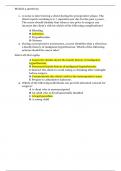
1. A nurse is interviewing a client during the preoperative phase. The
client reports smoking 6 to 7 cigarettes per day for the past 4 years.
The nurse should identify that tobacco use prior to surgery can
increase the client’s risk for which of the following complications?

A Bleeding
B Infection
C Hypothermia
D Nausea
2. During a preoperative assessment, a nurse identifies that a client has
a family history of malignant hyperthermia. Which of the following
actions should the nurse take?

Select all that apply.

A Assess the details about the family history of malignant
hyperthermia.
B Document family history of malignant hyperthermia.
C Instruct the client to avoid eating or drinking after midnight
before surgery.
D Communicate the client's risk to the intraoperative team.
E Prepare to administer naloxone.
3. Which of the following individuals can provide informed consent for
surgery?
A A client who is unemancipated
B An adult who is developmentally disabled
C A legal guardian
D A young child

, Module 3 questions

4. For each of the following nursing actions, identify the appropriate
nurse to perform it.
OR
Provide updates to the client's family members
Initiate time-out procedure
Document the count of surgical sponges and equipment
Obtain supplies for the surgery team
Ensure a patent airway
PACU
Manage nausea
Administer pain medications
Control shivering
Pre-Op
Perform teaching on deep breathing and coughing
Collect the client's height and weight
Obtain history of allergies
Witness consent
5. A nurse is preparing a preoperative teaching plan for an older adult
client scheduled for surgery. Which of the following strategies should
the nurse include to reduce the risk of postoperative delirium?
A Administer benzodiazepines for preoperative anxiety.
B Plan to use opioid-based medications for postoperative pain
management.
C Schedule the client for surgery late in the day to ensure
adequate rest beforehand.
D Perform a CGA to identify risk factors.
6. A nurse is preparing a client for surgery. Which of the following
factors identified during the preoperative assessment should the
nurse recognize as increasing the client's risk for VTE?
Select all that apply.
A Use of corticosteroids
B BMI
C History of occasional alcohol consumption
D History of smoking
E Controlled type 2 diabetes


7. What signs and symptoms may indicate an infection in a wound?
$14.09
Get access to the full document:

100% satisfaction guarantee
Immediately available after payment
Both online and in PDF
No strings attached

Get to know the seller
Seller avatar
Empire25

Also available in package deal

Thumbnail
Package deal
NUR 213 Modules 1 to 5 Complete questions and answers, exam solution guide_Updated 2025/2026.
-
6 2025
$ 80.04 More info

Get to know the seller

Seller avatar
Empire25 Azusa Pacific University
View profile
Follow You need to be logged in order to follow users or courses
Sold
0
Member since
2 year
Number of followers
0
Documents
90
Last sold
-
COLLEGE EDUCATOR

I offer course materials, learning platforms, and resources catered to your subject area.

0.0

0 reviews

5
0
4
0
3
0
2
0
1
0

Recently viewed by you

Why students choose Stuvia

Created by fellow students, verified by reviews

Quality you can trust: written by students who passed their tests and reviewed by others who've used these notes.

Didn't get what you expected? Choose another document

No worries! You can instantly pick a different document that better fits what you're looking for.

Pay as you like, start learning right away

No subscription, no commitments. Pay the way you're used to via credit card and download your PDF document instantly.

Student with book image

“Bought, downloaded, and aced it. It really can be that simple.”

Alisha Student

Frequently asked questions