WGU D295 Task 3: Designing Collaborative E-Learning Experiences
WGU D295
Task 3: Designing Collaborative E-Learning Experiences
04/02/2025
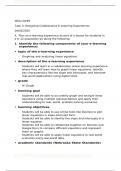
A. Plan an e-learning experience as part of a lesson for students in
a K–12 population by doing the following:
1. Identify the following components of your e-learning
experience:
• topic of the e-learning experience
- Graphing and analyzing linear equations.
• description of the e-learning experience
- Students will learn in a collaborative online learning experience
where they will learn how to graph linear equations, identify
key characteristics like the slope and intercepts, and interpret
real-world applications using digital tools.
• grade
- 9th Grade
• learning goal
- Students will be able to accurately graph and analyze linear
equations using multiple representations and apply their
understanding to real- world, problem-solving scenarios.
• learning objectives
- Students will be able to use online tools like Desmos to plot
linear equations in slope-intercept form.
- Students will be able to identify the slope and intercepts in a
linear equation.
- Students will be able to collaborate together on Desmos and
Google Docs to compare different equations and represent
them on graphs.
- Students will be able to apply linear equations to real-world
scenarios using real-world data.
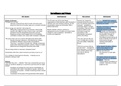
• academic standards (Nebraska State Standards)
WGU D295 Task 3: Designing Collaborative E-Learning Experiences
, WGU D295 Task 3: Designing Collaborative E-Learning Experiences
WGU D295 Task 3: Designing Collaborative E-Learning Experiences
WGU D295
Task 3: Designing Collaborative E-Learning Experiences
04/02/2025
A. Plan an e-learning experience as part of a lesson for students in
a K–12 population by doing the following:
1. Identify the following components of your e-learning
experience:
• topic of the e-learning experience
- Graphing and analyzing linear equations.
• description of the e-learning experience
- Students will learn in a collaborative online learning experience
where they will learn how to graph linear equations, identify
key characteristics like the slope and intercepts, and interpret
real-world applications using digital tools.
• grade
- 9th Grade
• learning goal
- Students will be able to accurately graph and analyze linear
equations using multiple representations and apply their
understanding to real- world, problem-solving scenarios.
• learning objectives
- Students will be able to use online tools like Desmos to plot
linear equations in slope-intercept form.
- Students will be able to identify the slope and intercepts in a
linear equation.
- Students will be able to collaborate together on Desmos and
Google Docs to compare different equations and represent
them on graphs.
- Students will be able to apply linear equations to real-world
scenarios using real-world data.
• academic standards (Nebraska State Standards)
WGU D295 Task 3: Designing Collaborative E-Learning Experiences
, WGU D295 Task 3: Designing Collaborative E-Learning Experiences
WGU D295 Task 3: Designing Collaborative E-Learning Experiences