

WEEK 8
CHAPTER 17
17.1 - What is quality and why is it important?
● Revenues increased by better sales and enhanced prices in the market
● Costs decreased by improved efficiencies, productivity and the use of
capital
Operation’s view of quality
-Quality = consistent conformance to customers’ expectations
● “Conformance” -> need to meet a clear specification
● “Consistent” -> quality is used to design and run the processes to
produce products/services
● “Customers expectations” -> views of customers considered (may be
influenced by price)
● “Expectations” -> not wants and needs
Customers’ view of quality
-Quality is what customers perceive
● Past experiences, individual knowledge, history affect customer’s
expectations
● Customers may each perceive a service/product in different ways
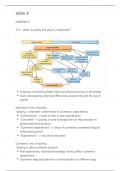
,Reconciling the operation’s and customers’ view of quality
-Quality = the degree of fit between customers’ expectations and
perceptions of a service/product
● If product/service better than expected -> customer is satisfied, quality
perceived to be high
● If product/service worse than expected -> customer is dissatisfied,
quality perceived to be low
● If product/service matches expectations-> product/service is seen as
acceptable
● Customer expectations and perceptions influenced by several factors -
some cant be controlled by operations / some can be managed
● The two domains meet in the actual product/service - provided by
organisations, experienced by customer
● Operation’s domain -> management is responsible for designing the
, ●
product/service and providing a specification of the quality to which the
product/service has to be created
● Customer’s domain -> their expectations are shaped by “quality
characteristics”
○ Factors e.g. previous experience with product/service, marketing
image provided by organisation and word-of mouth info from other
users
● If the perceived quality gap is such that customers’ perceptions of
product/service fail to match their expectations then the reason is in of
of the other gaps of the model
Gap 1: The customer’s specification-operation’s specification gap
● Perceived quality could be poor due to a mismatch between the
organisation’s own internal quality specification and the specification
expected by customer
Gap 2: The concept-specification gap
● Mismatch between the product/service concept and the way the
organisation has specified quality internally
Gap 3: The quality specification-actual quality gap
● Mismatch between actual quality and the internal quality specification
Gap 4: The actual quality-communicated image gap
● Mismatch between the organisation’s external communications or market
image and the actual quality of delivered to customer
● May be because the marketing function has set unachievable
expectations or operations is not capable of the level of quality expected
by the customer
-> Quality describes either physical products or intangible services or
anything combines both
-> But not all authorities or individual operations view quality in this way,
which can lead to confusion
● Quality of service (QoS) = describes how an operation serves its
customers by combining “quality” with some or all of the”speed”,
“dependability” and “flexibility”
○ May not capture overall satisfaction with the service as perceived by
users
○ Includes aspects of a service that are under the control of the
operation creating the service
, ● Quality of experience (QoE) = overall acceptability of the service, as
perceived subjectively by the end user
○ “The degree of delight or annoyance of the user of a product/service
- results from fullfilment of experience with respect to the utility
and/or enjoyment of the product/service in the light of the user’s
personality and current state”
○ Expresses and focuses on user satisfaction objectively and
subjectively
○ Involves aspects governed by operation + of the individual customer
+ context in which service is consumed
○ BUT difficult to operationalise
Service guarantee = a promise to recompense the customer for the product/
service that fails to meet a defined quality level
● Method of formalising quality standards from a customer’s viewpoint
● Ensures quality standards, overcomes customers’ potential doubts
regarding a service, encourages and rewards customers who report
problems (so operation can be made aware and correct them)
● A good guarantee: based on customers’ expectations, easy to understand
and explain level and type of quality promised and what the operation
will do if it is not met
● Should include a clear “easy to invoke” mechanism for customers to
trigger the guarantee and appropriate training and empowerment so
employees can come when a guarantee in invoked by customer
CHAPTER 17
17.1 - What is quality and why is it important?
● Revenues increased by better sales and enhanced prices in the market
● Costs decreased by improved efficiencies, productivity and the use of
capital
Operation’s view of quality
-Quality = consistent conformance to customers’ expectations
● “Conformance” -> need to meet a clear specification
● “Consistent” -> quality is used to design and run the processes to
produce products/services
● “Customers expectations” -> views of customers considered (may be
influenced by price)
● “Expectations” -> not wants and needs
Customers’ view of quality
-Quality is what customers perceive
● Past experiences, individual knowledge, history affect customer’s
expectations
● Customers may each perceive a service/product in different ways
,Reconciling the operation’s and customers’ view of quality
-Quality = the degree of fit between customers’ expectations and
perceptions of a service/product
● If product/service better than expected -> customer is satisfied, quality
perceived to be high
● If product/service worse than expected -> customer is dissatisfied,
quality perceived to be low
● If product/service matches expectations-> product/service is seen as
acceptable
● Customer expectations and perceptions influenced by several factors -
some cant be controlled by operations / some can be managed
● The two domains meet in the actual product/service - provided by
organisations, experienced by customer
● Operation’s domain -> management is responsible for designing the
, ●
product/service and providing a specification of the quality to which the
product/service has to be created
● Customer’s domain -> their expectations are shaped by “quality
characteristics”
○ Factors e.g. previous experience with product/service, marketing
image provided by organisation and word-of mouth info from other
users
● If the perceived quality gap is such that customers’ perceptions of
product/service fail to match their expectations then the reason is in of
of the other gaps of the model
Gap 1: The customer’s specification-operation’s specification gap
● Perceived quality could be poor due to a mismatch between the
organisation’s own internal quality specification and the specification
expected by customer
Gap 2: The concept-specification gap
● Mismatch between the product/service concept and the way the
organisation has specified quality internally
Gap 3: The quality specification-actual quality gap
● Mismatch between actual quality and the internal quality specification
Gap 4: The actual quality-communicated image gap
● Mismatch between the organisation’s external communications or market
image and the actual quality of delivered to customer
● May be because the marketing function has set unachievable
expectations or operations is not capable of the level of quality expected
by the customer
-> Quality describes either physical products or intangible services or
anything combines both
-> But not all authorities or individual operations view quality in this way,
which can lead to confusion
● Quality of service (QoS) = describes how an operation serves its
customers by combining “quality” with some or all of the”speed”,
“dependability” and “flexibility”
○ May not capture overall satisfaction with the service as perceived by
users
○ Includes aspects of a service that are under the control of the
operation creating the service
, ● Quality of experience (QoE) = overall acceptability of the service, as
perceived subjectively by the end user
○ “The degree of delight or annoyance of the user of a product/service
- results from fullfilment of experience with respect to the utility
and/or enjoyment of the product/service in the light of the user’s
personality and current state”
○ Expresses and focuses on user satisfaction objectively and
subjectively
○ Involves aspects governed by operation + of the individual customer
+ context in which service is consumed
○ BUT difficult to operationalise
Service guarantee = a promise to recompense the customer for the product/
service that fails to meet a defined quality level
● Method of formalising quality standards from a customer’s viewpoint
● Ensures quality standards, overcomes customers’ potential doubts
regarding a service, encourages and rewards customers who report
problems (so operation can be made aware and correct them)
● A good guarantee: based on customers’ expectations, easy to understand
and explain level and type of quality promised and what the operation
will do if it is not met
● Should include a clear “easy to invoke” mechanism for customers to
trigger the guarantee and appropriate training and empowerment so
employees can come when a guarantee in invoked by customer


