
CMN 548 Final Exam Study Guide - Fall 2024-2025
Guide
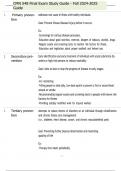
1. Primary preven- Addresses root cause of illness with healthy individuals.
tion
Goal: Prevent illness/disease/injury before it occurs.
Ex:
-Screenings for various disease processes.
-Education about good nutrition, exercise, dangers of tobacco, alcohol, drugs.
-Regular exams and screening tests to monitor risk factors for illness.
-Education and legislation about proper seatbelt and helmet use.
2. Secondary pre- Early identification and early treatment of individuals with acute/subclinical dis-
vention orders or high-risk persons to reduce morbidity
Goal: Aims to slow or stop the progress of disease in early stages.
Ex:
-A1c monitoring
-Telling people to take daily, low-dose aspirin to prevent a first or second heart
attack or stroke
-Recommending regular exams and screening tests in people with known risk
factors for illness
-Providing suitably modified work for injured workers
3. Tertiary preven- Attempts to reduce ettects of disorders on an individual through rehabilitation
tion and chronic illness care management
(i.e., diabetes, heart disease, cancer, and chronic musculoskeletal pain)
Goal: Preventing further physical deterioration and maximizing
quality of life
Ex:
-Therapy that meets periodically
, CMN 548 Final Exam Study Guide - Fall 2024-2025
Guide
-Cardiac or stroke rehabilitation program
-Chronic pain management program
-Patient support groups
4. Define dystonia Sustained muscle contraction with consequent twisting movements/abnormal
postures. Manifested with hyperpronation in upper extremities and foot inversion
with plantar flexion in lower extremities.
5. Clanging Speech with choice of words based on sound, rather than meaning, as in rhyming
and punning.
Ex: "Look at my eyes and nose, wise eyes and rosy nose. Two to one, the ayes have
it!"
6. Neologisms The invention of new "words."
7. Circumstantiality Excessively indirect speech; speech is liable to be over inclusive and include
irrelevant detail.
8. Echolalia The client repeats the words or phrases spoken to him.
9. What is a recom- Test the capacity to think abstractly in two ways.
mended way to Using Proverbs and Similarities
access abstract
thinking?
10. At what BMI 85% of ideal body weight or BMI < 17.5
would the
provider investi-
gate the possibil-
ity of anorexia?
11. Which cranial CN-VIII (8) Vestibulocochlear
nerve is assessed
, CMN 548 Final Exam Study Guide - Fall 2024-2025
Guide
during a patient's
hearing test?
12. Cultural aware- The ability to understand and accept one's own cultural beliefs, values, and
ness customs. It also involves understanding and accepting the values and beliefs of
other cultures
13. Cultural compe- Having the knowledge, abilities, and skills to deliver care congruent with the
tence client's cultural beliefs and practices.
14. Cultural humility A process that requires humility as individuals continue engaging in self-reflection
and self critique as lifelong learners and reflective practitioners in an ettort to
address power imbalances and advocate for others. It helps to implicit bias, pro-
motes empathy, and aids clinicians in acknowledging and respecting individuality.
15. Cultural percep- How a person's culture influences their worldview.
tivity Culture attects all areas of life, including Thought, Language, Religion, Food, and
The arts
16. Oral apraxia A disorder that makes it diflcult for a child to coordinate and initiate movements
of their lips, tongue, jaw, and soft palate
17. Aphonia Loss of ability to speak through disease of or damage to the larynx and/or mouth
or its nerve supply.
18. Dysarthria Refers to a defect in the muscular control of the speech apparatus (lips, tongue,
palate, or pharynx). Words may be nasal, slurred, or indistinct, but the central
symbolic aspect of language remains intact.
(Diflculty speaking because the muscles used for speech are weak)
Causes: motor lesions of the CNS or PNS , parkinsonism, and cerebellar disease.
19. Aphasia Loss of ability to understand or express speech/language
Causes: lesions in the dominant cerebral hemisphere, usually the left.
, CMN 548 Final Exam Study Guide - Fall 2024-2025
Guide
20. Mini Mental State A tool that systematically assesses mental status, consisting of 11 questions that
Exam (MMSE) test five areas of cognitive function.
A brief cognitive assessment used by HCPs to screen for potential cognitive
impairment by evaluating areas like orientation, attention, memory, language,
and visual-spatial skills through a series of questions and tasks, typically taking
around 5-10 minutes to administer; a score is calculated based on the answers,
with lower scores indicating possible cognitive decline.
21. Core skills of Mo- Open-ended questions, reflective listening, & aflrmations
tivational Inter-
viewing A set of well-documented techniques that improve health outcomes, especially for
patients with substance abuse. It encourages you to help your patients discover
their interest in considering and making a change in their behaviors.
These techniques encourage clients to articulate their own motivations and solu-
tions by facilitating a supportive dialogue.
Open-ended questions: These prompt detailed responses and allow the client to
explore their thoughts and feelings freely.
Reflective listening: Demonstrating empathy by actively listening and reflecting
back what the client is saying to ensure understanding.
Aflrmations: Recognizing and validating the client's strengths and positive qual-
ities to build self-eflcacy.
Do I listen more than I talk?
Or am I talking more than I listen?
Do I keep myself sensitive and open to this patient's issues, whatever they may
be?
Or am I talking about what I think the problem is?
Do I invite this patient to talk about and explore his/her own ideas for change?
Or am I jumping to conclusions and possible solutions?
Guide
1. Primary preven- Addresses root cause of illness with healthy individuals.
tion
Goal: Prevent illness/disease/injury before it occurs.
Ex:
-Screenings for various disease processes.
-Education about good nutrition, exercise, dangers of tobacco, alcohol, drugs.
-Regular exams and screening tests to monitor risk factors for illness.
-Education and legislation about proper seatbelt and helmet use.
2. Secondary pre- Early identification and early treatment of individuals with acute/subclinical dis-
vention orders or high-risk persons to reduce morbidity
Goal: Aims to slow or stop the progress of disease in early stages.
Ex:
-A1c monitoring
-Telling people to take daily, low-dose aspirin to prevent a first or second heart
attack or stroke
-Recommending regular exams and screening tests in people with known risk
factors for illness
-Providing suitably modified work for injured workers
3. Tertiary preven- Attempts to reduce ettects of disorders on an individual through rehabilitation
tion and chronic illness care management
(i.e., diabetes, heart disease, cancer, and chronic musculoskeletal pain)
Goal: Preventing further physical deterioration and maximizing
quality of life
Ex:
-Therapy that meets periodically
, CMN 548 Final Exam Study Guide - Fall 2024-2025
Guide
-Cardiac or stroke rehabilitation program
-Chronic pain management program
-Patient support groups
4. Define dystonia Sustained muscle contraction with consequent twisting movements/abnormal
postures. Manifested with hyperpronation in upper extremities and foot inversion
with plantar flexion in lower extremities.
5. Clanging Speech with choice of words based on sound, rather than meaning, as in rhyming
and punning.
Ex: "Look at my eyes and nose, wise eyes and rosy nose. Two to one, the ayes have
it!"
6. Neologisms The invention of new "words."
7. Circumstantiality Excessively indirect speech; speech is liable to be over inclusive and include
irrelevant detail.
8. Echolalia The client repeats the words or phrases spoken to him.
9. What is a recom- Test the capacity to think abstractly in two ways.
mended way to Using Proverbs and Similarities
access abstract
thinking?
10. At what BMI 85% of ideal body weight or BMI < 17.5
would the
provider investi-
gate the possibil-
ity of anorexia?
11. Which cranial CN-VIII (8) Vestibulocochlear
nerve is assessed
, CMN 548 Final Exam Study Guide - Fall 2024-2025
Guide
during a patient's
hearing test?
12. Cultural aware- The ability to understand and accept one's own cultural beliefs, values, and
ness customs. It also involves understanding and accepting the values and beliefs of
other cultures
13. Cultural compe- Having the knowledge, abilities, and skills to deliver care congruent with the
tence client's cultural beliefs and practices.
14. Cultural humility A process that requires humility as individuals continue engaging in self-reflection
and self critique as lifelong learners and reflective practitioners in an ettort to
address power imbalances and advocate for others. It helps to implicit bias, pro-
motes empathy, and aids clinicians in acknowledging and respecting individuality.
15. Cultural percep- How a person's culture influences their worldview.
tivity Culture attects all areas of life, including Thought, Language, Religion, Food, and
The arts
16. Oral apraxia A disorder that makes it diflcult for a child to coordinate and initiate movements
of their lips, tongue, jaw, and soft palate
17. Aphonia Loss of ability to speak through disease of or damage to the larynx and/or mouth
or its nerve supply.
18. Dysarthria Refers to a defect in the muscular control of the speech apparatus (lips, tongue,
palate, or pharynx). Words may be nasal, slurred, or indistinct, but the central
symbolic aspect of language remains intact.
(Diflculty speaking because the muscles used for speech are weak)
Causes: motor lesions of the CNS or PNS , parkinsonism, and cerebellar disease.
19. Aphasia Loss of ability to understand or express speech/language
Causes: lesions in the dominant cerebral hemisphere, usually the left.
, CMN 548 Final Exam Study Guide - Fall 2024-2025
Guide
20. Mini Mental State A tool that systematically assesses mental status, consisting of 11 questions that
Exam (MMSE) test five areas of cognitive function.
A brief cognitive assessment used by HCPs to screen for potential cognitive
impairment by evaluating areas like orientation, attention, memory, language,
and visual-spatial skills through a series of questions and tasks, typically taking
around 5-10 minutes to administer; a score is calculated based on the answers,
with lower scores indicating possible cognitive decline.
21. Core skills of Mo- Open-ended questions, reflective listening, & aflrmations
tivational Inter-
viewing A set of well-documented techniques that improve health outcomes, especially for
patients with substance abuse. It encourages you to help your patients discover
their interest in considering and making a change in their behaviors.
These techniques encourage clients to articulate their own motivations and solu-
tions by facilitating a supportive dialogue.
Open-ended questions: These prompt detailed responses and allow the client to
explore their thoughts and feelings freely.
Reflective listening: Demonstrating empathy by actively listening and reflecting
back what the client is saying to ensure understanding.
Aflrmations: Recognizing and validating the client's strengths and positive qual-
ities to build self-eflcacy.
Do I listen more than I talk?
Or am I talking more than I listen?
Do I keep myself sensitive and open to this patient's issues, whatever they may
be?
Or am I talking about what I think the problem is?
Do I invite this patient to talk about and explore his/her own ideas for change?
Or am I jumping to conclusions and possible solutions?


