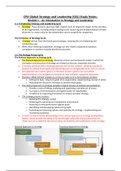
CPA Global Strategy and Leadership (GSL) Study Notes:
Module 1 – An Introduction to Strategy and Leadership:
1.1: Introducing Strategy and Leadership (p.3)
• Strategy: Those decisions that have high medium-term to long-term impact on the activities
of the organisation, including analysis leading to the resourcing and implementation of those
decisions, to create value for key stakeholders and to outperform competitors.
The Evolution of Strategy (p.4):
• ‘Strategy’ derives from the Greek word strategos, meaning the art of planning and
conducting a war.
• While often involving competition, strategy can also involve cooperation between
competitors to achieve mutually beneficial outcomes.
1.2: The Strategy Process (p.6):
The Rational Approach to Strategy (p.8)
• The Rational Approach to Strategy: Based on a linear and mechanistic model, in which the
conception and execution of strategy are treated as discrete, sequential activities
• It involves systematically comparing external and internal contexts, adopting a particular
position to achieve future goals and expressing that in a recognisable form, such as a vision.
• This approach also selects options on the basis of their relative merit and allows
implementation to be designed on the basis of clear and well- supported statements.
• Chandler (1962) defined strategy as a process made up of 2 chronological activities:
1. Setting the basic, long-term goals of an organisation, implementing courses of action
2. Allocating the resources necessary to achieve those goals.
• The rational approach to strategy provides a logical process of analysis and evaluation:
1. Provides a way of talking, analysing and organising a complex set of issues
2. Is a means of communication and legitimisation to stakeholders
3. Is useful as an organising framework to analyse and plan strategy
• The strategy process involves:
o Agreeing the strategy context
o Analysing the operating and competitive environment
o Assessing current performance against goals
o Identifying and developing options for growth
o Evaluating and selecting options and updating the strategy – implementing and
monitoring outcomes.
• In order to overcome the shortcomings of the rational approach to strategy development,
leaders should provide the ability to iterate through using rules and processes that are
robust but not so rigid that they do not allow for flexibility and modification of the strategy.
Rational Approach to Strategy Processual approach to strategy
,Strategy Development in Practice (p.10):
• Strategic management is an ongoing and dynamic process that requires constant monitoring
and adjustment.
• The execution of strategy and the resulting performance needs to be evaluated to ensure
operations are on track.
• The nature of a true competitive strategy involves performing activities differently, or to
perform different activities from one’s competitors.
• Converting strategic plans into actions and results tests a manager’s ability to direct
organizational change, motivate people, build and strengthen company competencies and
competitive capabilities, create and nurture a strategy-supportive work climate, and meet or
beat performance targets.
• While the rational approach is presented as a linear, step-by-step approach the process is
iterative and interdependent.
• Activities undertaken later in the process may lead to the need for change in the earlier
steps (E.g. Obstacles may occur that prevent implementation of the strategy, thus it might
be necessary to consider a completely new direction and develop an updated strategy)
• Leaders and managers need to:
o Be sensitive to the environment for new ideas and challenges
o Create context rather than plans, to encourage innovation and variety
o Tolerate imperfection
o Appreciate that the process of strategy is rarely a purely linear process, even if it
makes it easier to act as if it is
o Be prepared to regularly review the performance of the strategy
o Be prepared to refine/modify the strategy if it becomes evident change is required
o Keep rules simple and build adaptive tension in other words, provide sufficient order
to make things happen, but not stifle people with rigid controls.
• Strategy can therefore be understood as both planned and emergent, representing a pattern
of decisions intended to improve the performance and competitive position of the
organisation (E.g. Amazon’s planning, prioritisation and benchmarking process)
1.3: Gaining a Competitive Advantage (p.12):
• Competitive advantage is the ability of an organisation to outperform its competitors and
make more profits than its competitors do from an equivalent set of activities (E.g. Doing
things in a different way)
• It can do this by being more efficient than competitors or undertaking different activities
that allow it to charge higher prices or gain more market share and brand loyalty.
• Where data can create networks, it can create competitive advantage (e.g. Google maps
provides real time traffic data, road conditions and travel times unlike its competitors)
, • The ubiquity of the Internet challenges the activities that many established companies have
considered as central to their businesses, as they are offered by new, specialised
competitors that are better, faster, and more efficient products, services and solutions in
their area of focus.
• It is critically important for organisations to understand that what has set them apart from
competitors at one point in time will become commonplace and less valuable over time.
• The challenge for firms is how to respond before and when this happens and why
organisational speed, agility and innovation are key for growth and competitiveness.
Purpose and Strategy (p.13):
• ‘Creating new markets’, ‘serving broader stakeholder needs’ and ‘changing the rules of the
game’ are strategies commonly used by high-growth organisations.
• A company’s purpose extends the focus of the organisation across a network of connected
interests and relationships
• Their research suggests that competing based on current competitive conditions means that
competitive advantage becomes commoditised and found that high-growth companies
avoid limiting themselves in this way; instead they pursue opportunities that are consistent
with their purpose (E.g. Mars Petcare – Pedigree)
,Reshaping the Value Proposition (p.14):
• A value proposition describes the target customer, the problem that is solved for the
customer and why what is being offered is distinctly better than available alternatives.
• Creating a robust value proposition involves understanding customer wants and needs and
matching products and services that the firm develops to create value for the customer.
• The Value Proposition Canvas, shown in figure 1.5, has 2 sides:
1. The customer profile articulates customer understanding for specific customer
segments in terms of what the customer needs to get done, what is currently
difficult or challenging for them (the pain points) and ways that pain could be
addressed to create value for that particular customer segment:
o Pains describes obstacles that get in the way of jobs to be done
o Gains describes the outcomes customers are trying to achieve and the
benefits they are looking for
2. The value map articulates the ways an organisation describes how it will create
value for the customer by describing the products and services that will be offered,
how they will address current pain points for customers and how they will create
value for customers:
o Pain relievers describes how products and services could address customer
pain points
o Gain creators describe how products and services could help customers
achieve the outcome and benefits they are looking for.
• Fit between the customer profile and value map is achieved when customers respond
positively to the proposed value proposition
• E.g. The value proposition helps them achieve what they want to achieve, relieves current
pain points and/or creates new value that they are willing to pay for.
• Achieving fit involves experimentation, iteration, testing and validation with customers,
which is critical to reduce the risks of creating a value proposition that does not in fact have
value and/or resonate with the intended customer (E.g. Adopting an e-commerce approach)
The Productivity Frontier and Best Practice (p.16):
• The productivity frontier is an economic concept that represents the current level of best
practice and it is the curve where the most efficient performers in the industry are placed.
• Porter defines this as the ‘maximum value a company can deliver at a given cost, given the
best available technology, skills and management techniques’
• Operational efficiency relates to reducing costs in order to achieve better performance (e.g.
distribution company implementing GPS tracking and guidance equipment on their trucks)
, • Creating a competitive advantage is a way to create unique products whereas achieving
operational efficiency is about reducing costs compared to competitors
• Porter believes that there are 2 overall strategic approaches that an organisation can take:
1) Differentiating the product -> More effective method
2) Low cost production
• The aim of differentiation is to provide a unique product that raises the willingness to pay of
customers which increases profit margins.
• Although reducing costs can also do this, you are limited to how far you can go as only
differentiation can achieve higher and higher margins.
• Mintzberg's concluded that most organisations are not rigid in how they approach strategy,
nor sequential in the steps for strategy development that Porter wrote about.
• Mintzberg disagreed with Porter's rational approach to strategy because he saw
organisations as flexible, fluid entities where a level of trial and error must occur in strategy
development and implementation whilst Porter believes companies need to be able to say
no to new products or services if they don't align.
• Being at the productivity frontier means that organisations are operating efficiently and
effectively, however it does not deliver sustainable strategic advantage.
• This can only be achieved when organisations do something different by identifying and
investing in unique activities that are not factored into the industry’s productivity frontier.
Differentiating Strategy from Tactics (p.17):
• A true competitive strategy attempts to transform the activities performed, so that they
differ from rivals or are completed in a different manner to standard practice in the market
(E.g. Makes the company’s products completely unique)
• Porter suggests that an organisation needs to make itself distinct and different, as opposed
to trying to do the same thing as its competitors in a better or faster manner.
• In order to differentiate itself from its competitors, an organisation must do activities that
are similar to competitors in a different way or do completely different activities.
• Porter provides examples of being distinct, including organisations that only service
customers in a specific market niche, or focusing on particular geographic locations, or
providing a specific type of product, rather than a broad range of products.
• An important part of this approach is saying ‘no’ to new products, services or types of
customers that do not match the overall strategy.
Strategic Fit and Strategic Stretch (p.17):
• Strategic fit involves matching the organisation’s goals, values, assets and capabilities,
structures and systems to the external environment and market needs (E.g. Acquiring a
competitor, extending a product line, relocating production or divesting distribution)
• Strategic fit is ensuring that the organisation can meet the challenges associated with its
environment and markets and the changes occurring within it.
, • Strategic stretch is resource-led and based on leaders and managers challenging how
organisational resources and capabilities can be leveraged (‘stretched’) to create new
opportunities or competencies – Relates to competitive strategy (E.g. Create products,
reorganise resources – More risky and expensive but greater rewards
• The strategy needs to have enough stretch in it so that it extends upon the ‘fit’ that can
currently be achieved with the organisation’s present structure and offerings, creating a gap
to where it wants to be as it is this ‘stretch’ that is most likely to create competitive
advantage for an organisation.
1.4: Organisation Context for Strategy (p.18):
• Different types of firms exist and operate for many reasons and their success is evaluated by
their key stakeholders who have their own perspectives of what constitutes success.
• The size and scale of an organisation also influence its structure and how it is organised for
the purposes of management (E.g. Where are the organisation’s operations located and to
what extent is decision making centralised or de-centralised?)
• Similarly, industry life cycle stage and organisational maturity impact how strategy
development is approached, and the time and resources allocated.
Industry and Organisational Maturity (p.19):
• Different factors are relatively more important for firm competitiveness and success,
depending on the industry life cycle stage and the size and maturity of the organisation.
• Very different strategies and leadership styles and experience would be effective (E.g. A
start-up company seeking to establish a foothold in an emerging industry vs a company that
is having to make decisions to reduce the size of an organisation to remain in business)
• The negative cash flow experienced during the start-up stage is often referred to as the
‘valley of death’, which describes the period of time where a start-up has commenced
operations but is not yet generating revenue.
• It funds operations from either its own or investor equity capital, with the aim of managing
the rate that it uses cash (the cash burn rate) to last until revenue is earned in sufficient
amounts to cover operating expenses.
Module 1 – An Introduction to Strategy and Leadership:
1.1: Introducing Strategy and Leadership (p.3)
• Strategy: Those decisions that have high medium-term to long-term impact on the activities
of the organisation, including analysis leading to the resourcing and implementation of those
decisions, to create value for key stakeholders and to outperform competitors.
The Evolution of Strategy (p.4):
• ‘Strategy’ derives from the Greek word strategos, meaning the art of planning and
conducting a war.
• While often involving competition, strategy can also involve cooperation between
competitors to achieve mutually beneficial outcomes.
1.2: The Strategy Process (p.6):
The Rational Approach to Strategy (p.8)
• The Rational Approach to Strategy: Based on a linear and mechanistic model, in which the
conception and execution of strategy are treated as discrete, sequential activities
• It involves systematically comparing external and internal contexts, adopting a particular
position to achieve future goals and expressing that in a recognisable form, such as a vision.
• This approach also selects options on the basis of their relative merit and allows
implementation to be designed on the basis of clear and well- supported statements.
• Chandler (1962) defined strategy as a process made up of 2 chronological activities:
1. Setting the basic, long-term goals of an organisation, implementing courses of action
2. Allocating the resources necessary to achieve those goals.
• The rational approach to strategy provides a logical process of analysis and evaluation:
1. Provides a way of talking, analysing and organising a complex set of issues
2. Is a means of communication and legitimisation to stakeholders
3. Is useful as an organising framework to analyse and plan strategy
• The strategy process involves:
o Agreeing the strategy context
o Analysing the operating and competitive environment
o Assessing current performance against goals
o Identifying and developing options for growth
o Evaluating and selecting options and updating the strategy – implementing and
monitoring outcomes.
• In order to overcome the shortcomings of the rational approach to strategy development,
leaders should provide the ability to iterate through using rules and processes that are
robust but not so rigid that they do not allow for flexibility and modification of the strategy.
Rational Approach to Strategy Processual approach to strategy
,Strategy Development in Practice (p.10):
• Strategic management is an ongoing and dynamic process that requires constant monitoring
and adjustment.
• The execution of strategy and the resulting performance needs to be evaluated to ensure
operations are on track.
• The nature of a true competitive strategy involves performing activities differently, or to
perform different activities from one’s competitors.
• Converting strategic plans into actions and results tests a manager’s ability to direct
organizational change, motivate people, build and strengthen company competencies and
competitive capabilities, create and nurture a strategy-supportive work climate, and meet or
beat performance targets.
• While the rational approach is presented as a linear, step-by-step approach the process is
iterative and interdependent.
• Activities undertaken later in the process may lead to the need for change in the earlier
steps (E.g. Obstacles may occur that prevent implementation of the strategy, thus it might
be necessary to consider a completely new direction and develop an updated strategy)
• Leaders and managers need to:
o Be sensitive to the environment for new ideas and challenges
o Create context rather than plans, to encourage innovation and variety
o Tolerate imperfection
o Appreciate that the process of strategy is rarely a purely linear process, even if it
makes it easier to act as if it is
o Be prepared to regularly review the performance of the strategy
o Be prepared to refine/modify the strategy if it becomes evident change is required
o Keep rules simple and build adaptive tension in other words, provide sufficient order
to make things happen, but not stifle people with rigid controls.
• Strategy can therefore be understood as both planned and emergent, representing a pattern
of decisions intended to improve the performance and competitive position of the
organisation (E.g. Amazon’s planning, prioritisation and benchmarking process)
1.3: Gaining a Competitive Advantage (p.12):
• Competitive advantage is the ability of an organisation to outperform its competitors and
make more profits than its competitors do from an equivalent set of activities (E.g. Doing
things in a different way)
• It can do this by being more efficient than competitors or undertaking different activities
that allow it to charge higher prices or gain more market share and brand loyalty.
• Where data can create networks, it can create competitive advantage (e.g. Google maps
provides real time traffic data, road conditions and travel times unlike its competitors)
, • The ubiquity of the Internet challenges the activities that many established companies have
considered as central to their businesses, as they are offered by new, specialised
competitors that are better, faster, and more efficient products, services and solutions in
their area of focus.
• It is critically important for organisations to understand that what has set them apart from
competitors at one point in time will become commonplace and less valuable over time.
• The challenge for firms is how to respond before and when this happens and why
organisational speed, agility and innovation are key for growth and competitiveness.
Purpose and Strategy (p.13):
• ‘Creating new markets’, ‘serving broader stakeholder needs’ and ‘changing the rules of the
game’ are strategies commonly used by high-growth organisations.
• A company’s purpose extends the focus of the organisation across a network of connected
interests and relationships
• Their research suggests that competing based on current competitive conditions means that
competitive advantage becomes commoditised and found that high-growth companies
avoid limiting themselves in this way; instead they pursue opportunities that are consistent
with their purpose (E.g. Mars Petcare – Pedigree)
,Reshaping the Value Proposition (p.14):
• A value proposition describes the target customer, the problem that is solved for the
customer and why what is being offered is distinctly better than available alternatives.
• Creating a robust value proposition involves understanding customer wants and needs and
matching products and services that the firm develops to create value for the customer.
• The Value Proposition Canvas, shown in figure 1.5, has 2 sides:
1. The customer profile articulates customer understanding for specific customer
segments in terms of what the customer needs to get done, what is currently
difficult or challenging for them (the pain points) and ways that pain could be
addressed to create value for that particular customer segment:
o Pains describes obstacles that get in the way of jobs to be done
o Gains describes the outcomes customers are trying to achieve and the
benefits they are looking for
2. The value map articulates the ways an organisation describes how it will create
value for the customer by describing the products and services that will be offered,
how they will address current pain points for customers and how they will create
value for customers:
o Pain relievers describes how products and services could address customer
pain points
o Gain creators describe how products and services could help customers
achieve the outcome and benefits they are looking for.
• Fit between the customer profile and value map is achieved when customers respond
positively to the proposed value proposition
• E.g. The value proposition helps them achieve what they want to achieve, relieves current
pain points and/or creates new value that they are willing to pay for.
• Achieving fit involves experimentation, iteration, testing and validation with customers,
which is critical to reduce the risks of creating a value proposition that does not in fact have
value and/or resonate with the intended customer (E.g. Adopting an e-commerce approach)
The Productivity Frontier and Best Practice (p.16):
• The productivity frontier is an economic concept that represents the current level of best
practice and it is the curve where the most efficient performers in the industry are placed.
• Porter defines this as the ‘maximum value a company can deliver at a given cost, given the
best available technology, skills and management techniques’
• Operational efficiency relates to reducing costs in order to achieve better performance (e.g.
distribution company implementing GPS tracking and guidance equipment on their trucks)
, • Creating a competitive advantage is a way to create unique products whereas achieving
operational efficiency is about reducing costs compared to competitors
• Porter believes that there are 2 overall strategic approaches that an organisation can take:
1) Differentiating the product -> More effective method
2) Low cost production
• The aim of differentiation is to provide a unique product that raises the willingness to pay of
customers which increases profit margins.
• Although reducing costs can also do this, you are limited to how far you can go as only
differentiation can achieve higher and higher margins.
• Mintzberg's concluded that most organisations are not rigid in how they approach strategy,
nor sequential in the steps for strategy development that Porter wrote about.
• Mintzberg disagreed with Porter's rational approach to strategy because he saw
organisations as flexible, fluid entities where a level of trial and error must occur in strategy
development and implementation whilst Porter believes companies need to be able to say
no to new products or services if they don't align.
• Being at the productivity frontier means that organisations are operating efficiently and
effectively, however it does not deliver sustainable strategic advantage.
• This can only be achieved when organisations do something different by identifying and
investing in unique activities that are not factored into the industry’s productivity frontier.
Differentiating Strategy from Tactics (p.17):
• A true competitive strategy attempts to transform the activities performed, so that they
differ from rivals or are completed in a different manner to standard practice in the market
(E.g. Makes the company’s products completely unique)
• Porter suggests that an organisation needs to make itself distinct and different, as opposed
to trying to do the same thing as its competitors in a better or faster manner.
• In order to differentiate itself from its competitors, an organisation must do activities that
are similar to competitors in a different way or do completely different activities.
• Porter provides examples of being distinct, including organisations that only service
customers in a specific market niche, or focusing on particular geographic locations, or
providing a specific type of product, rather than a broad range of products.
• An important part of this approach is saying ‘no’ to new products, services or types of
customers that do not match the overall strategy.
Strategic Fit and Strategic Stretch (p.17):
• Strategic fit involves matching the organisation’s goals, values, assets and capabilities,
structures and systems to the external environment and market needs (E.g. Acquiring a
competitor, extending a product line, relocating production or divesting distribution)
• Strategic fit is ensuring that the organisation can meet the challenges associated with its
environment and markets and the changes occurring within it.
, • Strategic stretch is resource-led and based on leaders and managers challenging how
organisational resources and capabilities can be leveraged (‘stretched’) to create new
opportunities or competencies – Relates to competitive strategy (E.g. Create products,
reorganise resources – More risky and expensive but greater rewards
• The strategy needs to have enough stretch in it so that it extends upon the ‘fit’ that can
currently be achieved with the organisation’s present structure and offerings, creating a gap
to where it wants to be as it is this ‘stretch’ that is most likely to create competitive
advantage for an organisation.
1.4: Organisation Context for Strategy (p.18):
• Different types of firms exist and operate for many reasons and their success is evaluated by
their key stakeholders who have their own perspectives of what constitutes success.
• The size and scale of an organisation also influence its structure and how it is organised for
the purposes of management (E.g. Where are the organisation’s operations located and to
what extent is decision making centralised or de-centralised?)
• Similarly, industry life cycle stage and organisational maturity impact how strategy
development is approached, and the time and resources allocated.
Industry and Organisational Maturity (p.19):
• Different factors are relatively more important for firm competitiveness and success,
depending on the industry life cycle stage and the size and maturity of the organisation.
• Very different strategies and leadership styles and experience would be effective (E.g. A
start-up company seeking to establish a foothold in an emerging industry vs a company that
is having to make decisions to reduce the size of an organisation to remain in business)
• The negative cash flow experienced during the start-up stage is often referred to as the
‘valley of death’, which describes the period of time where a start-up has commenced
operations but is not yet generating revenue.
• It funds operations from either its own or investor equity capital, with the aim of managing
the rate that it uses cash (the cash burn rate) to last until revenue is earned in sufficient
amounts to cover operating expenses.