Human Circulatory System
Introduction
The Human Circulatory
System, also called the
Cardiovascular System, is
responsible for the transport
of blood, oxygen, nutrients,
hormones, and wastes
throughout the body. It keeps
our cells supplied with what
they need and removes what
they don’t.
Main Parts of the Circulatory System
1. Heart
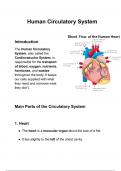
● The heart is a muscular organ about the size of a fist.
● It lies slightly to the left of the chest cavity.
, ● It works as a pump to circulate blood through the body.
● The heart has four chambers:
○ Right Atrium and Right Ventricle
○ Left Atrium and Left Ventricle
● The right side pumps deoxygenated blood to the lungs for
oxygenation (pulmonary circulation).
● The left side pumps oxygenated blood to the rest of the
body (systemic circulation).
● Valves (like tricuspid, bicuspid/mitral, semilunar) ensure
blood flows in one direction only.
2. Blood
● Blood is a fluid connective tissue that transports essential
substances.
● Main components:
○ Red Blood Cells (RBCs): Carry oxygen using
hemoglobin.
Introduction
The Human Circulatory
System, also called the
Cardiovascular System, is
responsible for the transport
of blood, oxygen, nutrients,
hormones, and wastes
throughout the body. It keeps
our cells supplied with what
they need and removes what
they don’t.
Main Parts of the Circulatory System
1. Heart
● The heart is a muscular organ about the size of a fist.
● It lies slightly to the left of the chest cavity.
, ● It works as a pump to circulate blood through the body.
● The heart has four chambers:
○ Right Atrium and Right Ventricle
○ Left Atrium and Left Ventricle
● The right side pumps deoxygenated blood to the lungs for
oxygenation (pulmonary circulation).
● The left side pumps oxygenated blood to the rest of the
body (systemic circulation).
● Valves (like tricuspid, bicuspid/mitral, semilunar) ensure
blood flows in one direction only.
2. Blood
● Blood is a fluid connective tissue that transports essential
substances.
● Main components:
○ Red Blood Cells (RBCs): Carry oxygen using
hemoglobin.