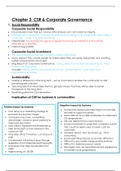
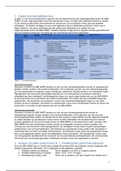
Chapter 3: CSR & Corporate Governance
1. Social Responsibility
Corporate Social Responsibility
• Encompasses more than just obvious ethical issues such as honesty & integrity
• Management’s obligation to protect & promote the welfare of all stakeholders (financially or
otherwise) – to act in an ethical manner
• Stakeholder: Any individual or group of people that have an interest in or that will be
affected by a business
• Internal responsibility
Corporate Social Investment
• The actual resources that are invested in these stakeholders
• many argue if they create wealth for stakeholders they are being responsible and anything
further is beyond the call of duty
• King Report on Corporate Governance: moving away from bottom line reporting to “Triple
Bottom Line Reporting”
- Includes: People, planet and people (economic, environmental, social aspects of
organisations activities)
Sustainability
• Making a difference in the long term – set up structures to enable the community to start
becoming self-sufficient
• Teaching skills that will enable them to get jobs means that they will be able to sustain
themselves in the long term
• Benefitting after the CSI intervention
Implication of CSR for business & communities
Negative impact for business
Positive impact for business
➢ Community being supported might not actually
➢ Can serve as a marketing strategy & be able to support business
promote the business image
➢ More difficult for smaller enterprises to implement
➢ Company may have competitive CSI programmes
advantage – leads to good publicity & ➢ CSI can distract from core functions
improved reputation ➢ Social involvement is paid from company’s profit
➢ May attract experienced employees & that could’ve been used to lower costs for
help retain staff as they believe in the customers
cause of CSR ➢ Detailed reports must be drawn up – time
➢ May help attract investors – conscious of consuming
CSR ➢ Social spending reduces economic efficiency
➢ Government will enforce issue through ➢ Difficult to accurately measure effectiveness
legislation if not implemented thoroughly ➢ Difficult to determine exact needs
➢ Businesses may help tax rebates from ➢ Managers may not be trained & lack experience
SARS to handle social programmes
➢ Higher rating on JSE SRI
, Positive impact for community Negative impact for community
➢ Supports business by purchasing its ➢ Distribution of scarce CSR resources to selected
products & contributing to business beneficiaries may cause problems such as
profitability discrimination
➢ Community provides labour – are ➢ Benefits of programmes may not filter to intended
customers & suppliers to business persons in community
➢ Provision of bursaries increase ➢ Programmes may not satisfy all needs
standard of living for community ➢ Hand-out programmes discourage locals from
➢ Improves welfare taking their own initiative – become dependent on
➢ Involves employees in community social investment programmes
projects ➢ Sustaining projects after businesses withdraw their
➢ Better educational facilities are assistance are often difficult to continue without
established in poor communities right expertise
➢ Spending money on CSR means business has to
recover it – leads to higher prices & inflation,
negative impact on economy
2. CSR in South Africa
Various factors contributing to need for CSR in South Africa
1. Inequalities of the past: education (illiterate adults without job-related skills
necessary to secure employment)
2. Difficult to break cycle of poverty: entire rural communities are unemployed,
difficult for younger generation to break out & seek opportunities
3. Dualistic economy: developing and developed side of the country – cannot
provide housing, medical care or education
4. Apartheid: funds poured into various political issues instead of economic issues.
- Economic boycotts prevented FDI (Foreign Direct Investment)
5. HIV/AIDS epidemic: leaves households with no adults – child led families battle to
survive, they do not have skill or education to earn enough money for a decent
existence, many drop out of school
6. Limited water supplies: 12% of land is arable, this with concentration of natural
resources has led to large populations in small areas – strain on already scarce
resources
7. Technological advancement: many menial jobs have been automated –
difficult to find employment without appropriate qualifications
8. Global Village Phenomenon: increased imports, is cheaper than indigenous
products. Local industry putting pressure on government to increase impo
9. rt levies to protect jobs in SA
10. Culture of crime and violence: produces future generations who actively need
to break out of cycle in order to become citizens who can contribute to
economic well-being of community
1. Social Responsibility
Corporate Social Responsibility
• Encompasses more than just obvious ethical issues such as honesty & integrity
• Management’s obligation to protect & promote the welfare of all stakeholders (financially or
otherwise) – to act in an ethical manner
• Stakeholder: Any individual or group of people that have an interest in or that will be
affected by a business
• Internal responsibility
Corporate Social Investment
• The actual resources that are invested in these stakeholders
• many argue if they create wealth for stakeholders they are being responsible and anything
further is beyond the call of duty
• King Report on Corporate Governance: moving away from bottom line reporting to “Triple
Bottom Line Reporting”
- Includes: People, planet and people (economic, environmental, social aspects of
organisations activities)
Sustainability
• Making a difference in the long term – set up structures to enable the community to start
becoming self-sufficient
• Teaching skills that will enable them to get jobs means that they will be able to sustain
themselves in the long term
• Benefitting after the CSI intervention
Implication of CSR for business & communities
Negative impact for business
Positive impact for business
➢ Community being supported might not actually
➢ Can serve as a marketing strategy & be able to support business
promote the business image
➢ More difficult for smaller enterprises to implement
➢ Company may have competitive CSI programmes
advantage – leads to good publicity & ➢ CSI can distract from core functions
improved reputation ➢ Social involvement is paid from company’s profit
➢ May attract experienced employees & that could’ve been used to lower costs for
help retain staff as they believe in the customers
cause of CSR ➢ Detailed reports must be drawn up – time
➢ May help attract investors – conscious of consuming
CSR ➢ Social spending reduces economic efficiency
➢ Government will enforce issue through ➢ Difficult to accurately measure effectiveness
legislation if not implemented thoroughly ➢ Difficult to determine exact needs
➢ Businesses may help tax rebates from ➢ Managers may not be trained & lack experience
SARS to handle social programmes
➢ Higher rating on JSE SRI
, Positive impact for community Negative impact for community
➢ Supports business by purchasing its ➢ Distribution of scarce CSR resources to selected
products & contributing to business beneficiaries may cause problems such as
profitability discrimination
➢ Community provides labour – are ➢ Benefits of programmes may not filter to intended
customers & suppliers to business persons in community
➢ Provision of bursaries increase ➢ Programmes may not satisfy all needs
standard of living for community ➢ Hand-out programmes discourage locals from
➢ Improves welfare taking their own initiative – become dependent on
➢ Involves employees in community social investment programmes
projects ➢ Sustaining projects after businesses withdraw their
➢ Better educational facilities are assistance are often difficult to continue without
established in poor communities right expertise
➢ Spending money on CSR means business has to
recover it – leads to higher prices & inflation,
negative impact on economy
2. CSR in South Africa
Various factors contributing to need for CSR in South Africa
1. Inequalities of the past: education (illiterate adults without job-related skills
necessary to secure employment)
2. Difficult to break cycle of poverty: entire rural communities are unemployed,
difficult for younger generation to break out & seek opportunities
3. Dualistic economy: developing and developed side of the country – cannot
provide housing, medical care or education
4. Apartheid: funds poured into various political issues instead of economic issues.
- Economic boycotts prevented FDI (Foreign Direct Investment)
5. HIV/AIDS epidemic: leaves households with no adults – child led families battle to
survive, they do not have skill or education to earn enough money for a decent
existence, many drop out of school
6. Limited water supplies: 12% of land is arable, this with concentration of natural
resources has led to large populations in small areas – strain on already scarce
resources
7. Technological advancement: many menial jobs have been automated –
difficult to find employment without appropriate qualifications
8. Global Village Phenomenon: increased imports, is cheaper than indigenous
products. Local industry putting pressure on government to increase impo
9. rt levies to protect jobs in SA
10. Culture of crime and violence: produces future generations who actively need
to break out of cycle in order to become citizens who can contribute to
economic well-being of community