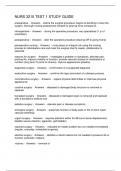
NURS 3210 TEST 1 STUDY GUIDE
preoperative - Answers - before the surgical procedure, begins at deciding to have the
surgery, thorough nursing assessment needed for post-op to be compare to
intraoperative - Answers - during the operative procedure, very specialized (1 yr of
orientation)
postoperative - Answers - after the operative procedure (leaving OR to going home)
perioperative nursing - Answers - nurse plays an integral role using the nursing
process to individualize care and meet the surgical client's needs, collaboration is
essential
reasons for surgery - Answers - investigate a problem or symptoms, alleviate pain,
prolong life, improve mobility or function, provide vascular access for medications or
nutrition (long term IV ports for chemo), improve appearance (plastics)
diagnostic surgery - Answers - confirmation of a suspected diagnosis
explorative surgery - Answers - confirms the type and extent of a disease process
reconstructive surgery - Answers - repairs physical deformities or improves physical
appearance
curative surgery - Answers - diseased or damaged body structure is removed or
repaired
transplant surgery - Answers - diseased or damaged organ is removed and replaced
with a donated or artificial one
pallative surgery - Answers - alleviate pain or disease symptoms
emergent surgery - Answers - preserves function of body parts or life of client (open
vascular bleeding)
urgent surgery - Answers - requires attention within 24-48 hours (bone displacement,
bladder severe infection, appendix, gall bladder)
required surgery - Answers - indicated for health problem but not needed immediately
(regular, everyday, scheduled surgeries)
elective surgery - Answers - satisfies a client's desire but not needed to preserve life or
function (cosmetic, implant)
-ectomy - Answers - removal of
, -lysis - Answers - destruction of
-orrhaphy - Answers - repair or suture of
-oscopy - Answers - creation of an opening into
-ostomy - Answers - cutting into or incision of
-plasty - Answers - repair or reconstruction of
ambulatory surgery - Answers - majority of surgeries, admitted on day of surgery and
discharged same day, few hours later, general regional or local anesthetis
hospital surgery - Answers - need for technology and more prolonged recover, need
nursing care
clinical or doctor's office surgeries - Answers - minor procedures, local anesthesia only
proper nutrition for surgical healing - Answers - vitamins A and C, protein
hygiene - Answers - the science of health and its maintenance
personal hygiene - Answers - self-care attending to functions of bathing, toileting,
general body hygiene and grooming. includes care of skin, hair, nails, teeth, oral and
nasal cavities, eyes, ears, and perineal care
benefits of bathing and hygiene - Answers - rid body of organisms, secretions, debris,
and odor, stimulate circulation, provide relaxation, improve mobility (ROM), evaluate
skin integrity (every patient), opportunity to establish rapport
5 major skin functions - Answers - protect underlying tissue from microorganisms
regullate body temperature, secrete sebum, transmit sensation through nerve receptors,
produce and absorb vitamin D in conjunction with ultraviolet rays
sweat glands - Answers - sudoriferous glands
apocrine glands - Answers - axillae, anogenital, begin to function at puberty
eccrine glands - Answers - glands responsible for thermoregulation, sweat
ammonia dermatitis - Answers - diaper rash, caused by urine in contact with skin, keep
person clean and dry
erythema - Answers - redness with conditions such as rashes, sun exposure, elevated
body temp
preoperative - Answers - before the surgical procedure, begins at deciding to have the
surgery, thorough nursing assessment needed for post-op to be compare to
intraoperative - Answers - during the operative procedure, very specialized (1 yr of
orientation)
postoperative - Answers - after the operative procedure (leaving OR to going home)
perioperative nursing - Answers - nurse plays an integral role using the nursing
process to individualize care and meet the surgical client's needs, collaboration is
essential
reasons for surgery - Answers - investigate a problem or symptoms, alleviate pain,
prolong life, improve mobility or function, provide vascular access for medications or
nutrition (long term IV ports for chemo), improve appearance (plastics)
diagnostic surgery - Answers - confirmation of a suspected diagnosis
explorative surgery - Answers - confirms the type and extent of a disease process
reconstructive surgery - Answers - repairs physical deformities or improves physical
appearance
curative surgery - Answers - diseased or damaged body structure is removed or
repaired
transplant surgery - Answers - diseased or damaged organ is removed and replaced
with a donated or artificial one
pallative surgery - Answers - alleviate pain or disease symptoms
emergent surgery - Answers - preserves function of body parts or life of client (open
vascular bleeding)
urgent surgery - Answers - requires attention within 24-48 hours (bone displacement,
bladder severe infection, appendix, gall bladder)
required surgery - Answers - indicated for health problem but not needed immediately
(regular, everyday, scheduled surgeries)
elective surgery - Answers - satisfies a client's desire but not needed to preserve life or
function (cosmetic, implant)
-ectomy - Answers - removal of
, -lysis - Answers - destruction of
-orrhaphy - Answers - repair or suture of
-oscopy - Answers - creation of an opening into
-ostomy - Answers - cutting into or incision of
-plasty - Answers - repair or reconstruction of
ambulatory surgery - Answers - majority of surgeries, admitted on day of surgery and
discharged same day, few hours later, general regional or local anesthetis
hospital surgery - Answers - need for technology and more prolonged recover, need
nursing care
clinical or doctor's office surgeries - Answers - minor procedures, local anesthesia only
proper nutrition for surgical healing - Answers - vitamins A and C, protein
hygiene - Answers - the science of health and its maintenance
personal hygiene - Answers - self-care attending to functions of bathing, toileting,
general body hygiene and grooming. includes care of skin, hair, nails, teeth, oral and
nasal cavities, eyes, ears, and perineal care
benefits of bathing and hygiene - Answers - rid body of organisms, secretions, debris,
and odor, stimulate circulation, provide relaxation, improve mobility (ROM), evaluate
skin integrity (every patient), opportunity to establish rapport
5 major skin functions - Answers - protect underlying tissue from microorganisms
regullate body temperature, secrete sebum, transmit sensation through nerve receptors,
produce and absorb vitamin D in conjunction with ultraviolet rays
sweat glands - Answers - sudoriferous glands
apocrine glands - Answers - axillae, anogenital, begin to function at puberty
eccrine glands - Answers - glands responsible for thermoregulation, sweat
ammonia dermatitis - Answers - diaper rash, caused by urine in contact with skin, keep
person clean and dry
erythema - Answers - redness with conditions such as rashes, sun exposure, elevated
body temp