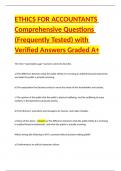
ETHICS FOR ACCOUNTANTS
Comprehensive Questions
(Frequently Tested) with
Verified Answers Graded A+
The term "expectations gap" has been coined to describe.
a) The difference between what the public thinks it is receiving in audited financial statements,
and what the public is actually receiving.
b) The expectation that business exists to serve the needs of the shareholders and society.
c) The opinion of the public that the public's physical wellbeing, and the wellbeing of some
workers, is threatened by corporate activity.
d) That directors, executives and managers are human, and make mistakes.
e) None of the above - Answer: a) The difference between what the public thinks it is receiving
in audited financial statements, and what the public is actually receiving.
Which among the following is NOT a common ethical decision-making pitfall?
a) Conforming to an ethical corporate culture.
,b) Focusing only on legalities.
c) Conflicts of interest.
d) Failure to consider the motivation for the decision.
e) Limits to rights canvassed - Answer: a) Conforming to an ethical corporate culture
Which of the following areas does the Sarbanes-Oxley Act NOT cover?
a) The responsibilities of management.
b) Conflicts of interest.
c) The responsibilities of the auditors.
d) Whistle-blower rights for employees of non-public companies - Answer: d) Whistle-blower
rights for employees of non-public companies
"Everyone is entitled to pursue their own goals as long as they do not violate the practical
imperative" is the deontological ethics principle of what moralist?
a) Frances Kamm.
b) Rene Descartes.
,c) Immanuel Kant.
d) Thomas Nagel. - Answer: c) Immanuel Kant
The United States Congress passed which act as a result of the subprime mortgage crisis?
a) Dodd-Frank Wall Street Reform and Consumer Protection Act.
b) American Recovery and Reinvestment Act.
c) United States Patriot Act.
d) Chinese Exclusion Act. - Answer: a) Dodd-Frank Wall Street Reform and Consumer Protection
Act.
Which of the following is a FALSE statement concerning Utilitarianism?
a) Utilitarianism ignores motivation and focuses only on consequences.
b) Utilitarianism has evolved along two main lines - "Act Utilitarianism" and "Rule
Utilitarianism."
c) Minority rights are always protected under Utilitarianism.
d) Act Utilitarianism is sometimes referred to as consequentialism. - Answer: c) Minority rights
are always protected under Utilitarianism
, Avoiding common ethical decision-making pitfalls is imperative. Which of the following are
common mistakes made by unaware decision-makers?
a) Conflicts of interest.
b) Interconnectedness of stakeholders.
c) Failure to rank the specific interest of stakeholders.
d) All of the above - Answer: a) Conflicts of interest.
b) Interconnectedness of stakeholders.
c) Failure to rank the specific interest of stakeholders.
D) ALL OF THE ABOVE
Which of the items below did Charles Fombrun identify as a determinant of reputation?
a) Credibility.
b) Reliability.
c) Trustworthiness.
d) Responsibility.
Comprehensive Questions
(Frequently Tested) with
Verified Answers Graded A+
The term "expectations gap" has been coined to describe.
a) The difference between what the public thinks it is receiving in audited financial statements,
and what the public is actually receiving.
b) The expectation that business exists to serve the needs of the shareholders and society.
c) The opinion of the public that the public's physical wellbeing, and the wellbeing of some
workers, is threatened by corporate activity.
d) That directors, executives and managers are human, and make mistakes.
e) None of the above - Answer: a) The difference between what the public thinks it is receiving
in audited financial statements, and what the public is actually receiving.
Which among the following is NOT a common ethical decision-making pitfall?
a) Conforming to an ethical corporate culture.
,b) Focusing only on legalities.
c) Conflicts of interest.
d) Failure to consider the motivation for the decision.
e) Limits to rights canvassed - Answer: a) Conforming to an ethical corporate culture
Which of the following areas does the Sarbanes-Oxley Act NOT cover?
a) The responsibilities of management.
b) Conflicts of interest.
c) The responsibilities of the auditors.
d) Whistle-blower rights for employees of non-public companies - Answer: d) Whistle-blower
rights for employees of non-public companies
"Everyone is entitled to pursue their own goals as long as they do not violate the practical
imperative" is the deontological ethics principle of what moralist?
a) Frances Kamm.
b) Rene Descartes.
,c) Immanuel Kant.
d) Thomas Nagel. - Answer: c) Immanuel Kant
The United States Congress passed which act as a result of the subprime mortgage crisis?
a) Dodd-Frank Wall Street Reform and Consumer Protection Act.
b) American Recovery and Reinvestment Act.
c) United States Patriot Act.
d) Chinese Exclusion Act. - Answer: a) Dodd-Frank Wall Street Reform and Consumer Protection
Act.
Which of the following is a FALSE statement concerning Utilitarianism?
a) Utilitarianism ignores motivation and focuses only on consequences.
b) Utilitarianism has evolved along two main lines - "Act Utilitarianism" and "Rule
Utilitarianism."
c) Minority rights are always protected under Utilitarianism.
d) Act Utilitarianism is sometimes referred to as consequentialism. - Answer: c) Minority rights
are always protected under Utilitarianism
, Avoiding common ethical decision-making pitfalls is imperative. Which of the following are
common mistakes made by unaware decision-makers?
a) Conflicts of interest.
b) Interconnectedness of stakeholders.
c) Failure to rank the specific interest of stakeholders.
d) All of the above - Answer: a) Conflicts of interest.
b) Interconnectedness of stakeholders.
c) Failure to rank the specific interest of stakeholders.
D) ALL OF THE ABOVE
Which of the items below did Charles Fombrun identify as a determinant of reputation?
a) Credibility.
b) Reliability.
c) Trustworthiness.
d) Responsibility.