INTERNATIONAL RELATIONS
FINALS JUNE 2025
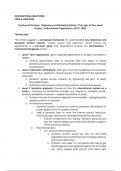
[Lecture 8] Putnam, “Diplomacy and Domestic Politics: The Logic of Two-Level
Games,” International Organization, 42(3), 1988.
The key idea:
The article suggests a conceptual framework for understanding how diplomacy and
domestic politics interact. Putnam argues that diplomacy (when making intl’
agreements) is a two-level game (intl’ negotiations involves two simultaneous +
interconnected games at one):
1. Level 1 (intl’ negotiation): govts negotiate agreements w/ foreign counterparts/
leaders.
a. national governments seek to maximize their own ability to satisfy
domestic pressures, while minimizing the adverse consequences of foreign
developments.
2. Level 2 (domestic ratification): each govt must secure approval from domestic
constituencies (e.g., legislators, interest groups, or the public) for the agreement
to be valid.
a. Domestic groups pursue interests by pressuring the govt’ to adopt
favourable policies.
b. Politicians seek power by constructing coalitions among those groups.
3. Level 3 (systemic analysis): focuses on how the international system as a
whole — including the distribution of power (e.g., bipolar vs. multipolar world),
alliances, and global structures — shapes the behavior of states.
a. Putnam criticizes the systemic approach as incomplete - highlighting that
domestic politics is necessary.
b. In Putnam’s framework:
i. Systemic analysis focuses on external pressures like balance of
power, global norms, or systemic threats.
ii. Adds a domestic layer to show the internal politics (elections,
interest groups, institutions) can shape international decisions.
1. Putnam complements this. Saying, “Systemic pressures are
real, but national leaders also have to win domestic support.
These two levels interact.”
iii. Real-life examples:
1. U.S.–Soviet Cold War Diplomacy
a. Systemic analysis would say: The U.S. and USSR
negotiated arms control because of strategic balance
and mutual deterrence.
b. Putnam’s view adds: U.S. presidents also had to get
Senate approval and respond to public fear of nuclear
war, which shaped what kind of arms deals were
, politically possible.
Summary Table:
Concept Meaning In Putnam’s View
Systemic Analysis of state behavior Important, but incomplete
Analysis based on global structure without domestic
(e.g., power, threats) politics
Putnam’s Adds the internal/domestic Shows how foreign policy is
Contribu layer to systemic analysis shaped by both global
tion and domestic forces
Main points:
● Intl’ agreements must also work domestically
○ i.e., a good deal abroad may still fail if it is unpopular back at home.
○ Example: The U.S. negotiated the Paris Climate Agreement in 2015 (Level
I), but in 2017, President Trump withdrew from it, arguing it was bad for
American workers and industries (Level II pressure). Even though the
international side was settled, domestic politics reversed it. [2nd image
reverse]
● Each country has a ‘win-set’
○ Win-Set: The set of all possible Level I agreements that would be
acceptable to domestic constituencies at Level II.
■ Larger win-sets = Level 1 agreements more likely = more flexibility
to compromise.
■ Smaller win-sets = harder to make a deal, but greater bargaining
power.
● If you want to make a better deal → you want to make the
impression you have a smaller win-set.
○ Example: During Brexit negotiations, UK Prime Minister Theresa May had a
tiny win-set because Parliament and the public were deeply divided. She
couldn’t offer or accept much, which made it very hard to strike a final deal
with the EU.
● Why are smaller winsets preferable?
1. Stronger Negotiating Position
a. Smaller winset means fewer acceptable deals for your domestic
audience.
b. Forces the other side to make greater concessions to fit with your
constraints.
2. Reduces the risk of rejection
a. Larger winsets also mean higher chance of disapproval
b. A smaller winset means credible commitment - deals that would
definitely pass would be proposed
3. Avoids involuntary defection
, a. Even if a deal is accepted at level 1, it may be rejected at level 2 (for
large winsets), thus smaller winsets are ratifiable from the start.
4. Encourages reciprocal concessions
a. If both sides have smaller winsets, they would negotiate seriously
and make realistic demands.
● Negotiator’s Role: Diplomats must manage both domestic and international
pressures.
○ Their strategies include:
1. Communicating the deal's benefits to domestic audiences.
2. Using side-payments or concessions (e.g., subsidies) to align
domestic preferences with international goals.
3. Manipulating uncertainty about domestic approval to influence
negotiations.
○ Negotiation is decomposed into two stages of process:
1. Level 1: Bargaining between the negotiators, leading to a tentative
agreement.
2. Level 2: Separate discussion within each group of constituents
about whether to ratify the agreement.
1. This may be an iterative process as negotiators try all
possible agreements + probe constituents’ view.
2. Level 2 actors may represent: bureaucratic agencies,
interest groups, social classes, public opinion.
3. Formal constraint of ratification: identical agreement must
be ratified by both sides.
How to secure the agreement at Level II:
Chief Negotiator of A → to Country B
Country A: Domestic Constituency Country B: Domestic Constituency
1. Reverberation
1. Side payments 2. Synergistic Linkage
2. Politicising (public opinion/
publicity) → decrease the size of
win-set or increase
3. Tying hands → decrease the size
of win-set
1. Side Payments: concession/ extra benefit offered to help secure the agreement -
esp. at Level II stage.
a. i.e., money, political favors, or policy adjustments
b. Aim: to win over reluctant domestic actors to get the agreement ratified.
, c. Putnam uses this idea to show that ratification isn't just about the
agreement itself — it's about making it acceptable to key domestic
players.
d. Side payments show how leaders often need to negotiate internally as
much as they do internationally.
e. Real-life examples:
i. North American Free Trade Agreement (NAFTA): Pres. Clinton
wanted to pass NAFTA in early 1990s, but labour unions/ Democrats
opposed it.
1. Result: the Clinton administration offered side payments ->
i.e., working retraining programs + environmental side
agreements ->in turn, they gained political support and was
ratified through Congress.
ii. EU Treaty Ratifications: EU member states wants to make domestic
concessions to pass EU treaties → i.e., promising referundums or
financial aid to regions hurt by integration.
2. Politicising: An international issue or agreement becomes a public, political
controversy domestically — making it harder to negotiate or ratify.
a. At Level I, leaders try to reach an agreement → at Level II, if the issue gets
politicised, it becomes harder to ratify the deal:
i. Politicians may take public positions for political gain.
ii. Media and opposition parties may attack the deal.
iii. Public protests or backlash can grow.
iv. Result: This shrinks the domestic “win-set” and limits flexibility.
b. Importance: Politicising an issue makes the Level II game harder to win.
i. It increases domestic resistance and decreases the room for
international compromise.
ii. Leaders may avoid politicising sensitive deals to preserve
negotiating flexibility.
c. Real-life examples:
i. The Transatlantic Trade and Investment Partnership (TTIP):
negotiated between the US, EU, TTIP -> became highly politicised in
Europe.
1. Protesters feared threats to food safety, labor rights, and
national sovereignty.
2. It became a rallying point for anti-globalization movements.
3. As a result, many European governments became unwilling
to ratify it.
ii. Brexit Referendum (2016): What started as an EU membership issue
became politicised in UK domestic politics:
1. Media coverage, populist rhetoric, and party politics turned it
into a national identity issue.
2. Once politicised, compromise became very difficult.
iii. Climate Agreements in the U.S.: The Kyoto Protocol and Paris
Agreement were both politicised in the U.S.:
FINALS JUNE 2025
[Lecture 8] Putnam, “Diplomacy and Domestic Politics: The Logic of Two-Level
Games,” International Organization, 42(3), 1988.
The key idea:
The article suggests a conceptual framework for understanding how diplomacy and
domestic politics interact. Putnam argues that diplomacy (when making intl’
agreements) is a two-level game (intl’ negotiations involves two simultaneous +
interconnected games at one):
1. Level 1 (intl’ negotiation): govts negotiate agreements w/ foreign counterparts/
leaders.
a. national governments seek to maximize their own ability to satisfy
domestic pressures, while minimizing the adverse consequences of foreign
developments.
2. Level 2 (domestic ratification): each govt must secure approval from domestic
constituencies (e.g., legislators, interest groups, or the public) for the agreement
to be valid.
a. Domestic groups pursue interests by pressuring the govt’ to adopt
favourable policies.
b. Politicians seek power by constructing coalitions among those groups.
3. Level 3 (systemic analysis): focuses on how the international system as a
whole — including the distribution of power (e.g., bipolar vs. multipolar world),
alliances, and global structures — shapes the behavior of states.
a. Putnam criticizes the systemic approach as incomplete - highlighting that
domestic politics is necessary.
b. In Putnam’s framework:
i. Systemic analysis focuses on external pressures like balance of
power, global norms, or systemic threats.
ii. Adds a domestic layer to show the internal politics (elections,
interest groups, institutions) can shape international decisions.
1. Putnam complements this. Saying, “Systemic pressures are
real, but national leaders also have to win domestic support.
These two levels interact.”
iii. Real-life examples:
1. U.S.–Soviet Cold War Diplomacy
a. Systemic analysis would say: The U.S. and USSR
negotiated arms control because of strategic balance
and mutual deterrence.
b. Putnam’s view adds: U.S. presidents also had to get
Senate approval and respond to public fear of nuclear
war, which shaped what kind of arms deals were
, politically possible.
Summary Table:
Concept Meaning In Putnam’s View
Systemic Analysis of state behavior Important, but incomplete
Analysis based on global structure without domestic
(e.g., power, threats) politics
Putnam’s Adds the internal/domestic Shows how foreign policy is
Contribu layer to systemic analysis shaped by both global
tion and domestic forces
Main points:
● Intl’ agreements must also work domestically
○ i.e., a good deal abroad may still fail if it is unpopular back at home.
○ Example: The U.S. negotiated the Paris Climate Agreement in 2015 (Level
I), but in 2017, President Trump withdrew from it, arguing it was bad for
American workers and industries (Level II pressure). Even though the
international side was settled, domestic politics reversed it. [2nd image
reverse]
● Each country has a ‘win-set’
○ Win-Set: The set of all possible Level I agreements that would be
acceptable to domestic constituencies at Level II.
■ Larger win-sets = Level 1 agreements more likely = more flexibility
to compromise.
■ Smaller win-sets = harder to make a deal, but greater bargaining
power.
● If you want to make a better deal → you want to make the
impression you have a smaller win-set.
○ Example: During Brexit negotiations, UK Prime Minister Theresa May had a
tiny win-set because Parliament and the public were deeply divided. She
couldn’t offer or accept much, which made it very hard to strike a final deal
with the EU.
● Why are smaller winsets preferable?
1. Stronger Negotiating Position
a. Smaller winset means fewer acceptable deals for your domestic
audience.
b. Forces the other side to make greater concessions to fit with your
constraints.
2. Reduces the risk of rejection
a. Larger winsets also mean higher chance of disapproval
b. A smaller winset means credible commitment - deals that would
definitely pass would be proposed
3. Avoids involuntary defection
, a. Even if a deal is accepted at level 1, it may be rejected at level 2 (for
large winsets), thus smaller winsets are ratifiable from the start.
4. Encourages reciprocal concessions
a. If both sides have smaller winsets, they would negotiate seriously
and make realistic demands.
● Negotiator’s Role: Diplomats must manage both domestic and international
pressures.
○ Their strategies include:
1. Communicating the deal's benefits to domestic audiences.
2. Using side-payments or concessions (e.g., subsidies) to align
domestic preferences with international goals.
3. Manipulating uncertainty about domestic approval to influence
negotiations.
○ Negotiation is decomposed into two stages of process:
1. Level 1: Bargaining between the negotiators, leading to a tentative
agreement.
2. Level 2: Separate discussion within each group of constituents
about whether to ratify the agreement.
1. This may be an iterative process as negotiators try all
possible agreements + probe constituents’ view.
2. Level 2 actors may represent: bureaucratic agencies,
interest groups, social classes, public opinion.
3. Formal constraint of ratification: identical agreement must
be ratified by both sides.
How to secure the agreement at Level II:
Chief Negotiator of A → to Country B
Country A: Domestic Constituency Country B: Domestic Constituency
1. Reverberation
1. Side payments 2. Synergistic Linkage
2. Politicising (public opinion/
publicity) → decrease the size of
win-set or increase
3. Tying hands → decrease the size
of win-set
1. Side Payments: concession/ extra benefit offered to help secure the agreement -
esp. at Level II stage.
a. i.e., money, political favors, or policy adjustments
b. Aim: to win over reluctant domestic actors to get the agreement ratified.
, c. Putnam uses this idea to show that ratification isn't just about the
agreement itself — it's about making it acceptable to key domestic
players.
d. Side payments show how leaders often need to negotiate internally as
much as they do internationally.
e. Real-life examples:
i. North American Free Trade Agreement (NAFTA): Pres. Clinton
wanted to pass NAFTA in early 1990s, but labour unions/ Democrats
opposed it.
1. Result: the Clinton administration offered side payments ->
i.e., working retraining programs + environmental side
agreements ->in turn, they gained political support and was
ratified through Congress.
ii. EU Treaty Ratifications: EU member states wants to make domestic
concessions to pass EU treaties → i.e., promising referundums or
financial aid to regions hurt by integration.
2. Politicising: An international issue or agreement becomes a public, political
controversy domestically — making it harder to negotiate or ratify.
a. At Level I, leaders try to reach an agreement → at Level II, if the issue gets
politicised, it becomes harder to ratify the deal:
i. Politicians may take public positions for political gain.
ii. Media and opposition parties may attack the deal.
iii. Public protests or backlash can grow.
iv. Result: This shrinks the domestic “win-set” and limits flexibility.
b. Importance: Politicising an issue makes the Level II game harder to win.
i. It increases domestic resistance and decreases the room for
international compromise.
ii. Leaders may avoid politicising sensitive deals to preserve
negotiating flexibility.
c. Real-life examples:
i. The Transatlantic Trade and Investment Partnership (TTIP):
negotiated between the US, EU, TTIP -> became highly politicised in
Europe.
1. Protesters feared threats to food safety, labor rights, and
national sovereignty.
2. It became a rallying point for anti-globalization movements.
3. As a result, many European governments became unwilling
to ratify it.
ii. Brexit Referendum (2016): What started as an EU membership issue
became politicised in UK domestic politics:
1. Media coverage, populist rhetoric, and party politics turned it
into a national identity issue.
2. Once politicised, compromise became very difficult.
iii. Climate Agreements in the U.S.: The Kyoto Protocol and Paris
Agreement were both politicised in the U.S.: