NSG 6005 Advanced Pharmacology FL02 Week 7 Discussion 1 / Discussion 2 Completed A
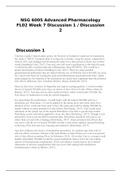
NSG 6005 Advanced Pharmacology FL02 Week 7 Discussion 1 / Discussion 2 Discussion 1 Tom has a grade I lateral ankle sprain, the first line of treatment would not be medication but rather a “RICE” treatment plan of resting the extremity, icing the sprain, compression with an ACE type bandage and elevating the ankle for a time period of about two to three weeks (Sandberg-Cook, 2017). Tom may also still need a medication to alleviate the pain, I would prescribe a nonsteroidal anti-inflammatory drug (NSAIDs). This would be a proper prescription of choice (Sandberg-Cook, 2017). There are some possible gastrointestinal difficulties that are linked with the use of NSAIDs, but if NSAIDs are used for a short term basis for treating the pain and inflammation associated with Tom’s ankle sprain diagnosis, the benefits of the medication are much more important than the potential side effects (Bekerom, Sjer, Somford, Bulstra, Struijs, Kerkhoffs, 2015). Since he does have a history of ibuprofen and aspirin causing gastritis, I would consider the use of topical NSAIDs since they are shown to have fewer GI side effects (Abate & Buttaro, 2015). Tom also has no other medical history which would make NSAIDs the best choice of medication to treat his current diagnosis. For prescribing the medications, I would begin with the topical NSAIDs such as a diclofenac gel. Diclofenac 1% can be applied to the sprain up to four times daily for a duration of two weeks has been seen to have the same pain relief as taking NSAIDs by mouth without as many potential GI side effects (Diclofenac, 2017). Tom would need education on the proper use of the topical Diclofenac to be able to get the best results. Diclofenac is best used when applied to clean, dry skin (Diclofenac, 2017). Though it was advised for Tom to use the RICE treatment plan, Diclofenac should be left open to air rather than covered with a bandage (Diclofenac, 2017). Some potential side effects that can occur with the use of topical NSAIDs include a rash where applied, unusual bleeding, yellowing of the skin and eyes, burning and numbness (Diclofenac, 2017). Age does influence the choice of medication prescribed. As a patient age, their risk of adverse effects increases. Patients with renal failure or heart disease are at an even greater risk of side effects occurring (Woo, & Robinson, 2015). Given that Tom is a young overall healthy individual, NSAIDs would be a good medication choice, but if he were taking aspirin or blood pressure medications, closer surveillance would need to be of utmost importance to prevent complications that can occur from taking both medications simultaneously (Abate & Buttaro, 2015). References: Abate, K. S., & Buttaro, T. M. (2015). Safe and effective NSAID use. Nurse Practitioner, 40(6), 18-22. doi:10.1097/01.NPR.5.35030.3a Bekerom, M., Sjer, A., Somford, M., Bulstra, G., Struijs, P., & Kerkhoffs, G. (2015). Non-steroidal anti-inflammatory drugs (NSAIDs) for treating acute ankle sprains in adults: benefits outweigh adverse events. Knee Surgery, Sports Traumatology, Arthroscopy, 23(8), . Diclofenac (Topical Application Route) Description and Brand Names. (2017, March 01). Retrieved from Sandberg-Cook, J. (2017). Ankle and foot pain. In T. M. Buttaro, J. A. Trybulski, P. Polgar-Bailey, & J. Sandberg-Cook (Eds). Primary care: A collaborative practice 5th Edition (pp. 897-905). Retrieved from: Woo, T. & Robinson, M. (2015). Pharmacotherapeutics for Advanced Practice Nurse Prescribers with Davis Plus eResourses, 4th ed. F.A. Davis Company. ISBN: 8273 Discussion 2 Ibuprofen, like other non-steroidal anti-inflammatory drugs (NSAIDs), has several potential side effects. The two most frequently affected organ systems are the renal (kidneys) and gastrointestinal (GI) systems. In the case of the former, kidney damage, usually reversible, can result from chronic ingestion of NSAIDs. It may also happen as the result of short-term ingestion, for example, taking one or two doses. There are contributing factors which increase the risk of renal toxicity for example diabetes, dehydration. Apart from damage to the kidneys, NSAIDs alter how the kidneys regulate sodium and water balance which may have profound consequences in hot training and racing environments (Wongrakpanich, Wongrakpanich, Melhado, & Rangaswami, 2018). Patient education is critical, the NP should educate the patient on NSAIDs which can increase the chance of heart attack or stroke. Inform the patient of nonsmoking, if the patient has high blood pressure, high cholesterol, diabetes disease they will also be at risk, therefore advising the patient. However, the risk may also be increased in people who do not have heart disease or those risk factors. Additionally, NSAIDs should not be used right before or after heart bypass surgery and NSAIDs may increase the chance of serious stomach and bowel side effects like ulcers and bleed (Wongrakpanich, Wongrakpanich, Melhado, & Rangaswami, 2018). An acute overdose happens if you accidentally take too much aspirin at one time. It leads to stomach upset, pain, nausea and vomiting. The severe irritation of the stomach lining can cause ulcers to develop. Permanent damage to the gastrointestinal tract is possible. Additionally, the patient should be educated about dosage, because an overdose can be fatal, and symptoms like hyperventilation, double vision and fainting can make it hard to seek help. Also, the NP should advise that it is best to take this medicine with food or milk, capsule, tablet, or coated tablet should be swallowed whole. The diagnosis for which you would administer NSAIDS are arthritis, bursitis, and tendonitis. NSAIDs are relatively inexpensive and are frequently the first line of medication used to relieve pain and reduce inflammation. Very low doses of NSAIDs may be prescribed for people with cardiac disease. Aspirin works by reducing substances in the body that cause pain, fever, and inflammation. Aspirin is used to treat pain and reduce fever or inflammation. It is sometimes used to treat or prevent heart attacks, strokes, and chest pain such as angina (Wongrakpanich, Wongrakpanich, Melhado, & Rangaswami, 2018). The labs or diagnostic tests would you perform for a patient who has consumed too much Aspirin would be to obtain a serum acetaminophen (APAP) level, in view of the possibility of co-ingestion. In acute overdose, asymptomatic patients with no co-ingestions may not require specific serum or urine studies other than a serum acetaminophen level. A 4-hour acetaminophen level should be ordered in every patient with suspected ingestion due to the notorious lack of signs and symptoms in the initial 24 hours after acetaminophen ingestion. Consider obtaining baseline renal and hepatic function tests in patients with asymptomatic ingestions of phenylbutazone, mefenamic acid, and meclofenamate. Additionally, patients who are symptomatic and/or those with large ingestions of NSAIDs should have blood taken to check their full blood count, clotting, electrolytes, renal function, liver function tests, and acid-base status. It is particularly important that patients with significant drowsiness and/or other neurological features should have an arterial blood gas to check for metabolic acidosis (Hunter, Wood, & Dargan, 2011). Reference Hunter, L. J., Wood, D. M., & Dargan, P. I. (2011). The patterns of toxicity and management of acute nonsteroidal anti-inflammatory drug (NSAID) overdose. Open Access Emergency Medicine : OAEM, 3, 39–48. Wongrakpanich, S., Wongrakpanich, A., Melhado, K., & Rangaswami, J. (2018). A Comprehensive Review of Non-Steroidal Anti-Inflammatory Drug Use in The Elderly. Aging and Disease, 9(1), 143–150.
Geschreven voor
- Instelling
-
South University
- Vak
-
NSG 6005
Documentinformatie
- Geüpload op
- 25 oktober 2020
- Aantal pagina's
- 4
- Geschreven in
- 2020/2021
- Type
- Study guide
Onderwerpen
-
nsg 6005 advanced pharmacology fl02 week 7 discussion 1 discussion 2 discussion 1 tom has a grade i lateral ankle sprain
-
the first line of treatment would not be medication but rather a “rice” tr
Ook beschikbaar in voordeelbundel