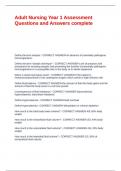
Adult Nursing Year 1 Assessment
Questions and Answers complete
Define the term asepsis - CORRECT ANSWER-an absence of potentially pathogenic
microorganisms.
Define the term "aseptic technique" - CORRECT ANSWER-a set of practices and
procedures for ensuring asepsis and preventing the transfer of potentially pathogenic
microorganisms to a susceptible site on the body or to sterile equipment
When is sterile technique used? - CORRECT ANSWER-if the patient is
immunocompromised or has undergone surgery which carries a high infection risk
Define fluid balance - CORRECT ANSWER-the amount of fluid the body gains and the
amount of fluid the body loses in a 24 hour period.
Consequences of fluid imbalance - CORRECT ANSWER-hypovolaemia,
hypervolaemia, electrolyte imbalance
Define hypervolaemia - CORRECT ANSWER-fluid overload
Define hypovolaemia - CORRECT ANSWER-dehydration or volume depletion
How much is the total body water volume? - CORRECT ANSWER-40l, 60% body
weight
How much is the intracellular fluid volume? - CORRECT ANSWER-25l, 40% body
weight
How much is the extracellular fluid volume? - CORRECT ANSWER-15l, 20% body
weight
How much is the interstitial fluid volume? - CORRECT ANSWER-12l, 80% of
extracellular fluid volume
,How much is the plasma volume? - CORRECT ANSWER-3l, 20% of extracellular fluid
volume
Function of potassium - CORRECT ANSWER-vita for the function of nerves and
muscles
Function of sodium - CORRECT ANSWER-regulates the amount of water in the body
and controls blood pressure
Function of chloride - CORRECT ANSWER-works alongside other electrolytes to
maintain the normal acid-base balance
signs of hypovolaemia include: - CORRECT ANSWER-dry mouth, poor skin turgor,
altered consciousness, poor capillary refill time, dark urine, fast pulse, low bp, fast resp
rate
Signs of Hypervolemia include: - CORRECT ANSWER-oedema, breathing difficulty,
increased jugular vein distention
What is urea in the urine an indicator of? - CORRECT ANSWER-breakdown of protein
What is creatinine in the urine an indicator of? - CORRECT ANSWER-muscle
breakdown
If urea and creatinine levels rise with a sudden reduction in renal function what is this an
indication of? - CORRECT ANSWER-acute kidney injury
What is normal urine output? - CORRECT ANSWER-0.5mL/kg/hour
Examples of fluid inputs: - CORRECT ANSWER-drinks, enteral feeds, iv fluids,
parenteral nutrition, fluids from foods
Examples of fluid output: - CORRECT ANSWER-urine, faecal losses, vomit, drains,
stoma
What should normal urine be? - CORRECT ANSWER-pale, odourless, straw coloured
Define oliguria - CORRECT ANSWER-urine output of less than 0.5mL/kg/hour
Define polyuria - CORRECT ANSWER-output more than 3L/day
Complications of hypervolaemia include: - CORRECT ANSWER-hypertensions,
congestive heart failure, pulmonary oedema, delayed wound healing
, How do diuretics work? - CORRECT ANSWER-they reduce sodium reabsorption at
different points in the nephrons of the kidneys, resulting in increased urinary sodium and
water loss
What is the measurement taken by a pulse oximeter? - CORRECT ANSWER-The
saturation of haemoglobin by oxygen in the arterial system
What important parameter of lung function does pulse oximetry not measure? -
CORRECT ANSWER-carbon dioxide
What is the target oxygen saturation for most acutely ill patients? - CORRECT
ANSWER-94-98
What is the preferred site of pulse oximetry for patients with poor peripheral blood flow?
- CORRECT ANSWER-ear lobe
What condition could produce a falsely high o2 sats reading? - CORRECT ANSWER-
carbon monoxide poisoning
Six factors which can lead to unreliable pulse oximetry reading? - CORRECT
ANSWER-cold extremities, shock, hypotension, hypothermia, cardiac arrhythmia, heart
failure, nail varnish
In acutely ill or deteriorating patients what other method is used to assess oxygen
saturation? - CORRECT ANSWER-arterial blood gas
Define the term bradypnoea - CORRECT ANSWER-slow respiratory rate less than 12
breaths per minute
Define the term tachypnoea - CORRECT ANSWER-fast respiratory rate more than 20
breaths per minute
Define the term apnoea - CORRECT ANSWER-Emergency when breathing stops
altogether
Define the term dyspnoea - CORRECT ANSWER-difficult, laboured, uncomfortable
breathing
Define the term orthopnoea - CORRECT ANSWER-dyspnoea experienced when
patient lies flat
What is external respiration? - CORRECT ANSWER-the drawing of air into the lungs
and gas exchange at the alveoli
What is internal respiration? - CORRECT ANSWER-exchange of gases between blood
and tissues
Questions and Answers complete
Define the term asepsis - CORRECT ANSWER-an absence of potentially pathogenic
microorganisms.
Define the term "aseptic technique" - CORRECT ANSWER-a set of practices and
procedures for ensuring asepsis and preventing the transfer of potentially pathogenic
microorganisms to a susceptible site on the body or to sterile equipment
When is sterile technique used? - CORRECT ANSWER-if the patient is
immunocompromised or has undergone surgery which carries a high infection risk
Define fluid balance - CORRECT ANSWER-the amount of fluid the body gains and the
amount of fluid the body loses in a 24 hour period.
Consequences of fluid imbalance - CORRECT ANSWER-hypovolaemia,
hypervolaemia, electrolyte imbalance
Define hypervolaemia - CORRECT ANSWER-fluid overload
Define hypovolaemia - CORRECT ANSWER-dehydration or volume depletion
How much is the total body water volume? - CORRECT ANSWER-40l, 60% body
weight
How much is the intracellular fluid volume? - CORRECT ANSWER-25l, 40% body
weight
How much is the extracellular fluid volume? - CORRECT ANSWER-15l, 20% body
weight
How much is the interstitial fluid volume? - CORRECT ANSWER-12l, 80% of
extracellular fluid volume
,How much is the plasma volume? - CORRECT ANSWER-3l, 20% of extracellular fluid
volume
Function of potassium - CORRECT ANSWER-vita for the function of nerves and
muscles
Function of sodium - CORRECT ANSWER-regulates the amount of water in the body
and controls blood pressure
Function of chloride - CORRECT ANSWER-works alongside other electrolytes to
maintain the normal acid-base balance
signs of hypovolaemia include: - CORRECT ANSWER-dry mouth, poor skin turgor,
altered consciousness, poor capillary refill time, dark urine, fast pulse, low bp, fast resp
rate
Signs of Hypervolemia include: - CORRECT ANSWER-oedema, breathing difficulty,
increased jugular vein distention
What is urea in the urine an indicator of? - CORRECT ANSWER-breakdown of protein
What is creatinine in the urine an indicator of? - CORRECT ANSWER-muscle
breakdown
If urea and creatinine levels rise with a sudden reduction in renal function what is this an
indication of? - CORRECT ANSWER-acute kidney injury
What is normal urine output? - CORRECT ANSWER-0.5mL/kg/hour
Examples of fluid inputs: - CORRECT ANSWER-drinks, enteral feeds, iv fluids,
parenteral nutrition, fluids from foods
Examples of fluid output: - CORRECT ANSWER-urine, faecal losses, vomit, drains,
stoma
What should normal urine be? - CORRECT ANSWER-pale, odourless, straw coloured
Define oliguria - CORRECT ANSWER-urine output of less than 0.5mL/kg/hour
Define polyuria - CORRECT ANSWER-output more than 3L/day
Complications of hypervolaemia include: - CORRECT ANSWER-hypertensions,
congestive heart failure, pulmonary oedema, delayed wound healing
, How do diuretics work? - CORRECT ANSWER-they reduce sodium reabsorption at
different points in the nephrons of the kidneys, resulting in increased urinary sodium and
water loss
What is the measurement taken by a pulse oximeter? - CORRECT ANSWER-The
saturation of haemoglobin by oxygen in the arterial system
What important parameter of lung function does pulse oximetry not measure? -
CORRECT ANSWER-carbon dioxide
What is the target oxygen saturation for most acutely ill patients? - CORRECT
ANSWER-94-98
What is the preferred site of pulse oximetry for patients with poor peripheral blood flow?
- CORRECT ANSWER-ear lobe
What condition could produce a falsely high o2 sats reading? - CORRECT ANSWER-
carbon monoxide poisoning
Six factors which can lead to unreliable pulse oximetry reading? - CORRECT
ANSWER-cold extremities, shock, hypotension, hypothermia, cardiac arrhythmia, heart
failure, nail varnish
In acutely ill or deteriorating patients what other method is used to assess oxygen
saturation? - CORRECT ANSWER-arterial blood gas
Define the term bradypnoea - CORRECT ANSWER-slow respiratory rate less than 12
breaths per minute
Define the term tachypnoea - CORRECT ANSWER-fast respiratory rate more than 20
breaths per minute
Define the term apnoea - CORRECT ANSWER-Emergency when breathing stops
altogether
Define the term dyspnoea - CORRECT ANSWER-difficult, laboured, uncomfortable
breathing
Define the term orthopnoea - CORRECT ANSWER-dyspnoea experienced when
patient lies flat
What is external respiration? - CORRECT ANSWER-the drawing of air into the lungs
and gas exchange at the alveoli
What is internal respiration? - CORRECT ANSWER-exchange of gases between blood
and tissues