ENGLISH 2: CONTENT CREATION
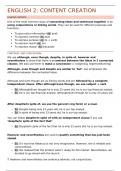
LINKING WORDS:
One of the most common ways of connecting ideas and sentences together is by
using conjunctions or linking words. They can be used for different purposes and
functions:
To give extra information (ex. and)
To express contrast (ex. but)
To express purpose (ex. to + verb)
To express result (ex. so)
To express reason (ex. because)
CONTRAST AND CONCESSION:
We use although, even though, despite, in spite of, however and
nevertheless to show that there is a contrast between the ideas in 2 connected
clauses. We also use them to make a concession (= toegeving, tegemoetkoming)
Although, even though and despite are similar to ‘but’, but emphasize the
difference between the contrasted ideas.
Although and even though act as linking words and are followed by a complete
independent clause. After although/even though, we use subject + verb
Ex. Although/Even though he is only 23 years old, he is our top financial analyst.
Ex. He is our top financial analyst, although/even though he is only 23 years old.
After despite/in spite of, we use the gerund (-ing form) or a noun.
Ex. Despite being only 23 years old, he is our top analyst.
Ex. In spite of being only 23 years old, he is our top analyst.
You can follow despite/in spite of with an independent clause if you use
‘despite/in spite of the fact that’:
Ex. Despite/In spite of the fact that he is only 23 years old, he is our top analyst.
However and nevertheless are used to qualify something that has just been
stated.
Ex. It’s true that Rebecca is not very imaginative. However, she is reliable and
conscientious.
Ex. We realized that the product wasn’t ready for the market. Nevertheless, we
decided to go ahead with the launch.
! However and nevertheless are sentence adverbs, not conjunctions.
LINKING WORDS:
One of the most common ways of connecting ideas and sentences together is by
using conjunctions or linking words. They can be used for different purposes and
functions:
To give extra information (ex. and)
To express contrast (ex. but)
To express purpose (ex. to + verb)
To express result (ex. so)
To express reason (ex. because)
CONTRAST AND CONCESSION:
We use although, even though, despite, in spite of, however and
nevertheless to show that there is a contrast between the ideas in 2 connected
clauses. We also use them to make a concession (= toegeving, tegemoetkoming)
Although, even though and despite are similar to ‘but’, but emphasize the
difference between the contrasted ideas.
Although and even though act as linking words and are followed by a complete
independent clause. After although/even though, we use subject + verb
Ex. Although/Even though he is only 23 years old, he is our top financial analyst.
Ex. He is our top financial analyst, although/even though he is only 23 years old.
After despite/in spite of, we use the gerund (-ing form) or a noun.
Ex. Despite being only 23 years old, he is our top analyst.
Ex. In spite of being only 23 years old, he is our top analyst.
You can follow despite/in spite of with an independent clause if you use
‘despite/in spite of the fact that’:
Ex. Despite/In spite of the fact that he is only 23 years old, he is our top analyst.
However and nevertheless are used to qualify something that has just been
stated.
Ex. It’s true that Rebecca is not very imaginative. However, she is reliable and
conscientious.
Ex. We realized that the product wasn’t ready for the market. Nevertheless, we
decided to go ahead with the launch.
! However and nevertheless are sentence adverbs, not conjunctions.