THE PASSIVE:
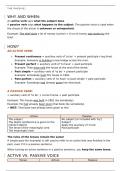
WHY AND WHEN:
An active verb says what the subject does.
A passive verb says what happens to the subject. The passive voice is used when
the clause of the action is unknown or unimportant.
Example: The thief stole a lot of money (active) > A lot of money was stolen by the
thief.
HOW?
AN ACTIVE VERB:
o Present continuous = auxiliary verb of ‘to be’ + present participle (-ing form)
Example: Someone is building a new bridge across the river.
o Present perfect = auxiliary verb of ‘to have’ + past participle
Example: They have sold the house at the end of the street.
o Past simple = auxiliary verb of ‘to be’ + present participle
Example: Somebody built this house in 1981.
o Past perfect = auxiliary verb of ‘to have’ or past simple + past participle
Example: Somebody had already given him that book.
A PASSIVE VERB:
= auxiliary verb of ‘to be’ + correct tense + past participle
Example: This house was built in 1981 (by somebody).
Example: He had already been given that book (by somebody).
> NIET: That book had already been given to him.
Active Passive
The subject No subject (or included with ‘by’)
The object (preference is given to the Subject
indirect object) Apply the auxiliary of ‘to be’
The tense of the meaningful verb Past participle
The meaningful verb
The rules of the tenses remain the same!
A simple past (for example) is still used to refer to an action that was finished in the
past, even if it is a passive sentence.
When turning an active sentence in a passive sentence, you keep the same tense.
ACTIVE VS. PASSIVE VOICE
Tense: Active: Passive:
WHY AND WHEN:
An active verb says what the subject does.
A passive verb says what happens to the subject. The passive voice is used when
the clause of the action is unknown or unimportant.
Example: The thief stole a lot of money (active) > A lot of money was stolen by the
thief.
HOW?
AN ACTIVE VERB:
o Present continuous = auxiliary verb of ‘to be’ + present participle (-ing form)
Example: Someone is building a new bridge across the river.
o Present perfect = auxiliary verb of ‘to have’ + past participle
Example: They have sold the house at the end of the street.
o Past simple = auxiliary verb of ‘to be’ + present participle
Example: Somebody built this house in 1981.
o Past perfect = auxiliary verb of ‘to have’ or past simple + past participle
Example: Somebody had already given him that book.
A PASSIVE VERB:
= auxiliary verb of ‘to be’ + correct tense + past participle
Example: This house was built in 1981 (by somebody).
Example: He had already been given that book (by somebody).
> NIET: That book had already been given to him.
Active Passive
The subject No subject (or included with ‘by’)
The object (preference is given to the Subject
indirect object) Apply the auxiliary of ‘to be’
The tense of the meaningful verb Past participle
The meaningful verb
The rules of the tenses remain the same!
A simple past (for example) is still used to refer to an action that was finished in the
past, even if it is a passive sentence.
When turning an active sentence in a passive sentence, you keep the same tense.
ACTIVE VS. PASSIVE VOICE
Tense: Active: Passive: