

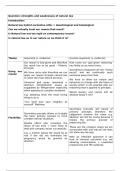
Question: strengths and weaknesses of natural law
Introduction:
Natural law hybrid normative ethic = deontological and teleological
Can we actually trust our reason that much?
Is Natural law not too rigid on contemporary issues?
Is natural law as in our nature as we think it is?
Theme Argument (+ evidence) Counter-argument (+ evidence)
Our reason is God given and therefore How come our ‘god given reasoning’
the result has to be good – Platonic has failed us so many times.
Principle
According to Augustine we are ‘messa
Using our We have recta ratio therefore we can pecati’ and we continually push
reason apply our reason through natural law ourselves away from God.
to make the most ethical decision.
We have to allow our nature and
Universal god given reasoning = behaviors to change with the times of
destroys interpretation issues as society which is not possible with our
suggested by Wittgenstein especially reasoning that is applied to precepts.
when applying to complex situations
Would slavery and racism still be
e.g. debating what the most loving allowed today if not?
thing to do is
“you shall love your neighbor as
yourself” Matthew
Secondary precepts still based of
primary precepts therefore the
Secondary precepts allows us to apply judgement remains the same e.g.
the basic primary precept to more abortion will still be wrong because it
Flexibility complex ethical situations. breaks the primary precept of
Double effect also considers the preserving life.
lesser of two evils = more likely to These are the complex issues we are
deal with complex issues successfully. surrounded with and natural law does
e.g. a mother whose life would be at not allow any lee way.
risk if she did not terminate her With an inflexible approach it can
pregnancy would be granted an lead to immoral outcomes e.g. not
abortion. allowing contraception = unwanted
pregnancies and HIV outbreak
, Aquinas’ natural law promotes The legalistic approach of the catholic
Christian virtues and recognizes love doctrine conflicts with the Christian
agape as a supreme virtue. notion of love.
Justice is always a virtue recognized ‘Sabbath was made for man, not man
and according to Fletcher “justice is for the sabbath” Mark
love distributed” and sometimes can
argue that justice is love. Christian love is person centered not
act centered
Primary and secondary precepts are
based on love. Doctrine of double effect also can
become problematic because who is
God gave us our recta ratio and since deciding want the lesser of two evils
God is good and all loving our moral is?
decisions should also be loving and
good = PLATONIC PRINCIPLE
Conclusion:
Specialist Terminology:
Synoptic Links:
,Question: “Human laws should be influenced by Natural Law”
Introduction:
Theme Argument (+ evidence) Counter-argument (+ evidence)
The deontological laws are a good Deontological rules are far too rigid to
guide for humans to follow since we apply to the contemporary ethical
Too rigid are corrupt and tend to sin. The issues of contemporary society. Do
precepts are also revealed through not consider modern issues like
recta ratio which is God given abortion and homosexual
therefore it has to be good. relationships.
The laws are based reason which is What about atheists? Can they get
favored in a post enlightenment era. behind a system with God at the
Therefore we can use our reason to center. There has been a decrease in
Based on determine how to do good and how to Christianity is society and some would
reason avoid evil which is then self-evident. say we are secularizing as a society
therefore perhaps Natural Law only
applies to the minority.
Human laws are already based on Natural Law undermines human rights
Natural Laws and it is effective in for example the right of a woman to
society. E.g. some of the UK laws choose whether she wants an
Reflects align with Christian deontological abortion or not – Kainz who is a
society rules such as ‘do not murder’. Roman Catholic theologian said this is
an important consideration.
, Conclusion:
Specialist Terminology:
Synoptic Links:
Question: “Aquinas’ Natural Law is a helpful moral guide”. Evaluate
Introduction:
Theme Argument (+ evidence) Counter-argument (+ evidence)
Introduction:
Natural law hybrid normative ethic = deontological and teleological
Can we actually trust our reason that much?
Is Natural law not too rigid on contemporary issues?
Is natural law as in our nature as we think it is?
Theme Argument (+ evidence) Counter-argument (+ evidence)
Our reason is God given and therefore How come our ‘god given reasoning’
the result has to be good – Platonic has failed us so many times.
Principle
According to Augustine we are ‘messa
Using our We have recta ratio therefore we can pecati’ and we continually push
reason apply our reason through natural law ourselves away from God.
to make the most ethical decision.
We have to allow our nature and
Universal god given reasoning = behaviors to change with the times of
destroys interpretation issues as society which is not possible with our
suggested by Wittgenstein especially reasoning that is applied to precepts.
when applying to complex situations
Would slavery and racism still be
e.g. debating what the most loving allowed today if not?
thing to do is
“you shall love your neighbor as
yourself” Matthew
Secondary precepts still based of
primary precepts therefore the
Secondary precepts allows us to apply judgement remains the same e.g.
the basic primary precept to more abortion will still be wrong because it
Flexibility complex ethical situations. breaks the primary precept of
Double effect also considers the preserving life.
lesser of two evils = more likely to These are the complex issues we are
deal with complex issues successfully. surrounded with and natural law does
e.g. a mother whose life would be at not allow any lee way.
risk if she did not terminate her With an inflexible approach it can
pregnancy would be granted an lead to immoral outcomes e.g. not
abortion. allowing contraception = unwanted
pregnancies and HIV outbreak
, Aquinas’ natural law promotes The legalistic approach of the catholic
Christian virtues and recognizes love doctrine conflicts with the Christian
agape as a supreme virtue. notion of love.
Justice is always a virtue recognized ‘Sabbath was made for man, not man
and according to Fletcher “justice is for the sabbath” Mark
love distributed” and sometimes can
argue that justice is love. Christian love is person centered not
act centered
Primary and secondary precepts are
based on love. Doctrine of double effect also can
become problematic because who is
God gave us our recta ratio and since deciding want the lesser of two evils
God is good and all loving our moral is?
decisions should also be loving and
good = PLATONIC PRINCIPLE
Conclusion:
Specialist Terminology:
Synoptic Links:
,Question: “Human laws should be influenced by Natural Law”
Introduction:
Theme Argument (+ evidence) Counter-argument (+ evidence)
The deontological laws are a good Deontological rules are far too rigid to
guide for humans to follow since we apply to the contemporary ethical
Too rigid are corrupt and tend to sin. The issues of contemporary society. Do
precepts are also revealed through not consider modern issues like
recta ratio which is God given abortion and homosexual
therefore it has to be good. relationships.
The laws are based reason which is What about atheists? Can they get
favored in a post enlightenment era. behind a system with God at the
Therefore we can use our reason to center. There has been a decrease in
Based on determine how to do good and how to Christianity is society and some would
reason avoid evil which is then self-evident. say we are secularizing as a society
therefore perhaps Natural Law only
applies to the minority.
Human laws are already based on Natural Law undermines human rights
Natural Laws and it is effective in for example the right of a woman to
society. E.g. some of the UK laws choose whether she wants an
Reflects align with Christian deontological abortion or not – Kainz who is a
society rules such as ‘do not murder’. Roman Catholic theologian said this is
an important consideration.
, Conclusion:
Specialist Terminology:
Synoptic Links:
Question: “Aquinas’ Natural Law is a helpful moral guide”. Evaluate
Introduction:
Theme Argument (+ evidence) Counter-argument (+ evidence)


