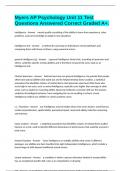
Myers AP Psychology Unit 11 Test
Questions Answered Correct Graded A+.
intelligence - Answer mental quality consisting of the ability to learn from experience, solve
problems, and use knowledge to adapt to new situations.
intelligence test - Answer a method for assessing an individual's mental aptitudes and
comparing them with those of others, using numerical scores.
general intelligence (g) - Answer a general intelligence factor that, according to Spearman and
others, underlies specific mental abilities and is therefore measured by every task on an
intelligence test.
Charles Spearman - Answer believed we have one general intelligence. He granted that people
often have special abilities that stand out and he helped develop factor analysis, a statistical
procedure that identifies clusters of related items. But Spearman also found that those who
score high in one area, such as verbal intelligence, typically score higher than average in other
areas, such as spatial or reasoning ability. Spearman believed a common skill set, the g factor,
underlies all intelligent behavior, from navigating the sea to excelling in school; a basic
intelligence predicts our abilities in varied academic areas.
L.L. Thurstone - Answer our intelligence may be broken down into seven factors: word fluency,
verbal comprehension, spatial ability, perceptual speed, numerical ability, inductive reasoning,
and memory.
factor analysis - Answer a statistical procedure that identifies clusters of related items (called
factors) on a test; used to identify different dimensions of performance that underlie a person's
total score.
Howard Gardner - Answer views intelligence as multiple abilities that come in different
packages; our abilities are best classified into eight independent intelligences, which include a
broad range of skills beyond traditional school smarts.
savant syndrome - Answer a condition in which a person otherwise limited in mental ability
has an exceptional specific skill, such as in computation or drawing.
Questions Answered Correct Graded A+.
intelligence - Answer mental quality consisting of the ability to learn from experience, solve
problems, and use knowledge to adapt to new situations.
intelligence test - Answer a method for assessing an individual's mental aptitudes and
comparing them with those of others, using numerical scores.
general intelligence (g) - Answer a general intelligence factor that, according to Spearman and
others, underlies specific mental abilities and is therefore measured by every task on an
intelligence test.
Charles Spearman - Answer believed we have one general intelligence. He granted that people
often have special abilities that stand out and he helped develop factor analysis, a statistical
procedure that identifies clusters of related items. But Spearman also found that those who
score high in one area, such as verbal intelligence, typically score higher than average in other
areas, such as spatial or reasoning ability. Spearman believed a common skill set, the g factor,
underlies all intelligent behavior, from navigating the sea to excelling in school; a basic
intelligence predicts our abilities in varied academic areas.
L.L. Thurstone - Answer our intelligence may be broken down into seven factors: word fluency,
verbal comprehension, spatial ability, perceptual speed, numerical ability, inductive reasoning,
and memory.
factor analysis - Answer a statistical procedure that identifies clusters of related items (called
factors) on a test; used to identify different dimensions of performance that underlie a person's
total score.
Howard Gardner - Answer views intelligence as multiple abilities that come in different
packages; our abilities are best classified into eight independent intelligences, which include a
broad range of skills beyond traditional school smarts.
savant syndrome - Answer a condition in which a person otherwise limited in mental ability
has an exceptional specific skill, such as in computation or drawing.