BSC 1010 Exam 2 Review questions with accurate
answers
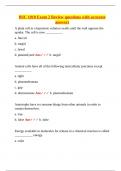
A plant cell in a hypotonic solution swells until the wall opposes the
uptake. The cell is now __________.
a. flaccid
b. turgid
c. lysed
d. plasmolyzed Ans✓✓✓ b. turgid
Animal cells have all of the following intercellular junctions except
__________.
a. tight
b. plasmodesmata
c. gap
d. desmosomes Ans✓✓✓ b. plasmodesmata
Autotrophs have to consume things from other animals in order to
sustain themselves.
a. true
b. false Ans✓✓✓ b. false
Energy available in molecules for release in a chemical reaction is called
___________ energy.
a. solar
, b. kinetic
c. potential
d. chemical Ans✓✓✓ d. chemical
Energy can be transferred and transformed, but it cannot be destroyed.
Which law of energy does this describe?
a. 1st law of thermodynamics
b. 2nd law of thermodynamics
c. spontaneous
d. free energy Ans✓✓✓ a. 1st law of thermodynamics
Energy that associated with random movement of atoms and molecules.
a. kinetic
b. heat
c. potential
d. thermal Ans✓✓✓ d. thermal
Energy that matter possesses because of the location or structure is
called __________ energy.
a. kinetic
b. thermal
c. potential Ans✓✓✓ c. potential
How much ATP is produced by the electron transport chain?
answers
A plant cell in a hypotonic solution swells until the wall opposes the
uptake. The cell is now __________.
a. flaccid
b. turgid
c. lysed
d. plasmolyzed Ans✓✓✓ b. turgid
Animal cells have all of the following intercellular junctions except
__________.
a. tight
b. plasmodesmata
c. gap
d. desmosomes Ans✓✓✓ b. plasmodesmata
Autotrophs have to consume things from other animals in order to
sustain themselves.
a. true
b. false Ans✓✓✓ b. false
Energy available in molecules for release in a chemical reaction is called
___________ energy.
a. solar
, b. kinetic
c. potential
d. chemical Ans✓✓✓ d. chemical
Energy can be transferred and transformed, but it cannot be destroyed.
Which law of energy does this describe?
a. 1st law of thermodynamics
b. 2nd law of thermodynamics
c. spontaneous
d. free energy Ans✓✓✓ a. 1st law of thermodynamics
Energy that associated with random movement of atoms and molecules.
a. kinetic
b. heat
c. potential
d. thermal Ans✓✓✓ d. thermal
Energy that matter possesses because of the location or structure is
called __________ energy.
a. kinetic
b. thermal
c. potential Ans✓✓✓ c. potential
How much ATP is produced by the electron transport chain?