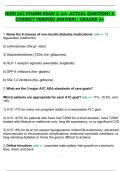
NURS 502 PHARM EXAM 2| 60+ ACTUAL QUESTIONS &
CORRECT VERIFIED ANSWERS | GRADED A+
1. Name the 6 classes of non-insulin diabetes medications. ANS >> 1)
biguanides (metformin)
2) sulfonylureas (the gl- -ides)
3) thiazolidinediones (TZDs; the -glitazones)
4) GLP-1 receptor agonists (exenatide, liraglutide)
5) DPP-4 inhibitors (the -gliptins)
6) SGLT-2 inhibitors (the -gliflozins)
2. What are the 3 major A1C ADA standards of care goals?
Which patients are appropriate for each A1C goal? ANS >> <7%, <6.5%, and
<8%
1) A1C <7% for many non pregnant adults is a reasonable A1C goal
2) A1C <6.5% for patients who have had T2DM for a short duration, have T2DM
treated with lifestyle or metformin only, long life expectancy, or no significant CVD
3) A1C <8% for its w/ h/o severe hypoglycemia, limited life expectancy, advanced
microvascular or microvascular complications, extensive comorbid conditions, or
long-standing diabetes in home the goal is difficult to achieve
3. Define hirsutism. ANS >> unwanted male-pattern hair growth on a woman's
face, chest, and back
1 N/ N
24
,4. How does metformin help control blood glucose? ANS >> lowers blood
glucose by decreasing hepatic glucose production and increasing insulin
sensitivity in both hepatic and peripheral muscle tissues.
5. How do thiazolidinediones lower blood glucose? ANS >> Increases free fatty
acids by binding to PPAR-gamma; increases insulin sensitivity by stimulating
PPAR-gamma;
binds to the PPAR-y (gamma) receptor in peripheral tissues to increase glucose
transporters (this increases glucose into the cell)
6. What are the 4 contraindications for thiazolidinediones? ANS >> 1) heart
failure (bc TZDs can cause fluid retention)
2) pregnancy (bc they are Pregnancy Category C)
3) active bladder CA
4) baseline ALT >2.5 times the ULN (upper limit of normal)
7. What are the side effects of thiazolidinediones? ANS >> 1) fluid retention and
edema
2) hepatotoxicity (but symptoms reverse w/in a few weeks of d/c the med), but check
LFTs (liver function tests) at baseline and periodically)
3) increase risk of heart failure
4) increase risk of upper and lower limb fractures (osteoporosis)
2 N/ N
24
, 5) may cause premenopausal anovulatory women to start ovulating, so counsel
N N N N N N N N N
all women capable of becoming pregnant
N N N N N N
6) increased risk of bladder CA N N N N
7) rosiglitazone may increase risk of MI and CV disease N N N N N N N N
8) weight gain N
8. What do all the drugs in the TZD class end in? ANS >> -glitazone
N N N N N N N N N N N N NN
9. What do (almost) all the drugs in the Sulfonylurea class start and
N N N N N N N N N N N
end in? ANS >> start with Gl-
N N N N NN N N
End in -ide N N
e.g. Glipizide, Glyburide, Glimepiride
N N N
10. What is the most important drug in the Biguanides class? ANS >>
N N N N N N N N N N N N
Metformin N
11. What do the drugs in the GLP-1 receptor agonist class end in? ANS >> -tid
N N N N N N N N N N N N N NN
e.g. Exenatide, Liraglutide
N N
12. What do the drugs in the DPP-4 Inhibitors class end in? ANS >> -gliptin
N N N N N N N N N N N N NN
e.g. Saxagliptin, Linagliptin, Alogliptin
N N N
13. What do the drugs in the SGLT-2 inhibitors class end in? ANS >> -gliflozin
N N N N N N N N N N N N NN
e.g. Canagliflozin, Dapagliflozin, Empagliflozin
N N N
3 N/ N
24
CORRECT VERIFIED ANSWERS | GRADED A+
1. Name the 6 classes of non-insulin diabetes medications. ANS >> 1)
biguanides (metformin)
2) sulfonylureas (the gl- -ides)
3) thiazolidinediones (TZDs; the -glitazones)
4) GLP-1 receptor agonists (exenatide, liraglutide)
5) DPP-4 inhibitors (the -gliptins)
6) SGLT-2 inhibitors (the -gliflozins)
2. What are the 3 major A1C ADA standards of care goals?
Which patients are appropriate for each A1C goal? ANS >> <7%, <6.5%, and
<8%
1) A1C <7% for many non pregnant adults is a reasonable A1C goal
2) A1C <6.5% for patients who have had T2DM for a short duration, have T2DM
treated with lifestyle or metformin only, long life expectancy, or no significant CVD
3) A1C <8% for its w/ h/o severe hypoglycemia, limited life expectancy, advanced
microvascular or microvascular complications, extensive comorbid conditions, or
long-standing diabetes in home the goal is difficult to achieve
3. Define hirsutism. ANS >> unwanted male-pattern hair growth on a woman's
face, chest, and back
1 N/ N
24
,4. How does metformin help control blood glucose? ANS >> lowers blood
glucose by decreasing hepatic glucose production and increasing insulin
sensitivity in both hepatic and peripheral muscle tissues.
5. How do thiazolidinediones lower blood glucose? ANS >> Increases free fatty
acids by binding to PPAR-gamma; increases insulin sensitivity by stimulating
PPAR-gamma;
binds to the PPAR-y (gamma) receptor in peripheral tissues to increase glucose
transporters (this increases glucose into the cell)
6. What are the 4 contraindications for thiazolidinediones? ANS >> 1) heart
failure (bc TZDs can cause fluid retention)
2) pregnancy (bc they are Pregnancy Category C)
3) active bladder CA
4) baseline ALT >2.5 times the ULN (upper limit of normal)
7. What are the side effects of thiazolidinediones? ANS >> 1) fluid retention and
edema
2) hepatotoxicity (but symptoms reverse w/in a few weeks of d/c the med), but check
LFTs (liver function tests) at baseline and periodically)
3) increase risk of heart failure
4) increase risk of upper and lower limb fractures (osteoporosis)
2 N/ N
24
, 5) may cause premenopausal anovulatory women to start ovulating, so counsel
N N N N N N N N N
all women capable of becoming pregnant
N N N N N N
6) increased risk of bladder CA N N N N
7) rosiglitazone may increase risk of MI and CV disease N N N N N N N N
8) weight gain N
8. What do all the drugs in the TZD class end in? ANS >> -glitazone
N N N N N N N N N N N N NN
9. What do (almost) all the drugs in the Sulfonylurea class start and
N N N N N N N N N N N
end in? ANS >> start with Gl-
N N N N NN N N
End in -ide N N
e.g. Glipizide, Glyburide, Glimepiride
N N N
10. What is the most important drug in the Biguanides class? ANS >>
N N N N N N N N N N N N
Metformin N
11. What do the drugs in the GLP-1 receptor agonist class end in? ANS >> -tid
N N N N N N N N N N N N N NN
e.g. Exenatide, Liraglutide
N N
12. What do the drugs in the DPP-4 Inhibitors class end in? ANS >> -gliptin
N N N N N N N N N N N N NN
e.g. Saxagliptin, Linagliptin, Alogliptin
N N N
13. What do the drugs in the SGLT-2 inhibitors class end in? ANS >> -gliflozin
N N N N N N N N N N N N NN
e.g. Canagliflozin, Dapagliflozin, Empagliflozin
N N N
3 N/ N
24