THE IMMUNE SYSTEM – PARHAM 4TH EDITION
CHAPTER 6
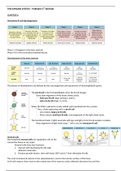
Overview B-cell development
Phase 1-3 happens in the bone marrow.
Phase 4-6 in the secondary lymphoid tissues.
Development in the bone marrow
The phases of development are defined by the rearrangement and expression of immunoglobulin genes.
The pro-B cell is the first identifiable cell in the B-cell lineage.
Gene rearrangement of the heavy chains starts.
- Early pro-B-cell stage: joining JH and DH
- Late pro-B-cell stage: VH to DJH
When the RNA is spliced to create mRNA and translated into the μ-chainchain.
" the μ-chainchain expressing cell is a pre-B cell.
- Less mature large pre-B cells.
- More mature small pre-B-cells: rearrangement of the light chain starts.
The functional chains (=IgM) associate with Igα and Igβ to form the B-receptor complex.
Rearrangement of light chain stops " cell is now an immature B-cell.
Stromal cells
Non-lymphoid stromal cells are supportive cells of the
connective tissue in any organ.
Stromal cells have two functions:
1. Interact with developing B-cells with
adhesion molecules.
2. Produce growth factors: stem cell-factor (SCF) and IL-7 that stimulates B-cells.
The most immature B-cells lie in the subendosteum, next to the interior surface of the bone.
As B-cells mature, they move to the central axis of the marrow cavity: adhesion becomes less and less.
, Gene rearrangement in B-cells: heavy chain
A B-cell has two copies of H-chain locus; one from the mother, one from the father.
When one fails to produce a productive gene, the other may try again.
(For transcription, RAG1 and RAG2 and other DNA-modifying enzymes are activated by
Transcription factors: E2A, EBF turn on Pax-5, a transcription factor for genes only expressed in B-cells.)
Most recombinations to the immunoglobulin genes
are nonproductive rearrangements.
The random addition of N and P nucleotides
can cause a reading frame shift.
After rearrangement of the V-D-J gene segments,
the pro-B cell gets survival signals and becomes a
large pre-B cell.
The process is highly inefficient.
Pre-B-cell receptor formation
The μ-chainchain must be able to combine with the light chain.
The pro-B cell produces:
- VpreB similar to the variable region
- λ5 similar to the constant region
Together they form the surrogate light chain.
The μ-chain and the surrogate light chain assemble with Igβ in the ER to form a pre-B-cell receptor.
If the μ-chain is functional " Igβ sends signals to stop heavy chain rearrangement and start cell division.
The pre-BCR causes allelic exclusion of the other μ-chain by:
- Signaling RAG gene transcription to stop.
- RAG proteins are degraded.
- The chromatin of the H-chain locus is reorganized to a non-rearrangeable state.
Two defective alleles of λ5 causes a B-cell immunodeficiency because the pre-BCR cannot be formed. Patients
have persistent bacterial infections and are treated with antibiotics and IV immunoglobulin.
Gene rearrangement in B-cells: light chain
RAG genes are reactivated to begin rearrangement of the light-chain genes in the large pre-B-cells.
VJ recombination starts on the κ-locus. When this produces unproductive genes, recombination of the λ locus starts.
There is no functional difference between κ- and λ-light chains.
It just increases the chance of making a productive Ig.
Functional light chain?
1) It binds with the H-chain to form IgM.
2) It associates with Igα and Igβ to form the mature B-cell receptor.
3) The B-cell receptor (BCR) assembles on the surface.
4) The BCR signals to stop gene rearrangement of the light chain.
= allelic exclusion and isotype
exclusion.
Clonal expansion…
of the large pre-B-cell has 2 benefits:
1. The investment to make the H-chain is not lost
when the L-chain fails
2. Diverse population of immature B-cells
CHAPTER 6
Overview B-cell development
Phase 1-3 happens in the bone marrow.
Phase 4-6 in the secondary lymphoid tissues.
Development in the bone marrow
The phases of development are defined by the rearrangement and expression of immunoglobulin genes.
The pro-B cell is the first identifiable cell in the B-cell lineage.
Gene rearrangement of the heavy chains starts.
- Early pro-B-cell stage: joining JH and DH
- Late pro-B-cell stage: VH to DJH
When the RNA is spliced to create mRNA and translated into the μ-chainchain.
" the μ-chainchain expressing cell is a pre-B cell.
- Less mature large pre-B cells.
- More mature small pre-B-cells: rearrangement of the light chain starts.
The functional chains (=IgM) associate with Igα and Igβ to form the B-receptor complex.
Rearrangement of light chain stops " cell is now an immature B-cell.
Stromal cells
Non-lymphoid stromal cells are supportive cells of the
connective tissue in any organ.
Stromal cells have two functions:
1. Interact with developing B-cells with
adhesion molecules.
2. Produce growth factors: stem cell-factor (SCF) and IL-7 that stimulates B-cells.
The most immature B-cells lie in the subendosteum, next to the interior surface of the bone.
As B-cells mature, they move to the central axis of the marrow cavity: adhesion becomes less and less.
, Gene rearrangement in B-cells: heavy chain
A B-cell has two copies of H-chain locus; one from the mother, one from the father.
When one fails to produce a productive gene, the other may try again.
(For transcription, RAG1 and RAG2 and other DNA-modifying enzymes are activated by
Transcription factors: E2A, EBF turn on Pax-5, a transcription factor for genes only expressed in B-cells.)
Most recombinations to the immunoglobulin genes
are nonproductive rearrangements.
The random addition of N and P nucleotides
can cause a reading frame shift.
After rearrangement of the V-D-J gene segments,
the pro-B cell gets survival signals and becomes a
large pre-B cell.
The process is highly inefficient.
Pre-B-cell receptor formation
The μ-chainchain must be able to combine with the light chain.
The pro-B cell produces:
- VpreB similar to the variable region
- λ5 similar to the constant region
Together they form the surrogate light chain.
The μ-chain and the surrogate light chain assemble with Igβ in the ER to form a pre-B-cell receptor.
If the μ-chain is functional " Igβ sends signals to stop heavy chain rearrangement and start cell division.
The pre-BCR causes allelic exclusion of the other μ-chain by:
- Signaling RAG gene transcription to stop.
- RAG proteins are degraded.
- The chromatin of the H-chain locus is reorganized to a non-rearrangeable state.
Two defective alleles of λ5 causes a B-cell immunodeficiency because the pre-BCR cannot be formed. Patients
have persistent bacterial infections and are treated with antibiotics and IV immunoglobulin.
Gene rearrangement in B-cells: light chain
RAG genes are reactivated to begin rearrangement of the light-chain genes in the large pre-B-cells.
VJ recombination starts on the κ-locus. When this produces unproductive genes, recombination of the λ locus starts.
There is no functional difference between κ- and λ-light chains.
It just increases the chance of making a productive Ig.
Functional light chain?
1) It binds with the H-chain to form IgM.
2) It associates with Igα and Igβ to form the mature B-cell receptor.
3) The B-cell receptor (BCR) assembles on the surface.
4) The BCR signals to stop gene rearrangement of the light chain.
= allelic exclusion and isotype
exclusion.
Clonal expansion…
of the large pre-B-cell has 2 benefits:
1. The investment to make the H-chain is not lost
when the L-chain fails
2. Diverse population of immature B-cells