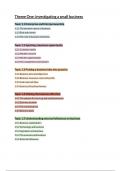
Theme One: Investigating a small business
Topic 1.1 Enterprise and Entrepreneurship
1.1.1 The dynamic nature of business
1.1.2 Risk and reward
1.1.3 The role of business enterprise
Topic 1.2 Spotting a business opportunity
1.2.1 Customer needs
1.2.2 Market research
1.2.3 Market segmentation
1.2.4 The competitive environment
Topic 1.3 Putting a business idea into practice
1.3.1 Business aims and objectives
1.3.2 Business revenues, costs and profits
1.3.3 Cash and cash flow
1.3.4 Sources of business finance
Topic 1.4 Making the business effective
1.4.1 The options for start-up and small businesses
1.4.2 Business location
1.4.3 The marketing mix
1.4.4 Business plans
Topic 1.5 Understanding external influences on business
1.5.1 Business stakeholders
1.5.2 Technology and business
1.5.3 Legislation and business
1.5.4 The economy and business
1.5.5 External influences
,Topic 1.1 Enterprise and Entrepreneurship
1.1.1 The Dynamic Nature of Business
What is the Dynamic Nature of Business?
The Dynamic Nature of Business is characterised by constant change, activity or progress. The
world of Business is ever changing with consumer’s wants and technology changing.
How do new business ideas come about?
- original ideas
- adapting existing products, services or ideas
Why do new business ideas come about?
- changes in technology
- changes in what consumers want
- products and services becoming obsolete
Obsolete
This refers to when a product is no longer used or produced.
Planned obsolescence
When businesses deliberately shorten life spans in order to lead customers into buying more
to replace them.
Original business idea
An idea that hasn’t been done before
Competitive advantage
A feature of a business that helps it to succeed against rivals
Adapting existing products
Finding new products based on the original one
Benefits:
- requires less research and development and other investments
- hard to find a new product people love
- already has a guaranteed market
What can businesses do to ensure that changing customer tastes doesn't make all of their
products/services obsolete?
- think ahead to how customer habits are changing and be one step ahead
- come up with new bright business ideas
- research the consumer market and find their needs
,1.1.2 Risk and Reward
Calculated Risk
Decisions taken after considering the potential rewards in comparison to the probability of
risks and failure
How do entrepreneurs go about trying to reduce the risk of business failure?
- researching the market
- completing financial assessments
- understanding the customers needs
Risks of running a Business
- business failure
- financial loss
- lack of financial security (uncertain income)
Rewards of running a Business
- profit and wealth
- independence (be your own boss)
- business success
Business Failure
The collapse of a business, probably leading to its closure.
Independence for a successful business owner
The need by many business owners to make their own decisions and be their own boss
Risk and Reward is the balance between the worst that can happen and the best that can happen.
, 1.1.3 Role of Business Enterprise
What is the main purpose of business activity and enterprise?
The purpose of business activity and enterprise is to produce goods or services which meet
customer needs.
Why do most businesses seek to meet customer needs?
Most businesses are incentivised by profit, therefore if they can meet customer needs then
businesses are likely to generate more revenue and therefore more profit.
What must decisions made by the entrepreneur ensure?
Decisions made by the entrepreneur must ensure that the costs of production are less than the
revenue. Otherwise, business failure will occur.
Three Main Role of the Entrepreneur
1) Organise Resources
Sourcing raw materials, workers and a suitable location
2) Make business decisions
Decide upon what to sell, who to sell it to and for what price
- Customer needs can be learnt through market research
3) Take risks
Calculated risks based on the likelihood of success and failure
Goods
Tangible and physical products purchased by a customer
Services
Intangible purchase of a skill to assist the customer
Added Value
The difference between the sale price (paid by the customer) and the cost of production (paid
by the business)
- enables a business to charge a higher price
- the greater the difference between price and costs, the more profit the business makes
Methods of Adding Value
- Convenience: Saving time for the customer
- Branding: Identity, connotations, and feel of the good/service
- Quality: Standard of raw materials and service provided
- Design: Aesthetics, appearance and function
- USP: Feature that rivals don’t have (competitive advantage)
Topic 1.1 Enterprise and Entrepreneurship
1.1.1 The dynamic nature of business
1.1.2 Risk and reward
1.1.3 The role of business enterprise
Topic 1.2 Spotting a business opportunity
1.2.1 Customer needs
1.2.2 Market research
1.2.3 Market segmentation
1.2.4 The competitive environment
Topic 1.3 Putting a business idea into practice
1.3.1 Business aims and objectives
1.3.2 Business revenues, costs and profits
1.3.3 Cash and cash flow
1.3.4 Sources of business finance
Topic 1.4 Making the business effective
1.4.1 The options for start-up and small businesses
1.4.2 Business location
1.4.3 The marketing mix
1.4.4 Business plans
Topic 1.5 Understanding external influences on business
1.5.1 Business stakeholders
1.5.2 Technology and business
1.5.3 Legislation and business
1.5.4 The economy and business
1.5.5 External influences
,Topic 1.1 Enterprise and Entrepreneurship
1.1.1 The Dynamic Nature of Business
What is the Dynamic Nature of Business?
The Dynamic Nature of Business is characterised by constant change, activity or progress. The
world of Business is ever changing with consumer’s wants and technology changing.
How do new business ideas come about?
- original ideas
- adapting existing products, services or ideas
Why do new business ideas come about?
- changes in technology
- changes in what consumers want
- products and services becoming obsolete
Obsolete
This refers to when a product is no longer used or produced.
Planned obsolescence
When businesses deliberately shorten life spans in order to lead customers into buying more
to replace them.
Original business idea
An idea that hasn’t been done before
Competitive advantage
A feature of a business that helps it to succeed against rivals
Adapting existing products
Finding new products based on the original one
Benefits:
- requires less research and development and other investments
- hard to find a new product people love
- already has a guaranteed market
What can businesses do to ensure that changing customer tastes doesn't make all of their
products/services obsolete?
- think ahead to how customer habits are changing and be one step ahead
- come up with new bright business ideas
- research the consumer market and find their needs
,1.1.2 Risk and Reward
Calculated Risk
Decisions taken after considering the potential rewards in comparison to the probability of
risks and failure
How do entrepreneurs go about trying to reduce the risk of business failure?
- researching the market
- completing financial assessments
- understanding the customers needs
Risks of running a Business
- business failure
- financial loss
- lack of financial security (uncertain income)
Rewards of running a Business
- profit and wealth
- independence (be your own boss)
- business success
Business Failure
The collapse of a business, probably leading to its closure.
Independence for a successful business owner
The need by many business owners to make their own decisions and be their own boss
Risk and Reward is the balance between the worst that can happen and the best that can happen.
, 1.1.3 Role of Business Enterprise
What is the main purpose of business activity and enterprise?
The purpose of business activity and enterprise is to produce goods or services which meet
customer needs.
Why do most businesses seek to meet customer needs?
Most businesses are incentivised by profit, therefore if they can meet customer needs then
businesses are likely to generate more revenue and therefore more profit.
What must decisions made by the entrepreneur ensure?
Decisions made by the entrepreneur must ensure that the costs of production are less than the
revenue. Otherwise, business failure will occur.
Three Main Role of the Entrepreneur
1) Organise Resources
Sourcing raw materials, workers and a suitable location
2) Make business decisions
Decide upon what to sell, who to sell it to and for what price
- Customer needs can be learnt through market research
3) Take risks
Calculated risks based on the likelihood of success and failure
Goods
Tangible and physical products purchased by a customer
Services
Intangible purchase of a skill to assist the customer
Added Value
The difference between the sale price (paid by the customer) and the cost of production (paid
by the business)
- enables a business to charge a higher price
- the greater the difference between price and costs, the more profit the business makes
Methods of Adding Value
- Convenience: Saving time for the customer
- Branding: Identity, connotations, and feel of the good/service
- Quality: Standard of raw materials and service provided
- Design: Aesthetics, appearance and function
- USP: Feature that rivals don’t have (competitive advantage)