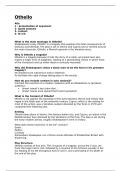
Othello
AOs
1 - presentation of argument
2- quote analysis
3- context
5- lit crit
What is the main message in Othello?
Shakespeare's play 'Othello' is a tragedy that explores the fatal consequences of
jealousy and betrayal. The play is set in Venice and Cyprus and is centred around
the main character, Othello, a Moorish general in the Venetian army.
Why is Othello a tragedy?
Othello is a tragedy because it tells the story of a noble, principled hero who
makes a tragic error of judgment, leading to a devastating climax in which most
of the characters end up either dead or seriously wounded.
Why did Shakespeare chose a black man to be the hero in his greatest
tragedy?
He wanted to be subversive and to entertain
To facilitate the rapid change taking place in his society
How do you include context in your analysis?
Contrast the reactions of a modern audience with an Elizabethan or Jacobean
audience.
(Insert name)’s key claim that …
(Insert name) once opined that (insert quotation)
What is the Context of Othello?
Othello is set against the backdrop of the wars between Venice and Turkey that
raged in the latter part of the sixteenth century. Cyprus, which is the setting for
most of the action, was a Venetian outpost attacked by the Turks in 1570 and
conquered the following year.
Setting
Othello takes place in Venice, the famous Italian city, and Cyprus, an island in the
Mediterranean Sea colonised by the Venetians at the time. The play is set during
the early modern period, roughly Shakespeare's time in history.
What does Venice stand for in the 16th century?
Exotic
Politics
Civilised
Somewhere Shakespear can criticise social attitudes of Elizabethan Britain with
distancing.
Play Structure
Othello consists of five acts. This is typical of a tragedy; across the 5 acts, we
track the tragic hero's rise, followed by a reversal of his fortunes (usually in Act
III), leading to his fall throughout Acts IV and V, and culminating in his death at
the end of the play.
,Start of Act III scene three to the end of the play is the course of
Othello’s madness – ‘ha I like not that’
Themes
Some of the major themes in this play include racial prejudice, manipulation, and
jealousy. Specifically, Othello is regarded as a beast by other characters because
he is black. Iago is jealous of Cassio because Othello promotes him to a higher
military position.
Prejudice.
Appearance vs. Reality.
Jealousy.
Manhood and Honor.
Womanhood and Sexuality.
Identity
Purity and madness
Symbols
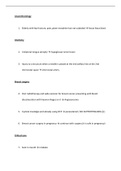
Handkerchief
it’s loss causes him to go into a separation disarray
Objects like this are symbols and projections of emotions
It was Othello’s first gift to Desdemona, she talks to it when Othello is
gone
the handkerchief is stolen in Act 3, Scene 3. Desdemona offers to bind
Othello's aching head with her handkerchief, but it drops as they exit.
Emilia, Iago's wife, picks it up and Iago then snatches it from he
Marriage Bed
the marriage bed becomes a powerful symbol of both intimacy and death,
highlighting the play's central themes of love, betrayal, and the
destructive nature of jealousy.
Othello's act of strangling Desdemona in her bed, the private space of
their marriage, transforms the bed into a symbol of her supposed guilt and
Othello's rage.
Goats/ sheep
Devil – associated with blackness, goats associated
The names of the characters
Key terms
Term Definition
Soliloquy a soliloquy refers to the act of speaking one's thoughts aloud
when by oneself or regardless of listeners and a formal speech is
made directly to an audience.
Monologue A monologue refers to a long speech delivered by a character
during a conversation
Antithesis Opposite
Peripeteia A reversal of fortune
Hamartia Fatal flaw – jealousy
Othello’s hamartia is adhering to the expectations of a society
that does not want to include him - many proposèd matches
Of her own clime, complexion, and degree, Whereto we
see in all things nature tends— scene 3
,Anagnorisi The revelation/realisation of evil – When Othello realises iago is a
s villain
Characters
Othello Protagonist
Othello starts off as an honourable, successful man: a
general for the Venetian army, married to the woman he
loves, the perfect romantic hero. Despite being an
outsider, he has made an impressive place for himself in
Venetian society - though he struggles with his identity.
Othello’s reputation starts of a gallant and strong, level
minded however this does a 180° from act three
onwards
As the play progresses Othello starts to mimic Iago’s
language
Iago Antagonist - Iago is the play's main antagonist, and
Othello's standard-bearer. He is the husband of Emilia,
who is in turn the attendant of Othello's wife Desdemona.
Iago hates Othello and devises a plan to destroy him by
making him believe that Desdemona is having an affair
with his lieutenant, Michael Cassio.
Iago's lost promotion thus serves as the premise to his
“evil:” just as his lack of political authority provokes him
to commit crimes that cause him to dehumanise those
around him,
Gentlemen – Status
Speaks in prose much of the time
Cassio Cassio serves as General Othello's Lieutenant - a position
that Iago wanted, Othello's ensign (a lower military rank)
envies. Iago takes advantage of Cassio's friendly yet
naive nature and spreads false rumors about Cassio's
love for Desdemona, Othello's wife.
‘ I want to be a member of his love again’ Cassio is driven
by emotion not ambition like Iago
Provides a modern audience insight into the expectations
of masculinity in the 1600s
Rodreigo Dupe – fool/ puppet
Maybe a foil to Cassio. Rodrigo is rejected by Desdemona
whereas Cassio is thought of as a suitable suitor
Emillia Emilia is Iago's wife, and Desdemona's maid, a woman of
practical intelligence and emotional resilience. She
follows Iago in wifely duty, but during the play develops a
strong loyalty to Desdemona and, at the end, denounces
Iago's lies to defend Desdemona's reputation.
Emilia's Epistemological Role - Perhaps most strongly
arguing to her centrality in the story of the play, Emilia
represents knowledge in Othello, which could very well be
called an epistemological tragedy.
Desdemona Almost Perfect representation of a 16th century woman
Desdemona is at times a submissive character, most
notably in her willingness to take credit for her own
, murder.
She starts the play confident in her and Othello's love, so
confident that she elopes with him and accepts her father
disowning her all for the sake of being with Othello.
However, she becomes increasingly isolated and
confused, and dies begging her husband to believe she
loves him.
Brabantio Brabantio as a character is every bit the overprotective
father, but in some ways, he represents the pull of youth
on Desdemona as well. He doesn't seem to recognize her
capacity for entering into a mature relationship with a
man, and keeps her trapped in perpetual childhood.
Bianca What does Bianca represent in Othello? - Though she
appears in only three scenes of Othello, Bianca is a
significant character. She serves as a figure of misfortune
and a sharp contrast to the virtuous Desdemona and
honest Emilia. Bianca is clearly in love with Cassio, who is
basically using her.
Montarno Former govener of Cyprus
Racism key quotes
What Iago says to Brabantio in A1;S1 when he speaks about Othello using
sheep imagery
"Even now, now, very now, an old black ram
Is tupping your white ewe.
...
Or else the devil will make a grandsire of you"
Iago to Brabantio in A1;S1 when speaks about Othello and his offspring, using
horse imagery
"...your daughter covered with a Barbary horse,
you'll have your nephews neigh to you, you'll have
coursers for cousins and jennets for germans"
Iago to Brabantio in A1;S1 when he refers to the missionary sex position in an
animalistic manner
"...your daughter and the Moor are now making the beast with two backs."
Brabantio to court in A1;S3
"To fall in love with what she feared to look on!
...
Against all rules of nature"
Duke of Venice to Brabantio in Act1;3
"Your son-in-law is far more fair than black"
Othello using his race when referring to his wife's supposed immorality in A3;S3
"As Dian's visage, is now begrimed and black
As mine own face"
Emilia to Othello in A5;2, when he lives up to racist stereotypes. (something to
consider in your essay)
"O, the more angel she, and you the blacker devil!"
Sexism key quotes
Look to your house, your daughter, and your bags!' (Iago, Act 1 Scene 1)
AOs
1 - presentation of argument
2- quote analysis
3- context
5- lit crit
What is the main message in Othello?
Shakespeare's play 'Othello' is a tragedy that explores the fatal consequences of
jealousy and betrayal. The play is set in Venice and Cyprus and is centred around
the main character, Othello, a Moorish general in the Venetian army.
Why is Othello a tragedy?
Othello is a tragedy because it tells the story of a noble, principled hero who
makes a tragic error of judgment, leading to a devastating climax in which most
of the characters end up either dead or seriously wounded.
Why did Shakespeare chose a black man to be the hero in his greatest
tragedy?
He wanted to be subversive and to entertain
To facilitate the rapid change taking place in his society
How do you include context in your analysis?
Contrast the reactions of a modern audience with an Elizabethan or Jacobean
audience.
(Insert name)’s key claim that …
(Insert name) once opined that (insert quotation)
What is the Context of Othello?
Othello is set against the backdrop of the wars between Venice and Turkey that
raged in the latter part of the sixteenth century. Cyprus, which is the setting for
most of the action, was a Venetian outpost attacked by the Turks in 1570 and
conquered the following year.
Setting
Othello takes place in Venice, the famous Italian city, and Cyprus, an island in the
Mediterranean Sea colonised by the Venetians at the time. The play is set during
the early modern period, roughly Shakespeare's time in history.
What does Venice stand for in the 16th century?
Exotic
Politics
Civilised
Somewhere Shakespear can criticise social attitudes of Elizabethan Britain with
distancing.
Play Structure
Othello consists of five acts. This is typical of a tragedy; across the 5 acts, we
track the tragic hero's rise, followed by a reversal of his fortunes (usually in Act
III), leading to his fall throughout Acts IV and V, and culminating in his death at
the end of the play.
,Start of Act III scene three to the end of the play is the course of
Othello’s madness – ‘ha I like not that’
Themes
Some of the major themes in this play include racial prejudice, manipulation, and
jealousy. Specifically, Othello is regarded as a beast by other characters because
he is black. Iago is jealous of Cassio because Othello promotes him to a higher
military position.
Prejudice.
Appearance vs. Reality.
Jealousy.
Manhood and Honor.
Womanhood and Sexuality.
Identity
Purity and madness
Symbols
Handkerchief
it’s loss causes him to go into a separation disarray
Objects like this are symbols and projections of emotions
It was Othello’s first gift to Desdemona, she talks to it when Othello is
gone
the handkerchief is stolen in Act 3, Scene 3. Desdemona offers to bind
Othello's aching head with her handkerchief, but it drops as they exit.
Emilia, Iago's wife, picks it up and Iago then snatches it from he
Marriage Bed
the marriage bed becomes a powerful symbol of both intimacy and death,
highlighting the play's central themes of love, betrayal, and the
destructive nature of jealousy.
Othello's act of strangling Desdemona in her bed, the private space of
their marriage, transforms the bed into a symbol of her supposed guilt and
Othello's rage.
Goats/ sheep
Devil – associated with blackness, goats associated
The names of the characters
Key terms
Term Definition
Soliloquy a soliloquy refers to the act of speaking one's thoughts aloud
when by oneself or regardless of listeners and a formal speech is
made directly to an audience.
Monologue A monologue refers to a long speech delivered by a character
during a conversation
Antithesis Opposite
Peripeteia A reversal of fortune
Hamartia Fatal flaw – jealousy
Othello’s hamartia is adhering to the expectations of a society
that does not want to include him - many proposèd matches
Of her own clime, complexion, and degree, Whereto we
see in all things nature tends— scene 3
,Anagnorisi The revelation/realisation of evil – When Othello realises iago is a
s villain
Characters
Othello Protagonist
Othello starts off as an honourable, successful man: a
general for the Venetian army, married to the woman he
loves, the perfect romantic hero. Despite being an
outsider, he has made an impressive place for himself in
Venetian society - though he struggles with his identity.
Othello’s reputation starts of a gallant and strong, level
minded however this does a 180° from act three
onwards
As the play progresses Othello starts to mimic Iago’s
language
Iago Antagonist - Iago is the play's main antagonist, and
Othello's standard-bearer. He is the husband of Emilia,
who is in turn the attendant of Othello's wife Desdemona.
Iago hates Othello and devises a plan to destroy him by
making him believe that Desdemona is having an affair
with his lieutenant, Michael Cassio.
Iago's lost promotion thus serves as the premise to his
“evil:” just as his lack of political authority provokes him
to commit crimes that cause him to dehumanise those
around him,
Gentlemen – Status
Speaks in prose much of the time
Cassio Cassio serves as General Othello's Lieutenant - a position
that Iago wanted, Othello's ensign (a lower military rank)
envies. Iago takes advantage of Cassio's friendly yet
naive nature and spreads false rumors about Cassio's
love for Desdemona, Othello's wife.
‘ I want to be a member of his love again’ Cassio is driven
by emotion not ambition like Iago
Provides a modern audience insight into the expectations
of masculinity in the 1600s
Rodreigo Dupe – fool/ puppet
Maybe a foil to Cassio. Rodrigo is rejected by Desdemona
whereas Cassio is thought of as a suitable suitor
Emillia Emilia is Iago's wife, and Desdemona's maid, a woman of
practical intelligence and emotional resilience. She
follows Iago in wifely duty, but during the play develops a
strong loyalty to Desdemona and, at the end, denounces
Iago's lies to defend Desdemona's reputation.
Emilia's Epistemological Role - Perhaps most strongly
arguing to her centrality in the story of the play, Emilia
represents knowledge in Othello, which could very well be
called an epistemological tragedy.
Desdemona Almost Perfect representation of a 16th century woman
Desdemona is at times a submissive character, most
notably in her willingness to take credit for her own
, murder.
She starts the play confident in her and Othello's love, so
confident that she elopes with him and accepts her father
disowning her all for the sake of being with Othello.
However, she becomes increasingly isolated and
confused, and dies begging her husband to believe she
loves him.
Brabantio Brabantio as a character is every bit the overprotective
father, but in some ways, he represents the pull of youth
on Desdemona as well. He doesn't seem to recognize her
capacity for entering into a mature relationship with a
man, and keeps her trapped in perpetual childhood.
Bianca What does Bianca represent in Othello? - Though she
appears in only three scenes of Othello, Bianca is a
significant character. She serves as a figure of misfortune
and a sharp contrast to the virtuous Desdemona and
honest Emilia. Bianca is clearly in love with Cassio, who is
basically using her.
Montarno Former govener of Cyprus
Racism key quotes
What Iago says to Brabantio in A1;S1 when he speaks about Othello using
sheep imagery
"Even now, now, very now, an old black ram
Is tupping your white ewe.
...
Or else the devil will make a grandsire of you"
Iago to Brabantio in A1;S1 when speaks about Othello and his offspring, using
horse imagery
"...your daughter covered with a Barbary horse,
you'll have your nephews neigh to you, you'll have
coursers for cousins and jennets for germans"
Iago to Brabantio in A1;S1 when he refers to the missionary sex position in an
animalistic manner
"...your daughter and the Moor are now making the beast with two backs."
Brabantio to court in A1;S3
"To fall in love with what she feared to look on!
...
Against all rules of nature"
Duke of Venice to Brabantio in Act1;3
"Your son-in-law is far more fair than black"
Othello using his race when referring to his wife's supposed immorality in A3;S3
"As Dian's visage, is now begrimed and black
As mine own face"
Emilia to Othello in A5;2, when he lives up to racist stereotypes. (something to
consider in your essay)
"O, the more angel she, and you the blacker devil!"
Sexism key quotes
Look to your house, your daughter, and your bags!' (Iago, Act 1 Scene 1)