MTTC Practice Exam Test, 084 Correctly Answered.
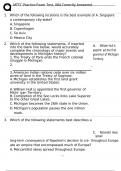
1. Which of the following locations is the best example of A. Singapore
a contemporary city-state?
A. Singapore
B. Copenhagen
C. Tel Aviv
D. Mexico City
2. Which of the following statements, if inserted
into the blank line below, would accurately A. William Hull is
complete the chronology of major events and appoint- ed the first
developments in Michigan history? governor of Michigan
1. The Treaty of Paris ends the French colonial Territory.
struggle in Michigan.
2.
3. American Indian nations cede over six million
acres of land in the Treaty of Saginaw.
4. Michigan establishes the first land grant
university in the United States.
A. William Hull is appointed the first governor of
Michi- gan Territory.
B. Completion of the Soo Locks links Lake Superior
to the other Great Lakes.
C. Michigan becomes the 26th state in the Union.
D. Michigan's population passes the one million
mark.
3. Which of the following statements best describes a
C. Nationalist ideas
spread
long-term consequence of Napoleon's decision to cre- throughout Europe.
ate an empire that encompassed much of Europe?
A. Mercantilist ideas spread throughout Europe.
, MTTC Practice Exam Test, 084 Correctly Answered.
B. Movements for liberal reform dissolved in
most parts of Europe.
, MTTC Practice Exam Test, 084 Correctly Answered.
C. Nationalist ideas spread throughout Europe.
D. Feudal institutions revived in most parts of Europe.
4. For a unit on the Progressive Era in the United
States, a teacher has students read and discuss
excerpts from a dozen autobiographies written by
people of that era. This activity is best designed
to help students:
A. distinguish between fact and opinion in
historical writing.
B. analyze major debates about U.S. history.
C. evaluate various ideas and values among
historical actors.
D. recognize the influence of the past on
subsequent periods of history.
5. A major difference between primary sources and
sec- ondary sources is that primary sources:
A. do not provide an interpretation of
historical events.
B. cannot be used to formulate historical questions.
C. are generally the most reliable type of
historical evidence.
D. provide firsthand historical information.
6. A person researching history would most likely use
an encyclopedia for which of the following
purposes?
A. to obtain contextual information concerning a
his- torical event
B. to assess the validity of a revisionist
interpretation of a historical event
C. to evaluate competing narratives of a
historical event
1. Which of the following locations is the best example of A. Singapore
a contemporary city-state?
A. Singapore
B. Copenhagen
C. Tel Aviv
D. Mexico City
2. Which of the following statements, if inserted
into the blank line below, would accurately A. William Hull is
complete the chronology of major events and appoint- ed the first
developments in Michigan history? governor of Michigan
1. The Treaty of Paris ends the French colonial Territory.
struggle in Michigan.
2.
3. American Indian nations cede over six million
acres of land in the Treaty of Saginaw.
4. Michigan establishes the first land grant
university in the United States.
A. William Hull is appointed the first governor of
Michi- gan Territory.
B. Completion of the Soo Locks links Lake Superior
to the other Great Lakes.
C. Michigan becomes the 26th state in the Union.
D. Michigan's population passes the one million
mark.
3. Which of the following statements best describes a
C. Nationalist ideas
spread
long-term consequence of Napoleon's decision to cre- throughout Europe.
ate an empire that encompassed much of Europe?
A. Mercantilist ideas spread throughout Europe.
, MTTC Practice Exam Test, 084 Correctly Answered.
B. Movements for liberal reform dissolved in
most parts of Europe.
, MTTC Practice Exam Test, 084 Correctly Answered.
C. Nationalist ideas spread throughout Europe.
D. Feudal institutions revived in most parts of Europe.
4. For a unit on the Progressive Era in the United
States, a teacher has students read and discuss
excerpts from a dozen autobiographies written by
people of that era. This activity is best designed
to help students:
A. distinguish between fact and opinion in
historical writing.
B. analyze major debates about U.S. history.
C. evaluate various ideas and values among
historical actors.
D. recognize the influence of the past on
subsequent periods of history.
5. A major difference between primary sources and
sec- ondary sources is that primary sources:
A. do not provide an interpretation of
historical events.
B. cannot be used to formulate historical questions.
C. are generally the most reliable type of
historical evidence.
D. provide firsthand historical information.
6. A person researching history would most likely use
an encyclopedia for which of the following
purposes?
A. to obtain contextual information concerning a
his- torical event
B. to assess the validity of a revisionist
interpretation of a historical event
C. to evaluate competing narratives of a
historical event