Chapter 16 – Cell signaling
General principles of cell signaling
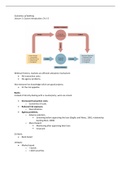
From extracellular signal molecule – receptor protein –
intracellular signal molecule – effector proteins – target cell
responds
Signal transduction (one type of signal is converted to another)
begins when the receptor receives an incoming extracellular
signal and converts it to the intracellular signaling molecules that alter cell behavior
Signals can act over a long or short range
Animals use extracellular signal molecules to
communicate with one another in various ways.
Endocrine; extracellular signal molecules are
called hormones; broadcasting signal through
whole body secreting it into bloodstream
Paracrine; extracellular signal molecules are
called local mediators; signal molecules diffuse
through extracellular fluid
Regulate inflammation (ontsteking), control cell
proliferation in healing wound
o Autocrine signaling; cells respond to local
mediators that are produced by themselves.
Cancer cells; promote their own survival and
proliferation
Neuronal; extracellular signal molecules are called neurotransmitters;
neurotransmitter released in gap.
Contact-dependent; extracellular signal molecules are called membrane-
bound signal molecules; does not require release of secreted molecules. Cells
make direct contact through signal molecule
During (embryonic) development, let neighbor know if they are bound. Telling
them to stop dividing for instance. (lot in epithelia cells)
Each cell responds to a limited set of extracellular signals, depending on its history
and its current state
If cells respond to a signal molecule depends of if
there is a receptor for that signal.
Watch out; the extracellular signal molecule alone is
not the message; the information conveyed
(getransporteerd) by the signal depends on how a
target cell receives and interprets the signal.
So, the same signal molecule can induce different responses in different
target cells.
A cell can have many sorts of receptors; to survive, grow + divide and
differentiate cell. No receptors? Cells are programmed to kill themselves
, A cell’s response to a signal can be fast or slow
Length of time a cell takes to respond to extracellular signal
Fast; signal affects the activity of proteins that are already present
inside the target cell
Slow; response requires changes in gene expression and production
of new proteins.
Some hormones cross the plasma membrane and bind to
intracellular receptors
Extracellular signal molecules fall into 2 classes
1. Cell-surface receptors; large and hydrophilic
2. Intracellular receptors; smaller and hydrophobic
o Steroid hormones; hydrophobic molecules. Pass through
membrane and bind to receptor proteins in cytosol or
nucleus. These receptors; nuclear receptor protein.
When a hormone binds the receptor undergo change that
activates protein. This promotes or inhibit the transcription of
specific target genes.
o Gases; they are small and diffuse across the membrane. Nitric
oxide (NO)
Cell surface receptors relay extracellular signals via intracellular signaling
pathway
Primary transduction; recognized of the extracellular signal by the receptor protein
and generating new intracellular signals
Components of intracellular signaling pathways
1. Relay; relay (brengen) signal onward, help spread it through the
cell.
2. Amplify (versterken); making it stronger so that a few
extracellular signal molecules are enough to evoke a large
intracellular response.
3. Integrate; detect signals form more than one intracellular
signaling pathway and integrate them
4. Distribute (verdelen); distribute the signal to more than one
effector protein.
The steps in the signaling pathway are modulated by feedback
regulation
Some intracellular signaling proteins act as molecular switches
Molecular switches; signal to switch from inactive to active
state.
2 classes of proteins that act as molecular switches
1. Signaling by phosphorylation
o Kinase; attaches a P group
o Phosphatase; remove a P group
2. Signaling by GTP-binding protein
o GTP binding; attaches a GTP bound
o GTP hydrolysis; remove GTP bound switch in GDP bound
General principles of cell signaling
From extracellular signal molecule – receptor protein –
intracellular signal molecule – effector proteins – target cell
responds
Signal transduction (one type of signal is converted to another)
begins when the receptor receives an incoming extracellular
signal and converts it to the intracellular signaling molecules that alter cell behavior
Signals can act over a long or short range
Animals use extracellular signal molecules to
communicate with one another in various ways.
Endocrine; extracellular signal molecules are
called hormones; broadcasting signal through
whole body secreting it into bloodstream
Paracrine; extracellular signal molecules are
called local mediators; signal molecules diffuse
through extracellular fluid
Regulate inflammation (ontsteking), control cell
proliferation in healing wound
o Autocrine signaling; cells respond to local
mediators that are produced by themselves.
Cancer cells; promote their own survival and
proliferation
Neuronal; extracellular signal molecules are called neurotransmitters;
neurotransmitter released in gap.
Contact-dependent; extracellular signal molecules are called membrane-
bound signal molecules; does not require release of secreted molecules. Cells
make direct contact through signal molecule
During (embryonic) development, let neighbor know if they are bound. Telling
them to stop dividing for instance. (lot in epithelia cells)
Each cell responds to a limited set of extracellular signals, depending on its history
and its current state
If cells respond to a signal molecule depends of if
there is a receptor for that signal.
Watch out; the extracellular signal molecule alone is
not the message; the information conveyed
(getransporteerd) by the signal depends on how a
target cell receives and interprets the signal.
So, the same signal molecule can induce different responses in different
target cells.
A cell can have many sorts of receptors; to survive, grow + divide and
differentiate cell. No receptors? Cells are programmed to kill themselves
, A cell’s response to a signal can be fast or slow
Length of time a cell takes to respond to extracellular signal
Fast; signal affects the activity of proteins that are already present
inside the target cell
Slow; response requires changes in gene expression and production
of new proteins.
Some hormones cross the plasma membrane and bind to
intracellular receptors
Extracellular signal molecules fall into 2 classes
1. Cell-surface receptors; large and hydrophilic
2. Intracellular receptors; smaller and hydrophobic
o Steroid hormones; hydrophobic molecules. Pass through
membrane and bind to receptor proteins in cytosol or
nucleus. These receptors; nuclear receptor protein.
When a hormone binds the receptor undergo change that
activates protein. This promotes or inhibit the transcription of
specific target genes.
o Gases; they are small and diffuse across the membrane. Nitric
oxide (NO)
Cell surface receptors relay extracellular signals via intracellular signaling
pathway
Primary transduction; recognized of the extracellular signal by the receptor protein
and generating new intracellular signals
Components of intracellular signaling pathways
1. Relay; relay (brengen) signal onward, help spread it through the
cell.
2. Amplify (versterken); making it stronger so that a few
extracellular signal molecules are enough to evoke a large
intracellular response.
3. Integrate; detect signals form more than one intracellular
signaling pathway and integrate them
4. Distribute (verdelen); distribute the signal to more than one
effector protein.
The steps in the signaling pathway are modulated by feedback
regulation
Some intracellular signaling proteins act as molecular switches
Molecular switches; signal to switch from inactive to active
state.
2 classes of proteins that act as molecular switches
1. Signaling by phosphorylation
o Kinase; attaches a P group
o Phosphatase; remove a P group
2. Signaling by GTP-binding protein
o GTP binding; attaches a GTP bound
o GTP hydrolysis; remove GTP bound switch in GDP bound