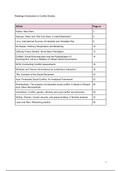
Readings Introduction to Conflict Studies
Article Page nr.
Kaldor: New Wars 2
Kalyvas: "New" and "Old Civil Wars: A Valid Distinction? 5
Levy: International Sources of Interstate and Intrastate War 8
De Swaan: Ordinary Perpetrators and Modernity 12
Galtung: Peace Studies: Some Basic Paradigms 13
Duffield: Social Reconstruction and the Radicalization of 14
Development: Aid as a Relation of Global Liberal Governance
DFID: Conducting Conflict Assessments 16
McAdam and Tarrow: Nonviolence as contentious interaction’ 18
Tilly: Invention of the Social Movement 20
Azar: Protracted Social Conflict: An Analytical Framework 23
Ramsbotham: The analysis of protracted social conflict: A tribute to Edward 26
Azar Oliver Ramsbotham
Handrahan: Conflict, gender, ethnicity and post-conflict reconstruction 29
McKay: Women, human security, and peace-building: A feminist analysis 32
Laws and Rein: Reframing practice 36
1
,Kaldor: New Wars
● Contemporary wars are different but it has take policy makers a long time to realize
that these new wars require a different policy approach
● The ´new war literature´ can be said to draw on three different sources:
○ 1. The decline of the “Clausewitzean war” (= wars fought between states in
which battle was the decisive encounter)
○ 2. The importance of private militias or warlords and economic agendas
(influenced by the wars in Africa)
○ 3. Rise of ethnic conflict
The ‘new wars’ thesis
● Kaldor uses the term ‘new wars’ to draw attention to the need for new approaches in
addressing contemporary conflicts
● A common proposition is that new wars are civil wars or intrastate wars
○ however, states are often involved in these wars (as outside actors)
● ‘New wars’ are wars that are the consequence and cause of what today are variously
called ‘weak’, ‘fragile’, ‘failed’, ‘failing’ or ‘collapsing’ states, where the binary
distinctions characteristic of the modern state – between internal and external, civil
and international, public and private, civilian and combatant, political and economic,
and even war and peace – are breaking down
No Clausewitzean wars
● Kaldor argues that new wars differ from ‘old wars’ in the nature of:
○ the warring parties
○ the political goals
○ the methods of warfare
○ and how the wars are financed
Clausewitzean wars New wars
Warring parties Armies/ hierarchical military Networks of state and non-state
organizations actors organized in loose
2
, horizontal coalitions
Political goals Geopolitical Identity politics
(control
of the
seas or
access
to oil)
Military
capture
of
territory
Methods of warfare Battle Battles are rare, and most violence
is directed against civilians
How the wars are financed increased taxation and the Methods that are dependent on
mobilization of a centralized violence: looting, kidnapping and
self-sufficient war economy hostage-taking, outside support,
smuggling etc.
● In contrast to ‘old wars’, ‘new wars’ are very difficult to end
○ The warring parties share a mutual interest in the enterprise of war,
■ either for political reasons
■ or because violence helps to solidify the polarization of identity by
spreading fear and hate;
■ or for economic reasons, because their sources of finance depend on
violence.
● New wars are very difficult to contain
○ They spread through refugees and displaced persons, through the virus of
identity politics and through the transnational criminal links established during
the conflict
Critiques
● New wars are not new wars
○ most of the characteristics of new wars were present in earlier wars
○ the dominance of the Cold War masked the continuing prevalence of ‘small
wars’ or ‘low-intensity wars’, which were much the same as ‘new wars’
BUT...
○ Kaldor: what the historical criticism misses is that my aim was to change the
way policy makers and policy shapers perceive these conflicts
○ The ‘new wars’ argument does reflect a new reality:
■ huge destructiveness of all types of military technology
■ difficulty of fighting ‘symmetric war’
○ casualties per conflict are decreasing, because ‘new wars’ are much less
intense than ‘old wars’, though more pervasive and longer lasting
Long wars
● Keegan and Van Creveld: contemporary wars were no longer Clausewitzean
because they are not fought by states
3
, ● Snow: ‘new wars’ are not rational
● Defenders of Clausewitz argue that Clausewitzean wars do not necessarily have to
be fought by states, and that ‘new wars’ are rational in the sense of instrumental
rationality
○ ethnic cleansing is a rational way to win elections on the basis of ethnicity.
● Kaldor: new wars are post-Clausewitzean because battle is very rare
○ New wars are a mutual enterprise in which both warring parties gain rather
than an attempt by one side to impose its will on the other.
■ The logical outcome of this definition of war is not extreme war but
long war.
● Another point of criticism on new wars is that ‘old wars’ are still important and may be
even more so in the future.
○ Kaldor:
■ There is indeed no guarantee that ‘old wars’ will not be repeated but,
given the immense destructiveness of such wars, which could
nowadays literally kill the planet, they have to be avoided at all costs
■ ‘old war’ thinking in ‘new war’ situations simply makes them worse
Implications
● The implication of ‘new war’ thinking is that a new way of addressing contemporary
conflicts is needed
● Kaldor argues for:
○ the establishment of legitimate political authority in place of weak states,
based on an inclusive ideology open to global engagement
○ a new kind of peacekeeping that is more like human rights enforcement than
either war-fighting or traditional peacekeeping;
○ a new approach to reconstruction that directly addresses the illicit ‘new war’
economy and focuses on legitimate ways of making a living.
● A focus on individual rights would mean a much greater commitment to implement
international law.
○ It would mean serious efforts to protect civilians who face large-scale human
rights violations and to arrest those who violate these rights.
● This kind of human rights enforcement needs to be backed by legal institutions, both
domestically and internationally.
4
Article Page nr.
Kaldor: New Wars 2
Kalyvas: "New" and "Old Civil Wars: A Valid Distinction? 5
Levy: International Sources of Interstate and Intrastate War 8
De Swaan: Ordinary Perpetrators and Modernity 12
Galtung: Peace Studies: Some Basic Paradigms 13
Duffield: Social Reconstruction and the Radicalization of 14
Development: Aid as a Relation of Global Liberal Governance
DFID: Conducting Conflict Assessments 16
McAdam and Tarrow: Nonviolence as contentious interaction’ 18
Tilly: Invention of the Social Movement 20
Azar: Protracted Social Conflict: An Analytical Framework 23
Ramsbotham: The analysis of protracted social conflict: A tribute to Edward 26
Azar Oliver Ramsbotham
Handrahan: Conflict, gender, ethnicity and post-conflict reconstruction 29
McKay: Women, human security, and peace-building: A feminist analysis 32
Laws and Rein: Reframing practice 36
1
,Kaldor: New Wars
● Contemporary wars are different but it has take policy makers a long time to realize
that these new wars require a different policy approach
● The ´new war literature´ can be said to draw on three different sources:
○ 1. The decline of the “Clausewitzean war” (= wars fought between states in
which battle was the decisive encounter)
○ 2. The importance of private militias or warlords and economic agendas
(influenced by the wars in Africa)
○ 3. Rise of ethnic conflict
The ‘new wars’ thesis
● Kaldor uses the term ‘new wars’ to draw attention to the need for new approaches in
addressing contemporary conflicts
● A common proposition is that new wars are civil wars or intrastate wars
○ however, states are often involved in these wars (as outside actors)
● ‘New wars’ are wars that are the consequence and cause of what today are variously
called ‘weak’, ‘fragile’, ‘failed’, ‘failing’ or ‘collapsing’ states, where the binary
distinctions characteristic of the modern state – between internal and external, civil
and international, public and private, civilian and combatant, political and economic,
and even war and peace – are breaking down
No Clausewitzean wars
● Kaldor argues that new wars differ from ‘old wars’ in the nature of:
○ the warring parties
○ the political goals
○ the methods of warfare
○ and how the wars are financed
Clausewitzean wars New wars
Warring parties Armies/ hierarchical military Networks of state and non-state
organizations actors organized in loose
2
, horizontal coalitions
Political goals Geopolitical Identity politics
(control
of the
seas or
access
to oil)
Military
capture
of
territory
Methods of warfare Battle Battles are rare, and most violence
is directed against civilians
How the wars are financed increased taxation and the Methods that are dependent on
mobilization of a centralized violence: looting, kidnapping and
self-sufficient war economy hostage-taking, outside support,
smuggling etc.
● In contrast to ‘old wars’, ‘new wars’ are very difficult to end
○ The warring parties share a mutual interest in the enterprise of war,
■ either for political reasons
■ or because violence helps to solidify the polarization of identity by
spreading fear and hate;
■ or for economic reasons, because their sources of finance depend on
violence.
● New wars are very difficult to contain
○ They spread through refugees and displaced persons, through the virus of
identity politics and through the transnational criminal links established during
the conflict
Critiques
● New wars are not new wars
○ most of the characteristics of new wars were present in earlier wars
○ the dominance of the Cold War masked the continuing prevalence of ‘small
wars’ or ‘low-intensity wars’, which were much the same as ‘new wars’
BUT...
○ Kaldor: what the historical criticism misses is that my aim was to change the
way policy makers and policy shapers perceive these conflicts
○ The ‘new wars’ argument does reflect a new reality:
■ huge destructiveness of all types of military technology
■ difficulty of fighting ‘symmetric war’
○ casualties per conflict are decreasing, because ‘new wars’ are much less
intense than ‘old wars’, though more pervasive and longer lasting
Long wars
● Keegan and Van Creveld: contemporary wars were no longer Clausewitzean
because they are not fought by states
3
, ● Snow: ‘new wars’ are not rational
● Defenders of Clausewitz argue that Clausewitzean wars do not necessarily have to
be fought by states, and that ‘new wars’ are rational in the sense of instrumental
rationality
○ ethnic cleansing is a rational way to win elections on the basis of ethnicity.
● Kaldor: new wars are post-Clausewitzean because battle is very rare
○ New wars are a mutual enterprise in which both warring parties gain rather
than an attempt by one side to impose its will on the other.
■ The logical outcome of this definition of war is not extreme war but
long war.
● Another point of criticism on new wars is that ‘old wars’ are still important and may be
even more so in the future.
○ Kaldor:
■ There is indeed no guarantee that ‘old wars’ will not be repeated but,
given the immense destructiveness of such wars, which could
nowadays literally kill the planet, they have to be avoided at all costs
■ ‘old war’ thinking in ‘new war’ situations simply makes them worse
Implications
● The implication of ‘new war’ thinking is that a new way of addressing contemporary
conflicts is needed
● Kaldor argues for:
○ the establishment of legitimate political authority in place of weak states,
based on an inclusive ideology open to global engagement
○ a new kind of peacekeeping that is more like human rights enforcement than
either war-fighting or traditional peacekeeping;
○ a new approach to reconstruction that directly addresses the illicit ‘new war’
economy and focuses on legitimate ways of making a living.
● A focus on individual rights would mean a much greater commitment to implement
international law.
○ It would mean serious efforts to protect civilians who face large-scale human
rights violations and to arrest those who violate these rights.
● This kind of human rights enforcement needs to be backed by legal institutions, both
domestically and internationally.
4